Near Cordova in Talbot County, Maryland — The American Northeast (Mid-Atlantic)
A Champion for Equality
Photographed by Bill Pfingsten, September 2, 2020
1. A Champion for Equality Marker
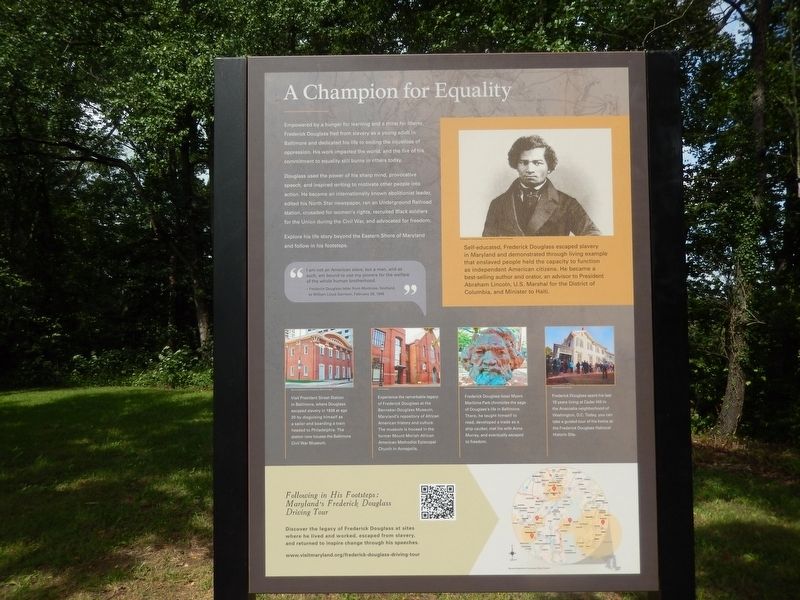
Empowered by a hunger for learning and a thirst for liberty, Frederick Douglass fled from slavery as a young adult in Baltimore and dedicated his life to ending the injustices of oppression. His work impacted the world, and the fire of his commitment to equality still burns in others today.
Douglass used ht power of his sharp mind, provocative speech, and inspired writing to motivate other people into action. He became an internationally known abolitionist leader, edited his North Star newspaper, ran an Underground Railroad station, crusaded for women's rights, recruited Black soldiers for the Union during the Civil War, and advocated for freedom.
Explore his life story beyond the Eastern Shore of Maryland and follow in his footsteps.
"I am not a American slave, but a man, and as such, am bound to use my powers for the welfare of the whole human brotherhood.
— Frederick Douglass letter from Montrose, Scotland,to William Lloyd Garrison, February 26, 1846."
Self-educated, Frederick Douglass escaped slavery in Maryland and demonstrated through living example that enslaved people held the capacity to function
this page online
[Captions:]
Visit President Street Station in Baltimore, where Douglass escaped slavery in 1838 at age 20 by disguising himself as a sailor and boarding a train headed to Philadelophi. The station now houses the Baltimore Civil War Museum.
Experience the remarkable legacy of Frederick Douglass at the Banneker-Douglass Museum, Maryland's repository of African American history and culture. The museum is housed in the former Mount Moriah African American Methodist Episcopal Church in Annapolis
Frederick Douglass Isaac Myers Maritime Park chronicles the saga of Douglass's life in Baltimore. Tnere, he taught himself to read, developed a trade as a ship caulker, met his wife Anna Murray, and eventually escaped to freedom.
Frederick Douglass spent his last 1 years living at Cedar Hill in the Anacostia neighborhood of Washington, D.C. Today, you can take a guided tour of his home at the Frederick Douglass National Historic Site.
Following in His Footsteps: Maryland's Frederick Douglass Driving Tour
Discover the legacy of Frederick Douglass at sites where he lived and worked, escaped from slavery, and returned to inspire change through his speeches.
www.visitmaryland.org/frederick-douglass-driving-tour
Erected by Talbot
Photographed by Bill Pfingsten, September 2, 2020
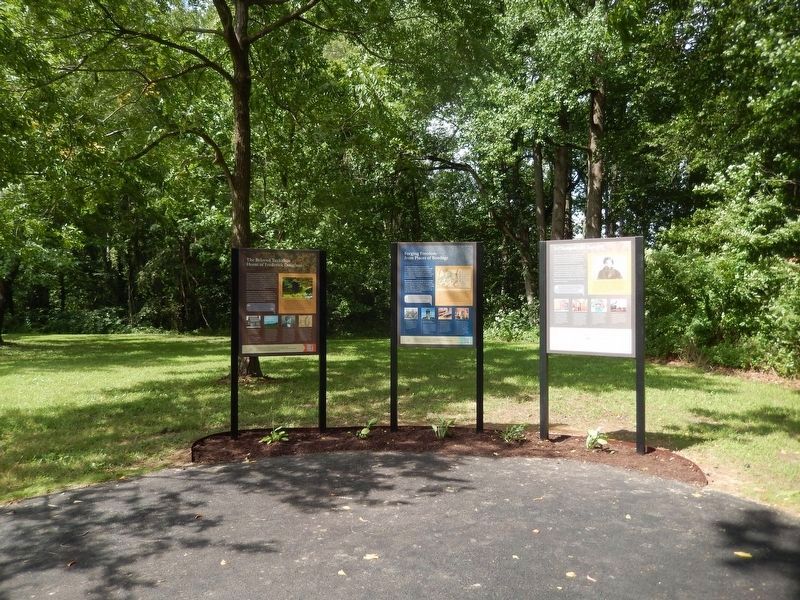
2. Group of three markers.
Topics. This historical marker is listed in these topic lists: Abolition & Underground RR • African Americans. A significant historical date for this entry is February 26, 1846.
Location. 38° 54.676′ N, 75° 57.004′ W. Marker is near Cordova, Maryland, in Talbot County. It can be reached from Lewistown Road (Maryland Route 303) north of Norwich Creek Road, on the left when traveling south. Touch for map. Marker is in this post office area: Cordova MD 21625, United States of America. Touch for directions.

Regionally, this marker is on the Eastern Shore. It is also in the American Mid-Atlantic, on the Delmarva Peninsula, in the Tidewater, in the Chesapeake Bay Region, and on the Eastern Seaboard. Globally, it is in the North Atlantic Region, North America, the Western Hemisphere, the Western World, and the Anglosphere. Historically, it finds itself in what was once one of the original Thirteen Colonies and also the Antebellum South.
Other nearby markers. At least 8 other markers are within 3 miles of this marker, measured as the crow flies: Forging Freedom from Places of Bondage (here, next to this marker); The Beloved Tuckahoe Home of Frederick Douglass (here, next to this marker); Honoring an American Hero (within shouting distance of this marker); Frederick Douglass (approx. half a mile away); St. Paul’s Episcopal Church (approx. half a mile away); a different marker also named Frederick Douglass (approx. 1.9 miles away); Tuckahoe Roots (approx. 2.7 miles away); Wood Ducks (approx. 3 miles away). Touch for a list and map of all markers in Cordova.
Another marker is no longer nearby. Frederick Douglass (was approx. half a mile away but has been replaced with another marker now near it).
Credits. This page was last revised on October 5, 2024. It was originally submitted on September 4, 2020, by Bill Pfingsten of Bel Air, Maryland. This page has been viewed 420 times since then and 28 times this year. Photos: 1, 2. submitted on September 4, 2020, by Bill Pfingsten of Bel Air, Maryland.
