Fort Smith in Sebastian County, Arkansas — The American South (West South Central)
Seminole Nation
Photographed by Cosmos Mariner, May 18, 2015
1. Seminole Nation Marker
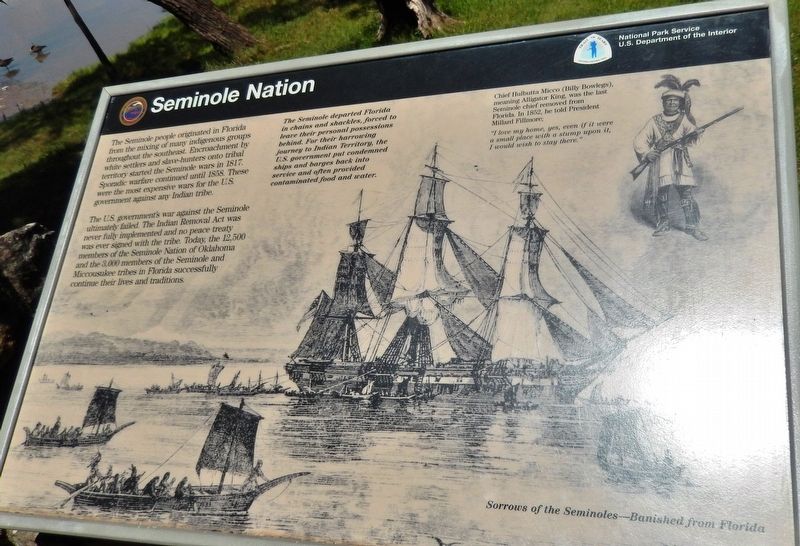
The Seminole people originated in Florida from the mixing of many indigenous groups throughout the southeast. Encroachment by white settlers and slave-hunters onto tribal territory started the Seminole wars in 1817. Sporadic warfare continued until 1858. These were the most expensive wars for the U.S. government against any Indian tribe.
The U.S. government’s war against the Seminole ultimately failed. The Indian Removal Act was never fully implemented and no peace treaty was ever signed with the tribe. Today, the 12,500 members of the Seminole Nation of Oklahoma and the 3,000 members of the Seminole and Miccosukee tribes in Florida successfully continue their lives and traditions.
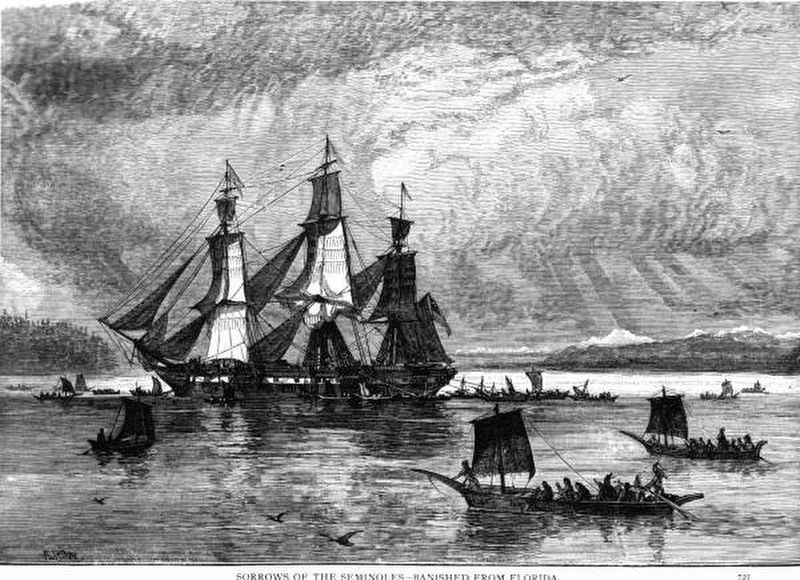
The Seminole departed Florida in chains and shackles, forced to leave their personal possessions behind. For their harrowing journey to Indian Territory, the U.S. government put condemned ships and barges back into service and often provided contaminated food and water.
Erected by National Park Service, U.S. Department of the Interior.
Topics and series. This historical marker is listed in these topic lists: Indigenous Peoples and Communities
this page online
Location. 35° 23.269′ N, 94° 26.002′ W. Marker is in Fort Smith, Arkansas, in Sebastian County. It can be reached from the intersection of Parker Avenue and South 3rd Street. Marker is located on the Fort Smith National Historic Site grounds, near Belle Point on the west side of the fort, overlooking the Arkansas River. Touch for map. Marker is at or near this postal address: 301 Parker Avenue, Fort Smith AR 72901, United States of America. Touch for directions.

Regionally, this marker is in the Arkansas River Valley, in the Cherokee Heritage Region, and in Osage Territory. It is also in the American South and specifically in the Upper South. Globally, it is in North America, the Western Hemisphere, the Western World, and the Anglosphere. Historically, it finds itself in what was once the territory of the Mississippian Culture, the Louisiana Purchase, one of the Confederate States of America, and the Antebellum South.
Other nearby markers. At least 8 other
2. Marker detail: Chief Hulbutta Micco
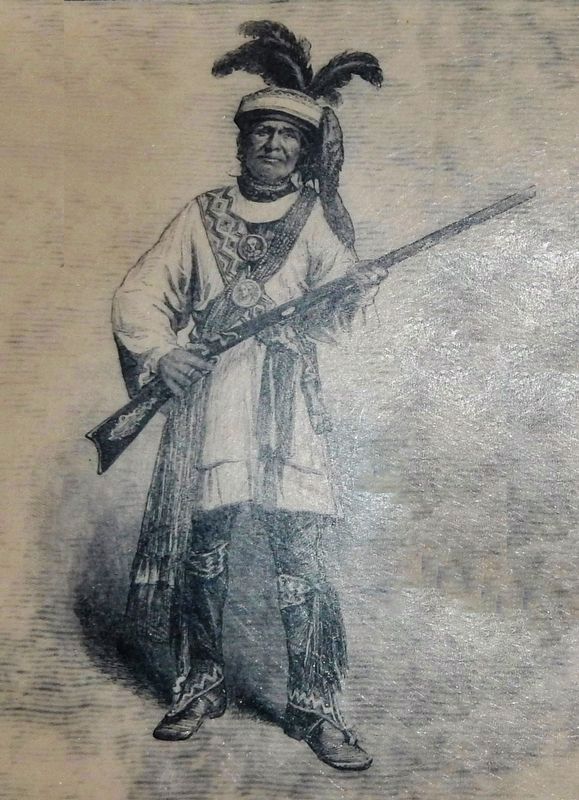
Chief Hulbutta Micco (Billy Bowlegs), meaning Alligator King, was the last Seminole chief removed from Florida. In 1852, he told President Millard Fillmore:
"I love my home, yes, even if it were a small place with a stump upon it, I would wish to stay there."
"I love my home, yes, even if it were a small place with a stump upon it, I would wish to stay there."
More about this marker. A Trail of Tears National Historic Trail interpretive site.
Also see . . . Trail of Tears. Wikipedia entry (Submitted on March 19, 2021, by Larry Gertner of New York, New York.)
Photographed by Cosmos Mariner, May 18, 2015
3. Seminole Nation Marker
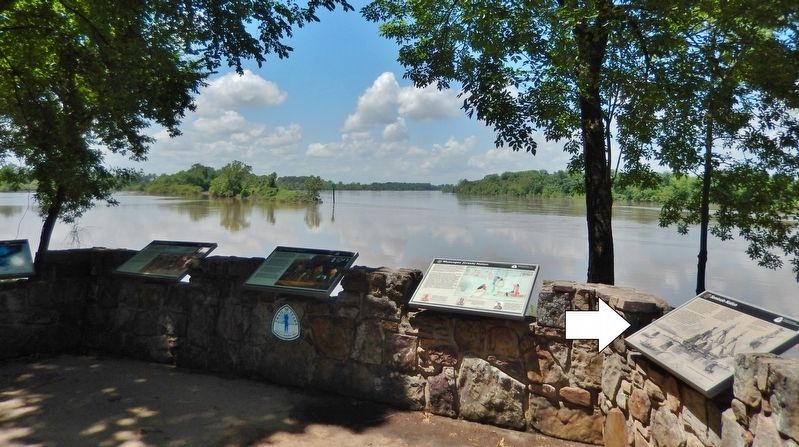
Arkansas River in background
via Florida Memory, 1830
4. "Sorrows of the Seminoles - Banished from Florida"
19th-century engraving depicting the deportation of the Seminoles from Florida. State Library and Archives of Florida
Credits. This page was last revised on May 9, 2021. It was originally submitted on September 28, 2020, by Cosmos Mariner of Cape Canaveral, Florida. This page has been viewed 495 times since then and 24 times this year. Photos: 1, 2, 3. submitted on October 2, 2020, by Cosmos Mariner of Cape Canaveral, Florida. 4. submitted on January 21, 2021, by Larry Gertner of New York, New York.
