Florence in Lauderdale County, Alabama — The American South (East South Central)
A More Inclusive Era
Photographed by Duane and Tracy Marsteller, September 27, 2020
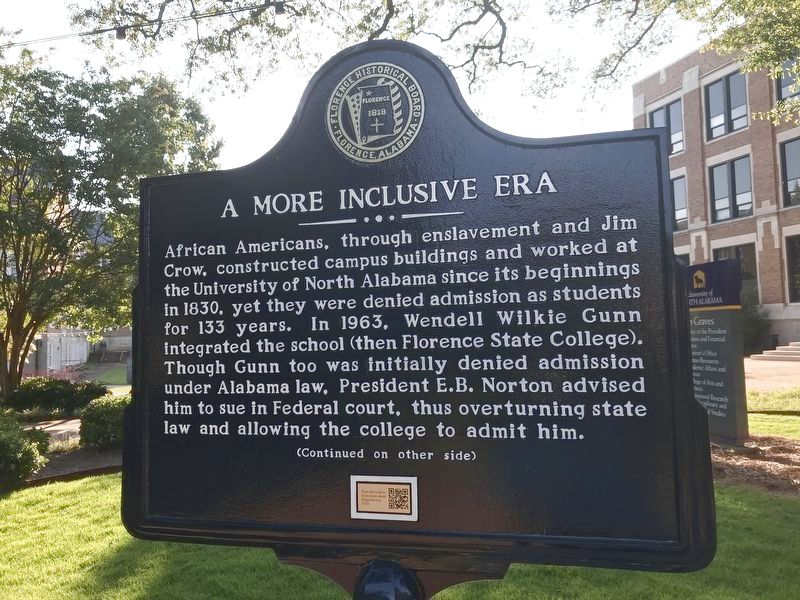
1. A More Inclusive Era Marker (Front)
African Americans, through enslavement and Jim Crow, constructed campus buildings and worked at the University of North Alabama since its beginnings in 1830, yet they were denied admission as students for 133 years. In 1963, Wendell Wilkie Gunn integrated the school (then Florence State College). Though Gunn too was initially denied admission under Alabama law, President E.B. Norton advised him to sue in Federal court, thus overturning state law and allowing the college to admit him.
Rear
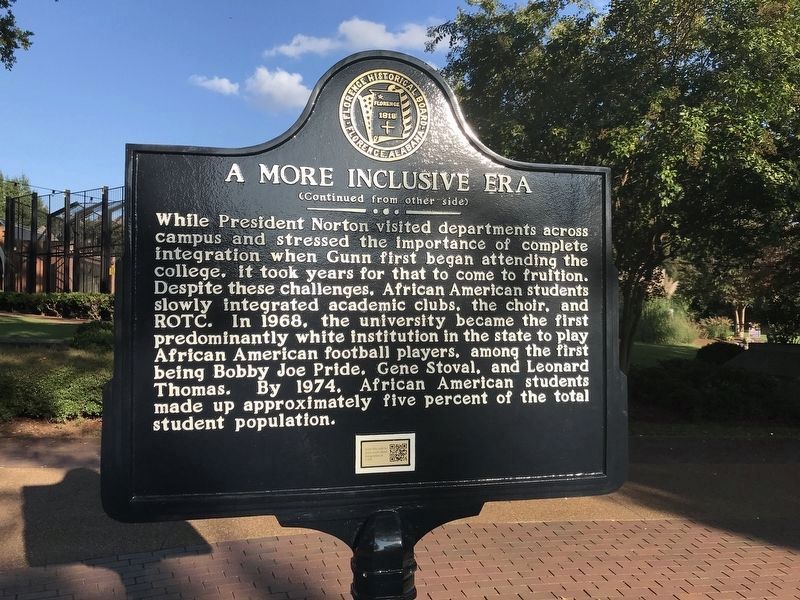
While President Norton visited departments across campus and stressed the importance of complete integration when Gunn first began attending the college, it took years for that to come to fruition. Despite these challenges. African American students slowly integrated academic clubs, the choir, and ROTC. In 1968, the university became the first predominantly white institution in the state to play African American football players, among the first being Bobby Joe Pride. Gene Stoval, and Leonard Thomas. By 1974, African American students made up approximately five percent of the total student population.
Erected by Florence Historical
this page online
Topics. This historical marker is listed in these topic lists: African Americans • Civil Rights • Education. A significant historical year for this entry is 1963.
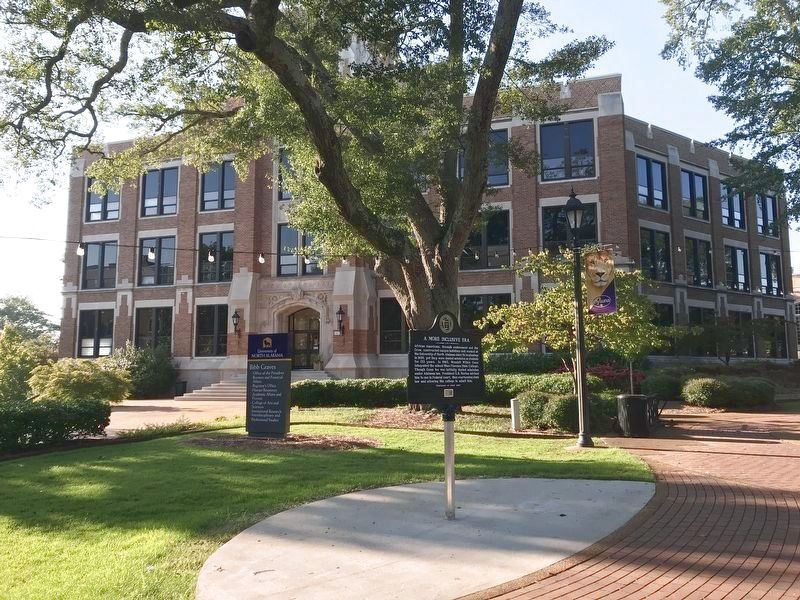
Location. 34° 48.449′ N, 87° 40.724′ W. Marker is in Florence, Alabama, in Lauderdale County. It can be reached from Cramer Way. Marker is in front of Bibb-Graves Hall and Harrison Plaza. Touch for map. Marker is at or near this postal address: 601 Cramer Way, Florence AL 35630, United States of America. Touch for directions.

Regionally, this marker is in North Alabama and in the Shoals. It is also in the American South, specifically in the Deep South, in Appalachia, and specifically in Southern Appalachia. Globally, it is in North America, a Gulf of Mexico state, the Western Hemisphere, the Western World, and the Anglosphere. Historically, it finds itself in what was once the territory of the Mississippian Culture, one of the Confederate States of America, and the Antebellum South.
Other nearby markers. At least 8 other markers are within walking distance of this marker: Locust Dell Academy (a few steps from this marker); George H. Carroll Lion Habitat
Photographed by Duane and Tracy Marsteller, September 27, 2020
2. A More Inclusive Era Marker (rear)
More about this marker. The marker contains a QR code that can be scanned for more information on integration at the university. (Link below)
Also see . . .
1. University of North Alabama. Wikipedia entry (Submitted on June 14, 2023, by Larry Gertner of New York, New York.)
2. Wendell Wilkie Gunn. Wikipedia entry (Submitted on June 14, 2023, by Larry Gertner of New York, New York.)
Photographed by Duane and Tracy Marsteller, September 27, 2020
3. Marker in front of Bibb-Graves Hall.
Credits. This page was last revised on June 14, 2023. It was originally submitted on September 28, 2020, by Duane and Tracy Marsteller of Murfreesboro, Tennessee. This page has been viewed 597 times since then and 25 times this year. Photos: 1, 2, 3. submitted on September 28, 2020, by Duane and Tracy Marsteller of Murfreesboro, Tennessee. • Mark Hilton was the editor who published this page.
