Leesburg in Loudoun County, Virginia — The American South (Mid-Atlantic)
18th Mississippi Infantry
Photographed by Craig Swain, September 1, 2007
1. 18th Mississippi Infantry Marker
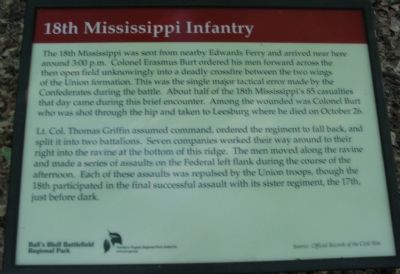
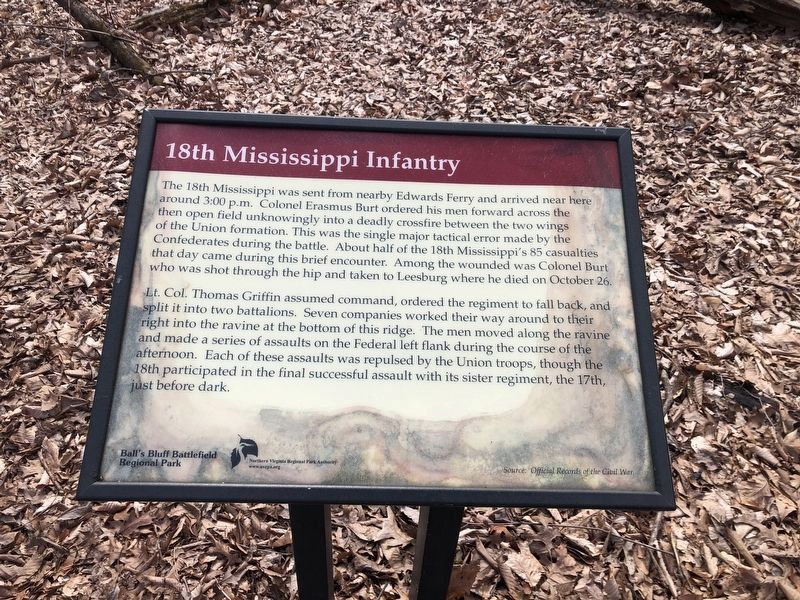
The 18th Mississippi Infantry was sent from nearby Edward's Ferry and arrived near here around 3:00 p.m. Colonel Erasmus Burt ordered his men forward across the then open field unknowingly into a deadly crossfire between the two wings of the Union formation. This was the single major tactical error made by the Confederates during the battle. About half of the 18th Mississippi’s 85 casualties that day came during this brief encounter. Among the wounded was Colonel Burt who was shot through the hip and taken to Leesburg where he died on Octorber 26.
Lt. Col. Thomas Griffin assumed command, ordered the regiment to fall back, and split it into two battalions. Seven companies worked their way around to the right into the ravine at the bottom of this ridge. The men moved along the ravine and made a series of assaults on the Federal left flank during the course of the afternoon. Each of these assaults was repulsed by the Union troops, though the 18th participated in the final successful assault with its sister regiment, the 17th, just before dark.
Erected by Ball’s Bluff Regional Park/Northern Virginia Regional Park Authority.
this page online
Topics and series. This historical marker is listed in this topic list: War, US Civil. In addition, it is included in the NOVA Parks series list.
Location. 39° 7.833′ N, 77° 31.671′ W. Marker is in Leesburg, Virginia, in Loudoun County. It can be reached from Ball’s Bluff Road, on the right when traveling east. Located at trail stop 9, inside Ball’s Bluff Regional Park. Touch for map. Marker is in this post office area: Leesburg VA 20175, United States of America. Touch for directions.

Regionally, this marker is in the Washington Metropolitan Area and in Northern Virginia. It is also in the American South, specifically in the Upper South, and in the Mid-Atlantic. Globally, it is in North America, the Western Hemisphere, the Western World, and the Anglosphere. Historically, it finds itself in what was once the territory of the Mississippian Culture, one of the original Thirteen Colonies, one of the Confederate States of America, and the Antebellum South.
Other nearby markers. At least 8 other markers are within walking distance of this marker: 42nd New York Infantry
Photographed by Devry Becker Jones (CC0), March 6, 2021
2. 18th Mississippi Infantry Marker
Unfortunately, the marker has experienced significant soiling.
Other markers no longer nearby. 18th Mississippi Infantry (has been replaced with this marker); a different marker also named Ball’s Bluff National Cemetery (was about 500 feet away but has been replaced with another marker now near it).
Regarding 18th Mississippi Infantry. This marker is one of a set along the Balls Bluff Battlefield walking trail. See the Balls Bluff Virtual Tour by Markers link below for details on each stop.
Related marker. Click here for another marker that is related to this marker. This marker has replaced the linked marker.
Also see . . .
1. 18th Mississippi Infantry Regiment.
2. Battle of Ball's Bluff. Wikipedia entry (Submitted on May 3, 2024, by Larry Gertner of New York, New York.)
3. Staff Ride Guide for the Battle of Balls Bluff. Center for Military History, U.S. Army PDF (Submitted on August 31, 2007, by Craig Swain of Leesburg, Virginia.)
4. Balls Bluff Battlefield Virtual Tour by Marker. Over twenty markers detail the action at Balls Bluff and related sites. Please use the Click to map all markers shown on this page option at the bottom of the page to view a map of the marker locations. The hybrid view offers an excellent overlook of the park. (Submitted on November 11, 2007, by Craig Swain of Leesburg, Virginia.)
Credits. This page was last revised on May 3, 2024. It was originally submitted on August 31, 2007. This page has been viewed 2,333 times since then and 35 times this year. Last updated on October 4, 2020, by Bradley Owen of Morgantown, West Virginia. Photos: 1. submitted on September 1, 2007, by Craig Swain of Leesburg, Virginia. 2, 3. submitted on March 6, 2021, by Devry Becker Jones of Washington, District of Columbia. • J. Makali Bruton was the editor who published this page.
