Algiers in New Orleans in Orleans Parish, Louisiana — The American South (West South Central)
Transatlantic Slave Trade to Louisiana

Photographed by John Bloomfield
1. Transatlantic Slave Trade to Louisiana Marker
Photo Courtesy of Middle Passage Ceremonies and Port Markers Project (MPCPMP)
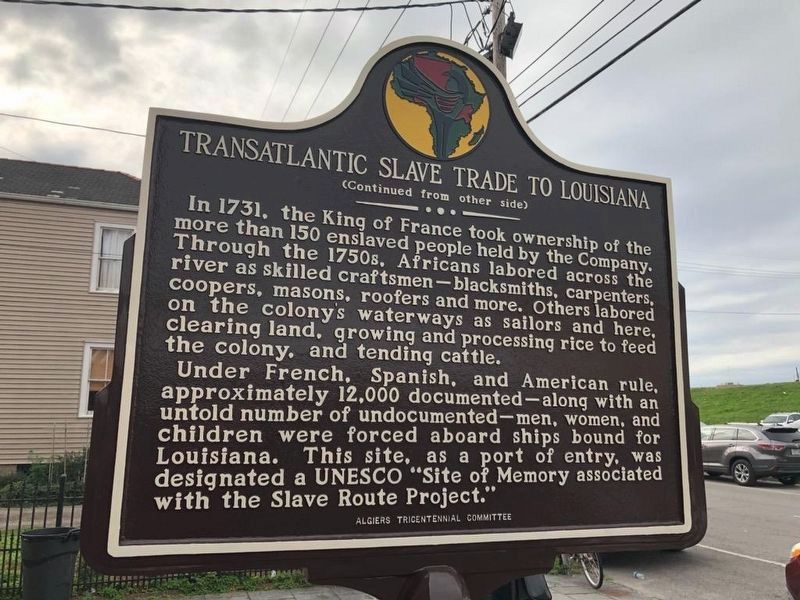
In 1731, the King of France took ownership of the more than 150 enslaved people held by the Company. Through the 1750s, Africans labored across the river as skilled craftsmen—blacksmiths, carpenters, coopers, masons, roofers and more. Others labored on the colony’s waterfront as sailors and here, clearing land, growing and processing rice to feed the colony, and tending to cattle.
Under French, Spanish, and American rule, approximately 12,000 documented—along with an untold number of
this page online
Erected by Algiers Tricentennial Committee.
Topics. This historical marker is listed in these topic lists: African Americans • Waterways & Vessels. A significant historical year for this entry is 1718.
Location. 29° 57.223′ N, 90° 3.253′ W. Marker is in New Orleans, Louisiana, in Orleans Parish. It is in Algiers. It is on Morgan Street west of Bermuda Street, on the left when traveling west. At Algiers Courthouse. (Morgan St is one-way westbound). Touch for map. Marker is at or near this postal address: 225 Morgan St, New Orleans LA 70114, United States of America. Touch for directions.

Regionally, this marker is in one of Louisiana’s River Parishes. It is also in the American South, specifically in the Deep South, on the Gulf Coast, and in the Great River Road Region. Globally, it is in North America, a Gulf of Mexico state, the Western Hemisphere, the Western World, and the Anglosphere. Historically, it finds itself
Photographed by John Bloomfield
2. Transatlantic Slave Trade to Louisiana Marker
Photo Courtesy of Middle Passage Ceremonies and Port Markers Project (MPCPMP)
Other nearby markers. At least 8 other markers are within walking distance of this marker: Algiers Courthouse (here, next to this marker); Hardy Residence (within shouting distance of this marker); Duverjé Plantation (within shouting distance of this marker); Algiers' Dry Docks (within shouting distance of this marker); Enslaved Africans (about 300 feet away, measured in a direct line); The Great Fire of Algiers, 1895 (about 400 feet away); Louis D. Armstrong (about 500 feet away); Historic Algiers (about 600 feet away). Touch for a list and map of all markers in New Orleans.
Regarding Transatlantic Slave Trade to Louisiana. On the Mississippi River, directly across from New Orleans’ old quarter, Algiers Point was a plantation owned by the French Company of the Indies that served as the quarantine and holding place for captive Africans who were inspected and their marketability determined after completing the Middle Passage.
Source: Africans in Colonial Louisiana: The Development of Afro-Creole Culture in the 18th Century, Gwendolyn Midlo Hall; The World That Made New Orleans: From Spanish Silver to Congo Square, Ned Sublette; Congo Square: African Roots in New Orleans, Freddi Williams Evans; Gumbo Yaya: A Collection of Louisiana Folk Tales, Robert Tallant. Dillard and Southern Universities also maintain extensive studies and papers on the history of Africans and their descendants in New Orleans; and the Trans-Atlantic Slave Trade Database. Emory University; Africans in Colonial Louisiana.
Related markers.

Photographed by Cajun Scrambler, November 26, 2020
3. Transatlantic Slave Trade to Louisiana Marker
Also see . . . Middle Passage Ceremonies and Port Markers Project. (Submitted on October 14, 2020, by John Bloomfield of Palm Coast, Florida.)
Additional keywords. Middle Passage
Credits. This page was last revised on February 12, 2023. It was originally submitted on October 14, 2020, by John Bloomfield of Palm Coast, Florida. This page has been viewed 1,515 times since then and 151 times this year. Photos: 1, 2. submitted on October 14, 2020, by John Bloomfield of Palm Coast, Florida. 3. submitted on November 26, 2020, by Cajun Scrambler of Assumption, Louisiana. • Mark Hilton was the editor who published this page.
