A Resting Place for the Weary
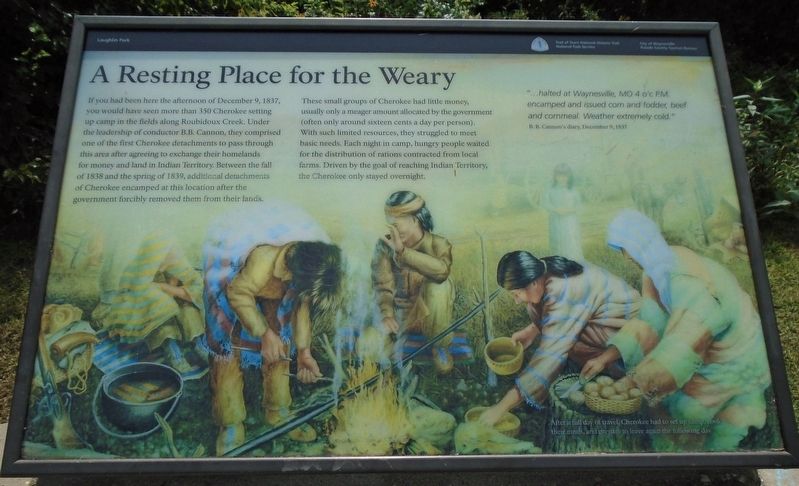
"...halted at Waynesville, MO o'c P.M. encamped and issued corn and fodder, beef and cornmeal. Weather extremely cold."
B. B. Cannon's diary, December 9, 1837
If you had been here the afternoon of December 9, 1837, you would have seen more than 350 Cherokee setting up camp in the fields along Roubidoux Creek. Under the leadership of conductor B.B. Cannon, they comprised one of the first Cherokee detachments to pass through this area after agreeing to exchange their homelands for money and land in Indian Territory. Between the fall of 1838 and the spring of 1839, additional detachments of Cherokee encamped at this location after the government forcibly removed them from their lands.
These small groups of Cherokee had little money, usually only a meager amount allocated by the government (often only around sixteen cents a day per person). With such limited resources, they struggled to meet basic needs. Each night in camp, hungry people waited for the distribution of rations contracted from local farms. Driven by the goal of reaching Indian Territory, the Cherokee only stayed overnight.
[Background illustration caption reads]
After
this page online
Erected 2015 by National Park Service, City of Waynesville, and Pulaski County Tourism Bureau.
Topics and series. This historical marker is listed in these topic lists: Civil Rights • Disasters • Indigenous Peoples and Communities. In addition, it is included in the Trail of Tears series list. A significant historical date for this entry is December 9, 1837.
Location. 37° 49.577′ N, 92° 12.214′ W. Marker is in Waynesville, Missouri, in Pulaski County. It is on Superior Road south of Old U.S. Route 66 (Business Interstate 44), on the right when traveling south. Marker is in Roy Laughlin Park. Touch for map. Marker is in this post office area: Waynesville MO 65583, United States of America. Touch for directions.

Regionally, this marker is in South-Central Missouri. It is also in the American Ozarks, in the Lewis & Clark Corridor, and in the Corn Belt. Globally, it is in North America, the Western Hemisphere, the Western World, and the Anglosphere. Historically, it finds itself in what was once the territory of
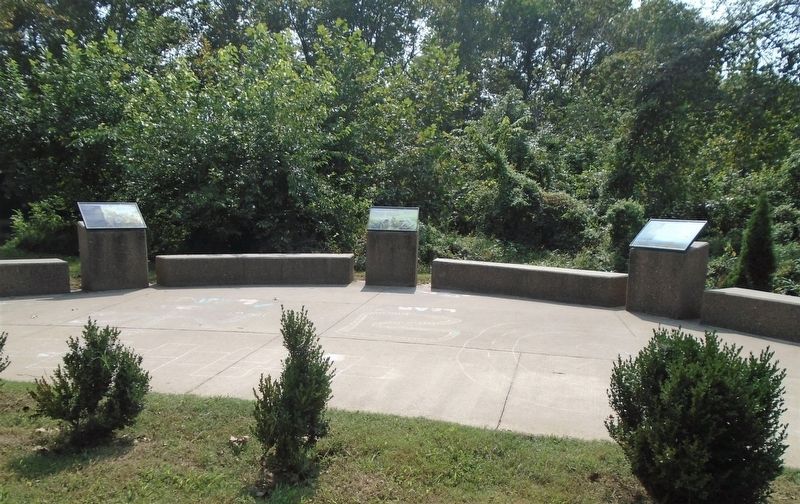
Other nearby markers. At least 8 other markers are within walking distance of this marker: A Trail of Tragedy (here, next to this marker); What is the Trail of Tears? (here, next to this marker); Discover a Hidden History (within shouting distance of this marker); A Road Through History (about 500 feet away, measured in a direct line); Waynesville Fort (approx. 0.2 miles away); A Frigid Crossing (approx. 0.2 miles away); Rigsby House and Standard Oil Station (approx. 0.2 miles away); Pulaski County (approx. 0.2 miles away). Touch for a list and map of all markers in Waynesville.
Also see . . .
1. Laughlin Park & Roubidoux Spring. City of Waynesville website entry (Submitted on February 10, 2025, by Larry Gertner of New York, New York.)
2. Trail Of Tears National Historic Trail. National Park Service website entry (Submitted on October 16, 2020, by William Fischer, Jr. of Reynoldsburg, Ohio.)

Trail of Tears Association president Jack Baker talked about the forced relocation of Native Americans in the early 19th century. Mr. Baker, a member of the Cherokee Nation, also discussed his own family's involuntary move to Oklahoma.
Click for more information.
Credits. This page was last revised on June 14, 2025. It was originally submitted on October 16, 2020, by William Fischer, Jr. of Reynoldsburg, Ohio. This page has been viewed 403 times since then and 31 times this year. Photos: 1, 2. submitted on October 16, 2020, by William Fischer, Jr. of Reynoldsburg, Ohio. 3. submitted on June 14, 2025, by Larry Gertner of New York, New York.
