Fuel Hazard Mitigation
United States Air Force Academy
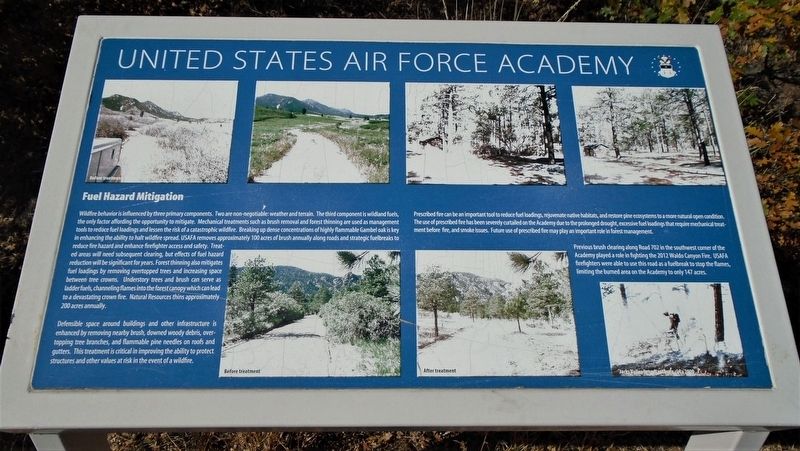
Wildfire behavior is influenced by three primary components. Two are non-negotiable: weather and terrain. The third component is wildland fuels, the only factor affording the opportunity to mitigate. Mechanical treatments such as brush removal and forest thinning are used as management tools to reduce fuel loadings and lessen the risk of a catastrophic wildfire. Breaking up dense concentrations of highly flammable Gambel oak is key in enhancing the ability to halt wildfire spread. USAFA removes approximately 100 acres of brush annually along roads and strategic fuelbreaks to reduce fire hazard and enhance firefighter access and safety. Treated areas will need subsequent clearing, but effects of fuel hazard reduction will be significant for years. Forest thinning also mitigates fuel loadings by removing overtopped trees and increasing space between tree crowns. Understory trees and brush can serve as ladder fuels, channeling flames into the forest canopy which can lead to a devastating crown fire. Natural Resources thins approximately 200 acres annually.
Defensible space around buildings and other infrastructure is enhanced
this page online
Prescribed fire can be an important tool to reduce fuel loadings, rejuvenate native habitats, and restore pine ecosystems to a more natural open condition. The use of prescribed fire has been severely curtailed on the Academy due to the prolonged drought, excessive fuel loadings that require mechanical treatment before fire, and smoke issues. Future use of prescribed fire may play an important role in forest management.
Previous brush clearing along Road 702 in the southwest corner of the Academy played a role in fighting the 2012 Waldo Canyon Fire. USAFA firefighters were able to use this road as a fuelbreak to stop the flames, limiting the burned area on the Academy to only 147 acres.
Erected by United States Air Force Academy.
Topics. This historical marker is listed in these topic lists: Disasters • Environment • Horticulture & Forestry. A significant historical year for this entry is 2012.
Location. 39° 0.417′ N,
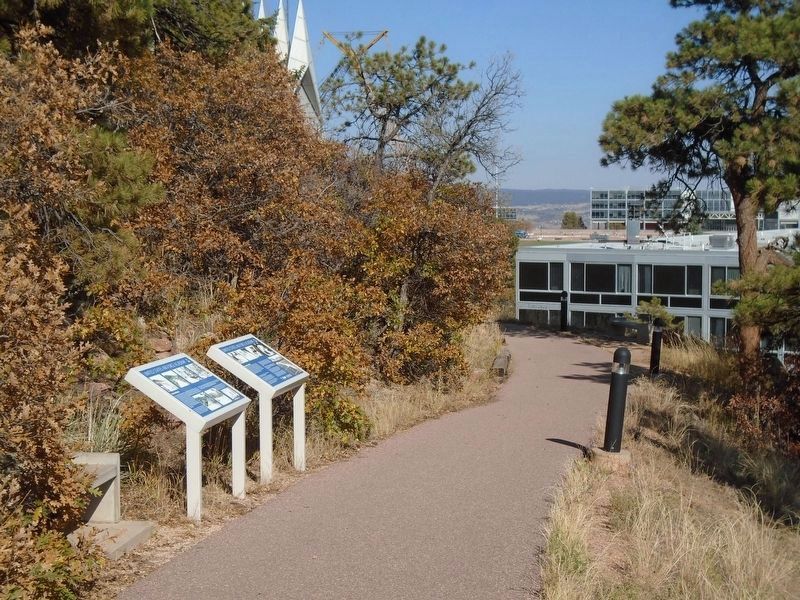

Regionally, this marker is in the Front Range and in Pikes Peak Region. It is also in the American Mountain West. Globally, it is in North America, the Rocky Mountains, the Western Hemisphere, the Western World, and the Anglosphere. Historically, it finds itself in what was once the Comanchería.
Other nearby markers. At least 8 other markers are within 2 miles of this marker, measured as the crow flies: An Ancient Geologic Past (within shouting distance of this marker); Before the Academy (within shouting distance of this marker); Veterans Memorial (about 400 feet away, measured in a direct line); Forest Management (about 400 feet away); Landscape Fire Ecology (about 400 feet away); Scrub (Gambel's) Oak (about 400 feet away); Abert's Squirrel (about 600 feet away); Memorial Pavilion Roll Call Record Locator Room (approx. 2 miles away). Touch for a list and map of all markers in United States Air Force Academy.
More about this marker. Visitors must have an unexpired official photo ID to present to security to access the USAF Academy grounds.
Regarding Fuel Hazard Mitigation. Marker has limited but important historical information.
Also see . . .
1. Waldo Canyon Fire Final After Action Report. (Submitted on October 20, 2020, by William Fischer, Jr. of Reynoldsburg, Ohio.)
2. Waldo Canyon Fire Burn Scar (NASA). (Submitted on October 20, 2020, by William Fischer, Jr. of Reynoldsburg, Ohio.)
3. What the recent Waldo Canyon Fire in Colorado can teach us about pre-fire mitigation (NFlA, 2012). (Submitted on October 20, 2020, by William Fischer, Jr. of Reynoldsburg, Ohio.)
Credits. This page was last revised on December 31, 2023. It was originally submitted on October 20, 2020, by William Fischer, Jr. of Reynoldsburg, Ohio. This page has been viewed 406 times since then and 8 times this year. Photos: 1, 2. submitted on October 20, 2020, by William Fischer, Jr. of Reynoldsburg, Ohio.
