
Harpers Ferry in Jefferson County, West Virginia — The American South (Appalachia)
Foundations of Freedom
Civil War Camp to College Campus
| — | Harpers Ferry National Historical Park, National Park Service, U.S. Department of the Interior | — |
Photographed by Bradley Owen, October 22, 2020
1. Foundations of Freedom Marker
Marker has been redesigned.
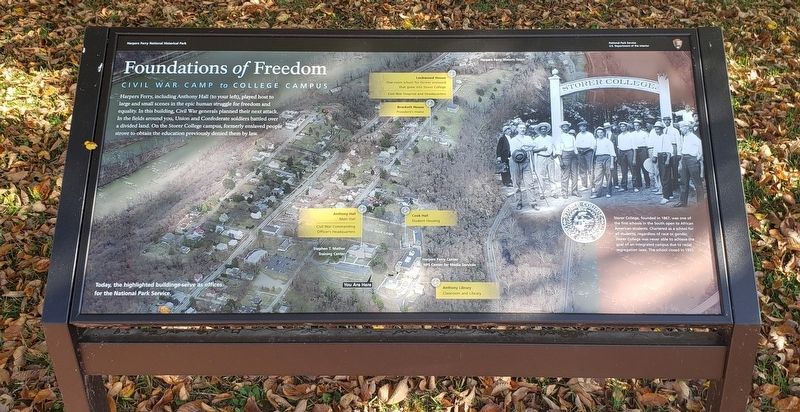
Harpers Ferry, including Anthony Hall (to your left), played host to large and small scenes in the epic human struggle for freedom and equality. In this building, Civil War generals planned their next attack. In the fields around you, Union and Confederate soldiers battled over a divided land. On the Storer College campus, formerly enslaved people strove to obtain the education previously denied them by law.
[Captions:]
Storer College, founded in 1867, was one of the first schools in the South open to African American students. Chartered as a school for all students, regardless of race or gender, Storer College was never able to achieve the goal of an integrated campus due to racial segregation laws. The school closed in 1955.
Today, the highlighted buildings serve as offices for the National Park Service.
Lockwood House
One-room school for former enslaved that grew into Storer College.
Civil War Hospital and Headquarters.
Brackett House
President's Home
Anthony Hall
Main Hall
Civil War Commanding Officer's Headquarters
Cook Hall
Student Housing
Anthony Library
Classroom and Library
Erected by National
this page online
Topics and series. This historical marker is listed in these topic lists: African Americans • Education • War, US Civil. In addition, it is included in the Historically Black Colleges and Universities series list. A significant historical year for this entry is 1867.
Location. 39° 19.424′ N, 77° 44.492′ W. Marker is in Harpers Ferry, West Virginia, in Jefferson County. It is on Mather Place 0.1 miles south of Hartzog Drive when traveling south. Touch for map. Marker is at or near this postal address: 63 Mather Pl, Harpers Ferry WV 25425, United States of America. Touch for directions.

Regionally, this marker is in the Washington Metropolitan Area and in the Eastern Panhandle. It is also in the American South, specifically in the Upper South, in Appalachia, and specifically in Northern Appalachia. Globally, it is in North America, the Western Hemisphere, the Western World, and the Anglosphere. Historically, it finds itself in what was once the territory of the Mississippian Culture and also the Antebellum South.
Other nearby markers. At least 8 other markers are within
Photographed by Bradley Owen, October 22, 2020
2. Foundations of Freedom Marker
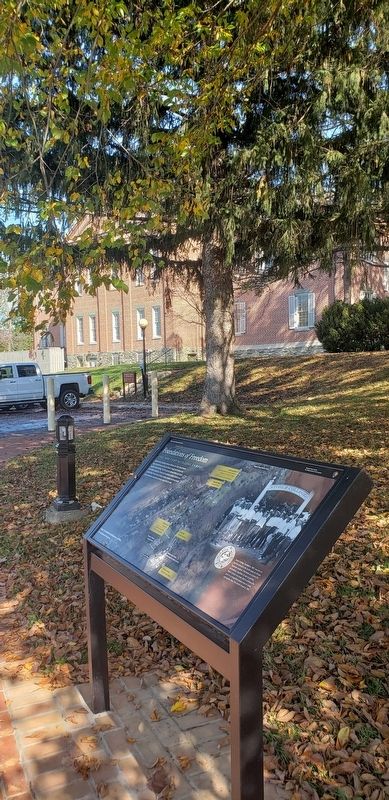
Stephen T. Mather Training Center is seen in the background.
Other markers no longer nearby. Foundations of Freedom (has been replaced with this marker); That was the happiest time of my life. (was within shouting distance of this marker but has been replaced with another marker now near it); The Niagara Movement at Storer College (was within shouting distance of this marker but has been replaced with another marker now near it); Camp Hill during the Civil War (was about 300 feet away, measured in a direct line but has been permanently removed); Storer College 1867-1955 (was about 300 feet away but has been permanently removed); A Land Divided (was about 300 feet away but has been replaced with another marker now near it); Church and School (was about 400 feet away but has been confirmed missing).
Related marker. Click here for another marker that is related to this marker. This marker has replaced the linked marker.
Credits. This page was last revised on October 25, 2020. It was originally submitted on October 25, 2020, by Bradley Owen of Morgantown, West Virginia. This page has been viewed 325 times since then and 11 times this year. Photos: 1, 2. submitted on October 22, 2020, by Bradley Owen of Morgantown, West Virginia. • Devry Becker Jones was the editor who published this page.
