Near New Market in Shenandoah County, Virginia — The American South (Mid-Atlantic)
Post-Appomattox Tragedy
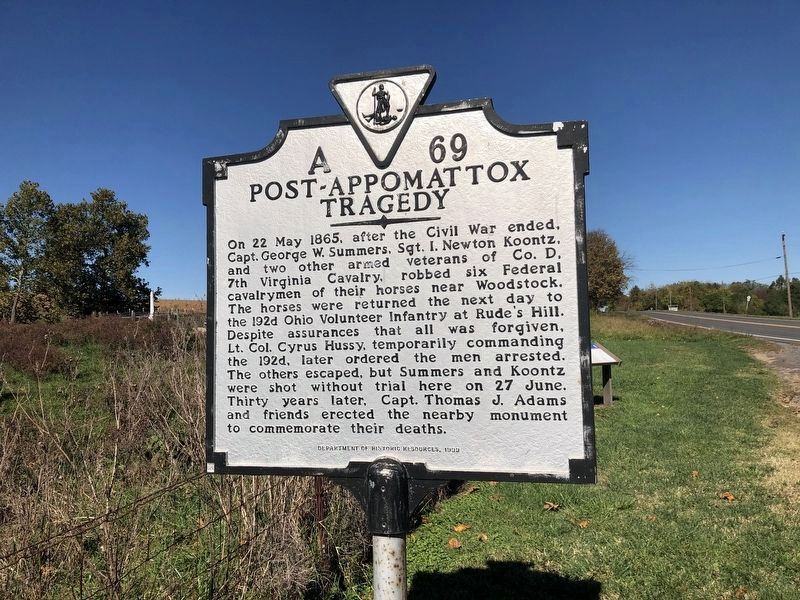
On 22 May 1865, after the Civil War ended. Capt. George W. Summers, Sgt. I. Newton Koontz, and two other armed veterans of Co. D, 7th Virginia Cavalry, robbed six Federal cavalrymen of their horses near Woodstock. The horses were returned the next day to the 192d Ohio Volunteer Infantry at Rude’s Hill. Despite assurances that all was forgiven, Lt. Col. Cyrus Hussy, temporarily commanding the 192nd, later ordered the men arrested. The others escaped, but Summers and Koontz were shot without trial here on 27 June. Thirty years later, Capt. Thomas J. Adams and friends erected the nearby monument to commemorate their deaths.
Erected 1999 by the Department of Historic Resources; funded privately by Mr. D. Coiner Rosen. (Marker Number A-69.)
Topics and series. This historical marker is listed in this topic list: War, US Civil. In addition, it is included in the Virginia Department of Historic Resources (DHR) series list. A significant historical date for this entry is May 22, 1865.
Location. 38° 41.564′ N, 78° 39′ W. Marker is near New Market, Virginia, in Shenandoah County. It is at the intersection of Old Valley Pike (U.S.
this page online

Regionally, this marker is in Virginia’s Shenandoah Valley. It is also in the American South, specifically in the Upper South, and in the Mid-Atlantic. Globally, it is in North America, the Western Hemisphere, the Western World, and the Anglosphere. Historically, it finds itself in what was once the territory of the Mississippian Culture, one of the original Thirteen Colonies, one of the Confederate States of America, and the Antebellum South.
Other nearby markers. At least 8 other markers are within walking distance of this marker: The Summers & Koontz Executions (a few steps from this marker); DuPont and the Union Retreat (a few steps from this marker); The Executions of George Summers and Isaac Koontz (a few steps from this marker); The Post-Appomattox Tragedy Monument (within shouting distance of this marker); Summers & Koontz Monument (within shouting distance of this marker); In Memory of Noah Richard Proctor
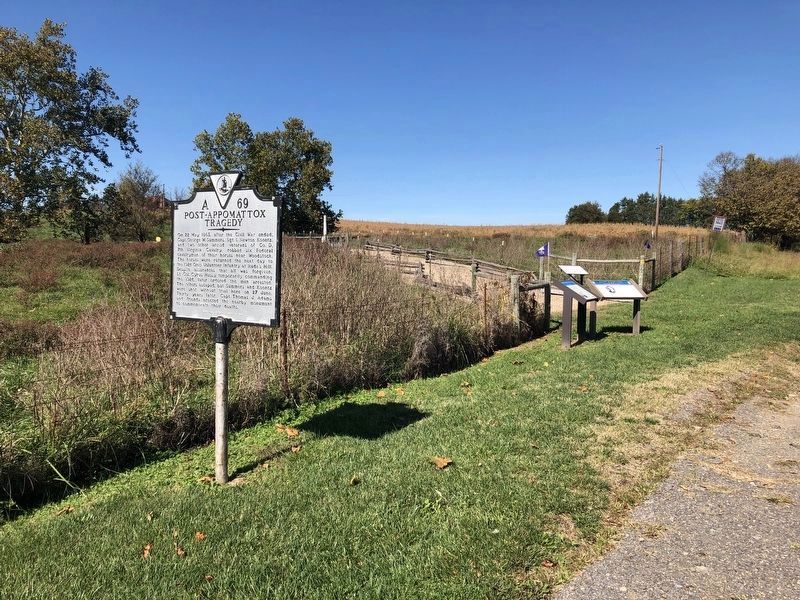
Another marker is no longer nearby. DuPont at Rude’s Hill (was a few steps from this marker but has been reported to have been replaced with another marker now near it).
Related markers. Click here for a list of markers that are related to this marker. Markers detailing this incident.
Also see . . . Tragedy in the Shenandoah Valley: The Story of the Summers-Koontz Execution. Book by Robert H. Moore, II on Amazon.com. Publisher’s Description:
“ ‘Try to meet me in Heaven where I hope to go.’
“These poignant words were written in the summer of 1865 by twenty-year-old Confederate Sergeant Isaac Newton Koontz, in a letter he penned for his fiancee just hours before his death at the hands of Union firing squad in the heart of Virginia’s Shenandoah Valley. The execution of Koontz and Captain George Summers came after the surrender at Appomattox Court House, and remains one of the most tragic yet little-known events of the Civil War.
“One
Photographed by J. J. Prats, September 26, 2006
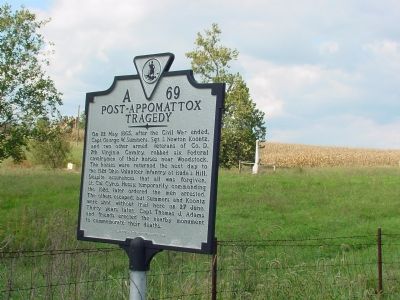
3. Marker and Monument
A fence topped with barbed wire used to prevent access to pasture where monument, visible in the distance to the right of marker, is located.
“As the sun crept over the horizon on June 27, 1865, Union soldiers—under new command—swarmed the family homes of Summers and Koontz in a swift raid and arrested the two bewildered men. They were told that their pardons were no longer valid, and later that same day they were tied to a stake and shot with Union muskets—no trial, no judge, no jury.
“Before their deaths, Summers and Koontz were allowed to write farewell letters to their loved ones, and these heartrending documents serve as the basis for Robert Moore’s insightful recounting of the Summers-Koontz execution. An experienced Civil War writer and a direct descendent
Photographed by J. J. Prats, September 26, 2006
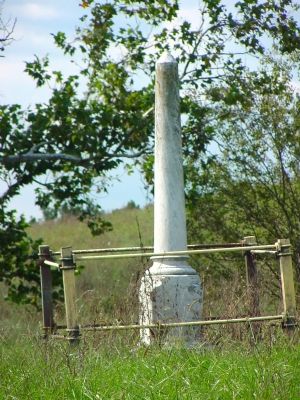
4. Telephoto Shot of Summers and Koontz Monument
Additional commentary.
1. Inscriptions on the Summers and Koontz Monument
[East -side toward the road]:
and
Sergt. Newton Koontz.
Company D. 7th Virginia Cavalry.
were here executed on
June27. 1865. By order of
Lt. Cal. Huzzy. 192d 0. V. M. I.
[North side]:
they having been arrested at their
homes in Page Co., brought here. and shot.
[West side is blank]:
[South side]:
Erected in 1893 by friends under the supervision of Capt. T. J. Adams
In November of 2008 the site was restored and is now open to the public. Capt. Jack Adams Camp No. 1951 Sons of Confederate Veterans, Edinburg VA
— Submitted January 5, 2009, by George Rogers of Basye, Virginia.
2.
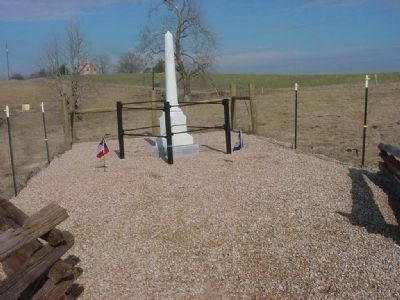
Photographed by George Rogers, February 14, 2009
5. Post-Appomattox Tragedy Monument
On May 22, 1865 Capt. George Summers and Sgt. Newton Koontz (7th Virginia Cavalry) were executed (murdered) on Rude's Hill—in an extra-legal action—by Lt. Col. Cyrus Hussy (192nd Ohio Infantry). Summers and Koontz had worked out a solution to their possession of Federal horses with another Federal officer, returning the horses to the camp of the 192nd Ohio; they were captured before they could receive their paroles. On Rude's Hill Hussy told his prisoners they would go no farther. The ex-Confederates were tied to a stake and shot. Two Virginia citizens never made it home to their families. Hussy never received justice from a civilian court for his crimes.
— Submitted September 13, 2024, by Steven Lee Cassel of Columbus, Ohio.
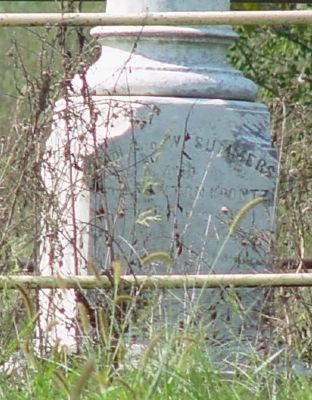
Photographed by J. J. Prats, September 26, 2006
6. Telephoto Close-Up of Monument Inscription
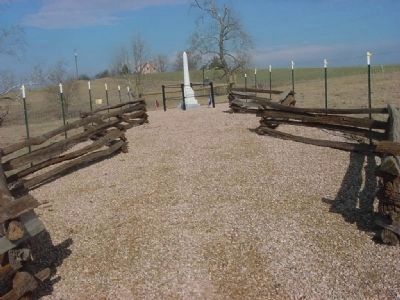
Photographed by George Rogers
7. Post-Appomattox Tragedy walkway to Monument
Credits. This page was last revised on September 28, 2024. It was originally submitted on January 29, 2007, by J. J. Prats of Powell, Ohio. This page has been viewed 6,990 times since then and 150 times this year. Last updated on February 6, 2009, by Robert H. Moore, II of Winchester, Virginia. Photos: 1, 2. submitted on October 18, 2020, by Devry Becker Jones of Washington, District of Columbia. 3, 4. submitted on January 29, 2007, by J. J. Prats of Powell, Ohio. 5. submitted on February 14, 2009, by George Rogers of Basye, Virginia. 6. submitted on January 29, 2007, by J. J. Prats of Powell, Ohio. 7. submitted on February 14, 2009, by George Rogers of Basye, Virginia. • Craig Swain was the editor who published this page.
