Near Moab in Grand County, Utah — The American Mountains (Southwest)
Monitor and Merrimac
Photographed by William Fischer, Jr., October 13, 2020
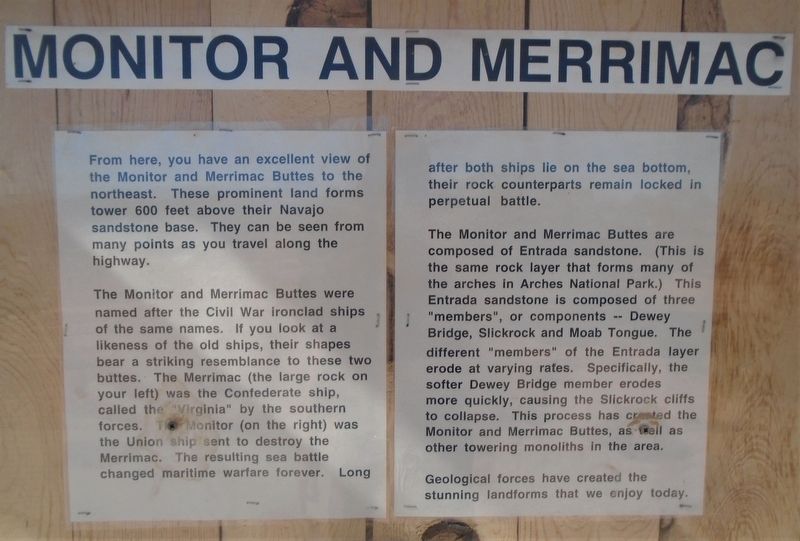
1. Monitor and Merrimac Marker
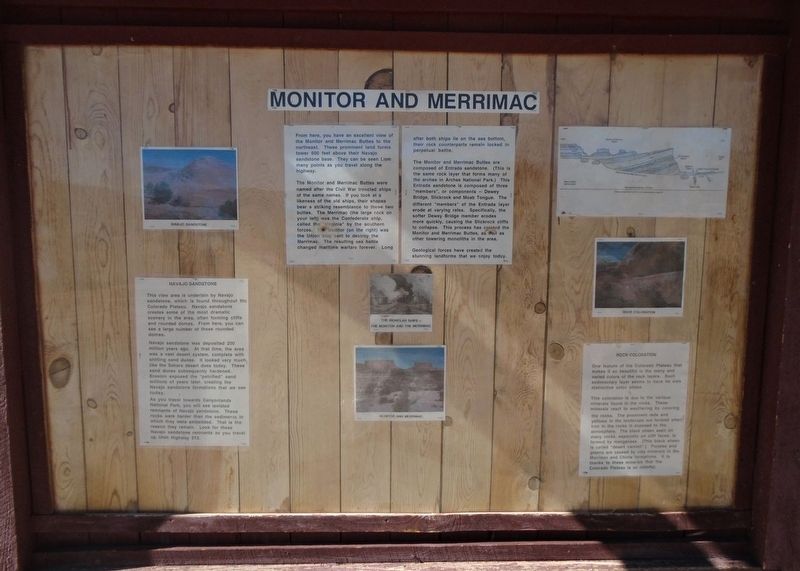
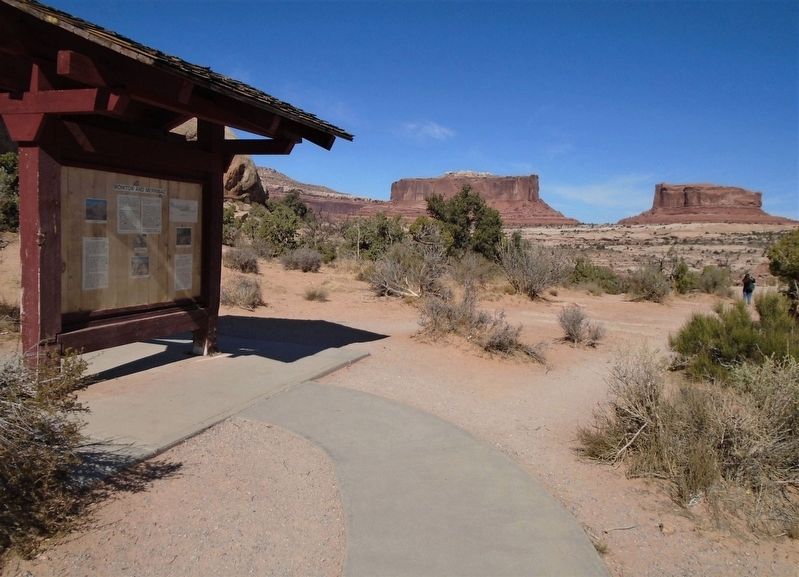
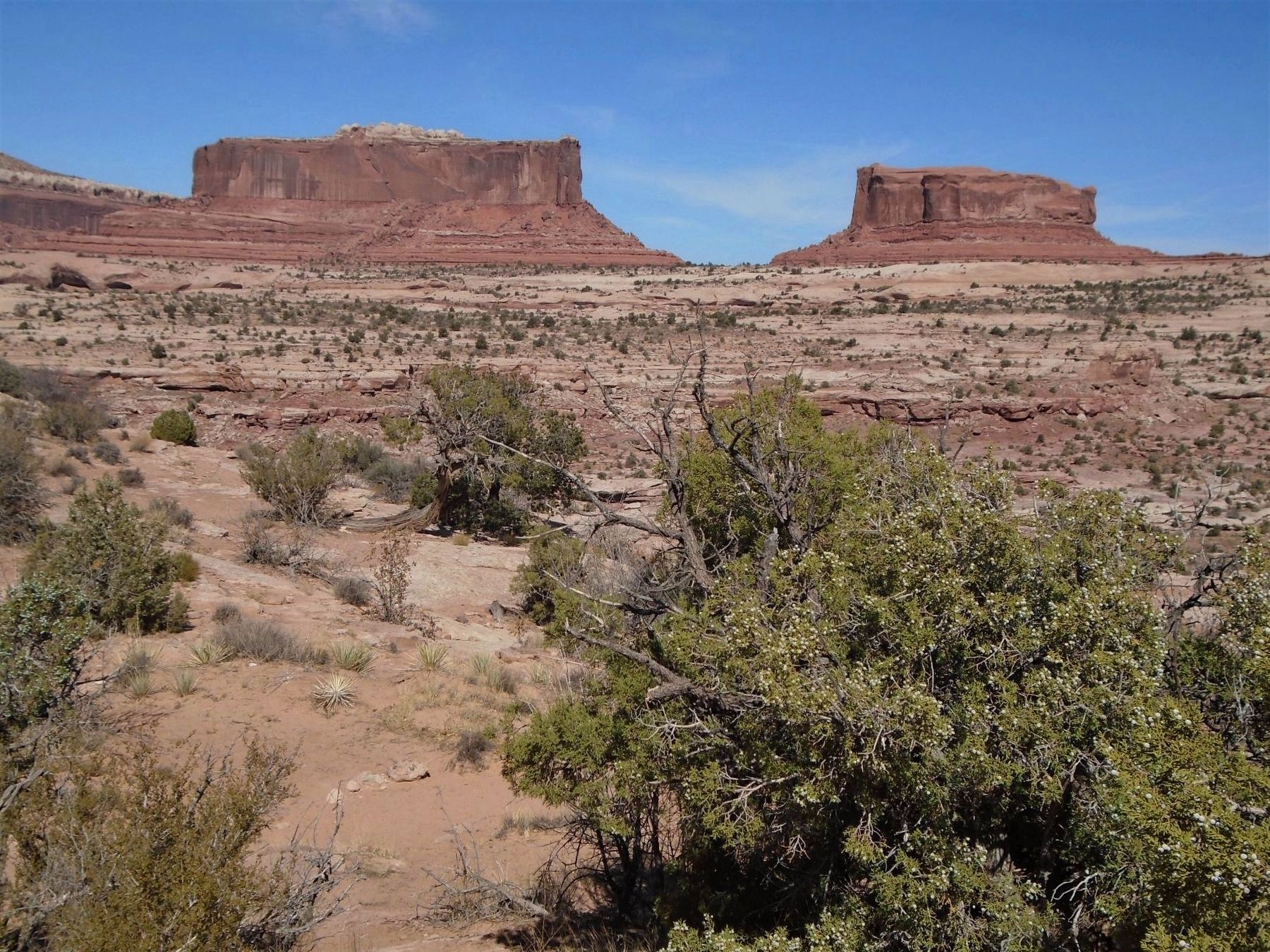
The Monitor and Merrimac Buttes were named after the Civil War ironclad ships of the same names. If you look at a likeness of the old ships, their shapes bear a striking resemblance to these two buttes. The Merrimac (the large rock on your left) was the Confederate ship, called the "Virginia" by the southern forces. The Monitor (on the right) was the Union ship sent to destroy the Merrimac. The resulting sea battle changed maritime warfare forever. Long after both ships lie on the sea bottom, their rock counterparts remain locked in perpetual battle.
The Monitor and Merrimac Buttes are composed of Entrada sandstone. (This is the same rock layer that forms many of the arches in Arches National Park.) This Entrada sandstone is composed of three "members", or components -- Dewey Bridge, Slickrock and Moab Tongue. The different "members" of the Entrada layer erode at varying rates. Specifically,
this page online
Geological forces have created the stunning landforms that we enjoy today.
Erected by Bureau of Land Management, U.S. Department of the Interior.
Topics. This historical marker is listed in this topic list: Natural Features.
Location. 38° 38.746′ N, 109° 44.174′ W. Marker is near Moab, Utah, in Grand County. It can be reached from Utah 313. Marker is at the pavilion in the Bureau of Land Management's Monitor and Merrimac Viewpoint, off Utah Route 313, about four miles west of US Highway 191. Touch for map. Marker is in this post office area: Moab UT 84532, United States of America. Touch for directions.

Regionally, this marker is in Canyon Country. It is also in the American Mountain West, on the Colorado Plateau, and at the Four Corners. Globally, it is in North America, the Western Hemisphere, the Western World, and the Anglosphere. Historically, it finds itself in

Photographed by William Fischer, Jr., October 13, 2020
2. Monitor and Merrimac Marker
Other nearby markers. At least 8 other markers are within 6 miles of this marker, measured as the crow flies: Navajo Sandstone (here, next to this marker); Cultural Connections (approx. 0.7 miles away); Dalton Wells (approx. 4.9 miles away); Camping at Courthouse Rock (approx. 5.2 miles away); Crocodile Slide (approx. 5.3 miles away); Dromaeosaur Tracks (approx. 5.3 miles away); Medium-size Theropod Tracks (approx. 5.3 miles away); Large Theropod Tracks (approx. 5.3 miles away). Touch for a list and map of all markers in Moab.
Also see . . .
1. The Geologic Story of Canyonlands National Park (USGS). (Submitted on November 11, 2020, by William Fischer, Jr. of Reynoldsburg, Ohio.)
2. Merrimac Butte at Wikipedia. (Submitted on November 11, 2020, by William Fischer, Jr. of Reynoldsburg, Ohio.)
Photographed by William Fischer, Jr., October 13, 2020
3. Monitor and Merrimac Buttes and Marker
Photographed by William Fischer, Jr., October 13, 2020
4. Merrimac Butte (left) and Monitor Butte (right)
Credits. This page was last revised on January 6, 2026. It was originally submitted on November 11, 2020, by William Fischer, Jr. of Reynoldsburg, Ohio. This page has been viewed 2,001 times since then and 148 times this year. Photos: 1, 2, 3, 4. submitted on November 11, 2020, by William Fischer, Jr. of Reynoldsburg, Ohio.
