Furnace Creek in Death Valley National Park in Inyo County, California — The American West (Pacific Coastal)
20 Mule Team Wagon Train
1885
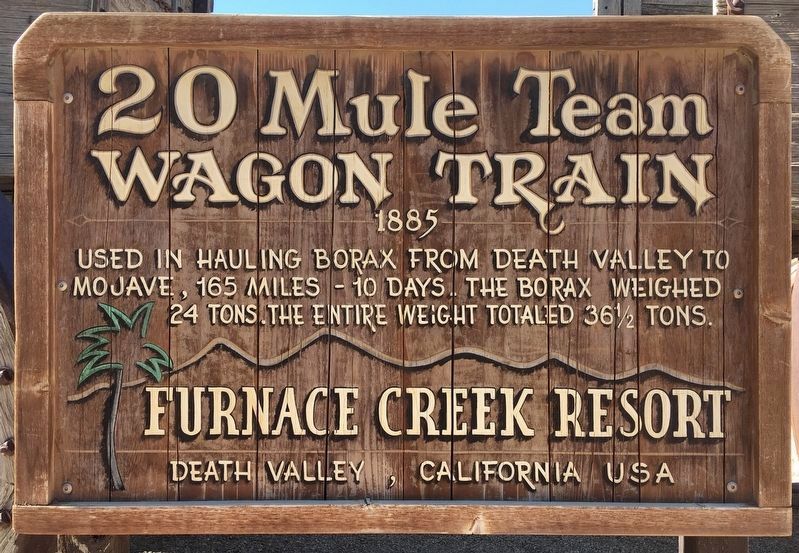
Photographed by Craig Baker, October 29, 2020
1. 20 Mule Team Wagon Train Marker
Erected by Furnace Creek Resort.
Topics. This historical marker is listed in these topic lists: Industry & Commerce • Roads & Vehicles.
Location. 36° 27.41′ N, 116° 52.061′ W. Marker is in Death Valley National Park, California, in Inyo County. It is in Furnace Creek. It can be reached from California Route 190 one mile north of Badwater Road, on the left when traveling north. Located behind the ranch museum. Touch for map. Marker is in this post office area: Death Valley CA 92328, United States of America. Touch for directions.

Regionally, this marker is in the Sierra Nevada. It is also in the American Mountain West. Globally, it is in North America, on the Ring of Fire, on the Pacific Rim, in the Western Hemisphere, in the Western World, and in the Anglosphere. Historically, it finds itself in what was once New Spain and also Mexico’s Alta California.
Other nearby markers. At least 8 other markers are within
this page online
Another marker is no longer nearby. 20 Mule Team Barn (was within shouting distance of this marker but has been permanently removed).
More about this marker. The wagons have been moved away from the main highway, to the ranch museum. The name of Furnace Creek Ranch has been changed to The Ranch At Death Valley, by the new owner, Xanterra Parks & Resorts.
Regarding 20 Mule Team Wagon Train. For more than a century, the 20 Mule Team has been a symbol of the borax industry — on product labels, in history books, and on television. The status is well-earned; mule teams helped solve the most difficult task
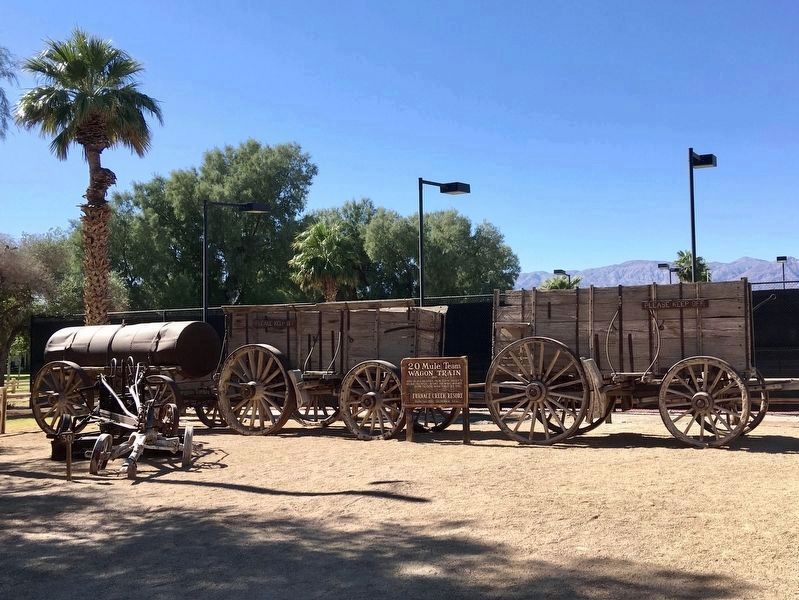
Photographed by Craig Baker, October 29, 2020
2. 20 Mule Team Wagon Train and Marker
Now located at the back of the museum outdoor collection, next to the tennis court.
The mule teams pulled loads weighing up to 36 tons, including 1,200 gallons of drinking water. The rear wagon wheels were 7 feet high, and the entire unit with mules was more than 100 feet long.
Borax has a wide variety of uses. It is a component of many detergents, cosmetics, and enamel glazes. It is also used to make buffer solutions in biochemistry, as a fire retardant, as an anti-fungal compound for fiberglass, as an insecticide, and as a flux in metallurgy.
Only three sets of original Twenty Mule Team Wagons still exist. The largest set is on display at nearby Harmony Borax Works. It is the only existing set of wagons that made the trip from Death Valley to Mojave, and it was built in Mojave. The other two sets of wagons are smaller and they made shorter trips from a mine near Daggett. They were built at Alf’s Blacksmith Shop in Daggett. One set is on display here, and the other set is on display in Boron at the Borax mine visitor center.
Related markers. Click here for a list of markers that are related to this marker. — 20 Mule Team routes.

Photographed by Mike Stroud, 2010
3. Original Marker - same text
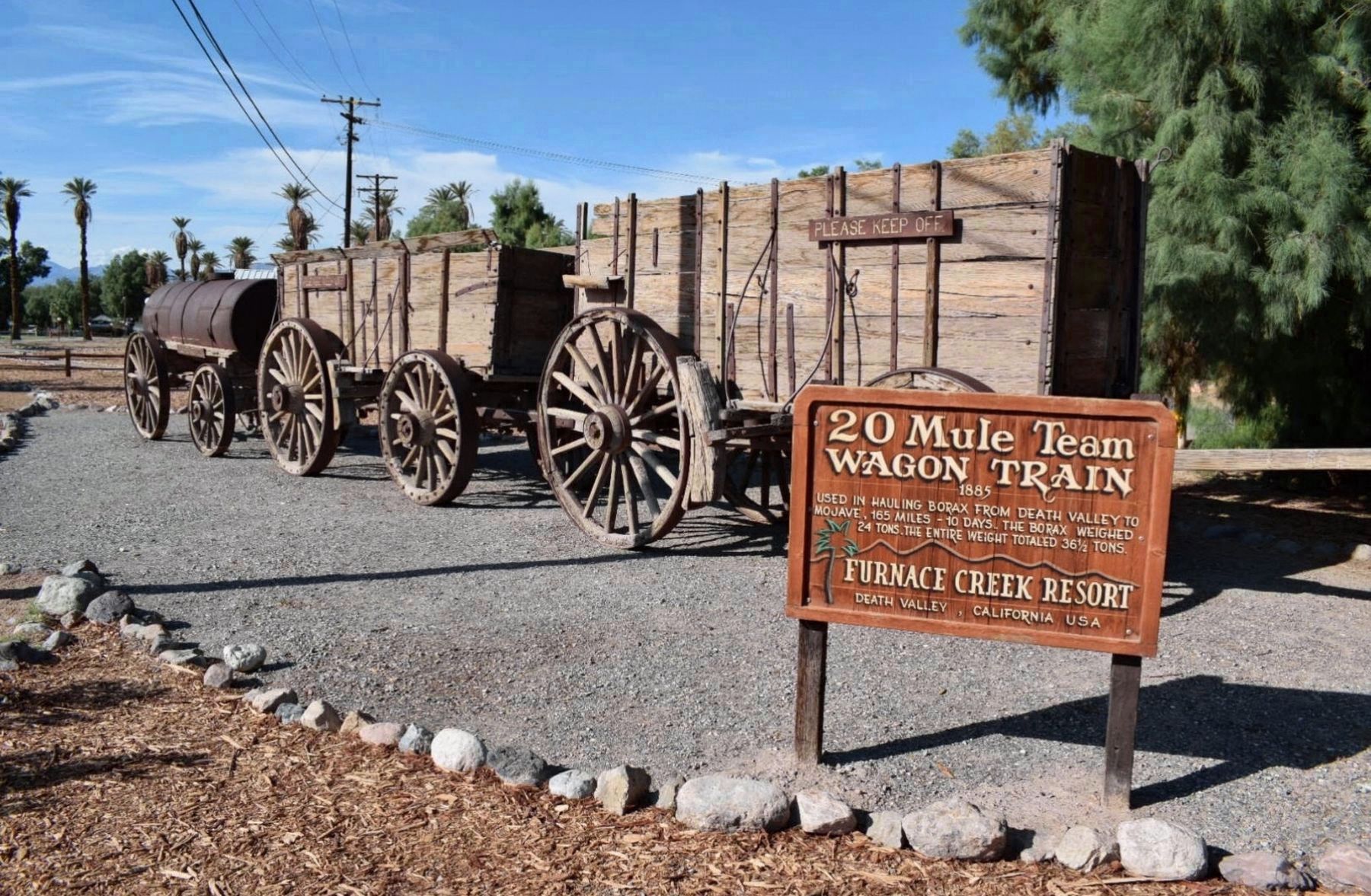
circa 2017
4. Temporary Location and New Marker with the same text.
Photographed by Mike Stroud, June 12, 2010
5. 20 Mule Team Wagon Train and Marker
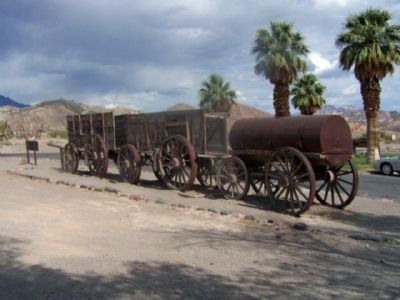
Photographed by Mike Stroud, June 12, 2010
6. 20 Mule Team Wagon Train
Twenty Mule Team Wagon hauled borax out of Death Valley
for only 6 years in the 1800s, yet are an enduring symbol of both borax and Death Valley.
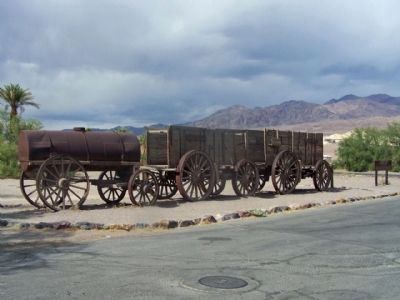
Photographed by Mike Stroud, June 12, 2010
7. 20 Mule Team Wagon Train
Originally located next to Highway 190.
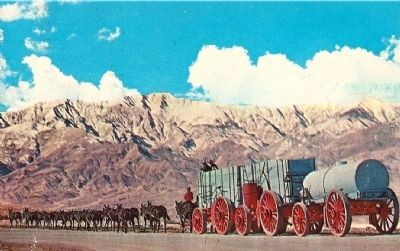
Ferris H. Scott, Santa Ana, Ca. - Western Resort Publications. Santa Ana, Ca. Color by Josef Muench
8. Death Valley National Monument, California
A typical twenty-mule team borax outfit in the foreground with the majestic Telescope Peak looming up in the background some 11,049 feet above sea level. The base of this mountain is below sealevel and it is the highest point in the Panamint Range.(Syd Whittle Collection)
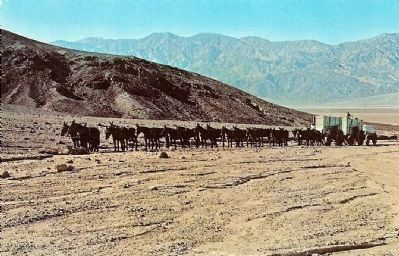
Death Valley Natural History Assoc-Decker Press, Inc. Photo by Warren Hill
9. Vintage Postcard - Typical Twenty Mule Team Outfit
During the 1880's, the twenty mule teams hauled borax from the refinery at Harmony Borax Works to the railroad at Mohave, California, 165 miles away. The twenty mule teams hauled loads of 36 1/2 tons and made the trip to Mojave in 10 days, maintaining almost timetable precision. The triumph of the twenty mule teams over the harsh desert was tremendous, but brief. In 1888 the great wagons and the twenty mule teams made their last trip out of Death Valley.
Credits. This page was last revised on July 15, 2026. It was originally submitted on June 21, 2010. This page has been viewed 5,117 times since then and 89 times this year. Last updated on November 12, 2020, by Craig Baker of Sylmar, California. Photos: 1, 2. submitted on November 12, 2020, by Craig Baker of Sylmar, California. 3. submitted on June 21, 2010, by Mike Stroud of Bluffton, South Carolina. 4. submitted on March 16, 2018, by Craig Baker of Sylmar, California. 5, 6, 7. submitted on June 21, 2010, by Mike Stroud of Bluffton, South Carolina. 8. submitted on June 20, 2010, by Mike Stroud of Bluffton, South Carolina. 9. submitted on September 29, 2008, by Syd Whittle of Mesa, Arizona. • J. Makali Bruton was the editor who published this page.
