Each lock could change the elevation of the boat about 8 feet between the upstream and downstream canals. "Wickets," small butterfly valves, were located near the bottom of the lock door (item B in the drawing) were used to flood the lock to the upstream level or to drain the lock to the downstream level. After pressure was equalized; the main doors could be easily opened, allowing the boat to pass into, or out of, the lock. If a wicket became jammed, it became a "sticky wicket," a phrase that survives today, though rarely associated with its original meaning. Lock 60 in Mont Clare has been restored to working condition. Frick's Lock in East Coventry is waiting for restoration.
Heavy Manual Labor Was Required to Build All of the Components
The canals, locks, and dams were created with large work crews using rudimentary tools like shovels, pickaxes, and wheelbarrows. Sickness was frequent in the difficult living conditions. The crew that is shown above has paused while building the Black Rock dam.
Black Rock Dam
The dams constructed along the river would create a stretch of placid water, sometimes
Click or scan to see this page online
stretching for 3 miles behind the dam. Canal boats navigated directly upon the river while in this quiet water. Upon reaching the dam, they would enter one or more locks located behind it, in order to transit the change in elevation.
Canal and Towpath
The canals were usually constructed very close to the river, as is seen here at Towpath Park. In special cases, such as southeast of this point on the map, the canal diverged from the river, shortening the amount of digging required. The width and depth of the canal were selected to balance the construction cost against the expected canal traffic. The growth of traffic in the Schuylkill Navigation System caused the system to be upgraded twice. Additionally, the canal banks were not impermeable, and breaches could occur, especially during heavy rains or flooding.
Canal Construction
The canal in front of you was part of the Girard Canal section of the Schuylkill Navigation System. It is one of the few preserved remnants of this Schuylkill heritage.
The Schuylkill was well suited for a canal system because it only dropped 618 feet over the 108 miles that it covered. In order for
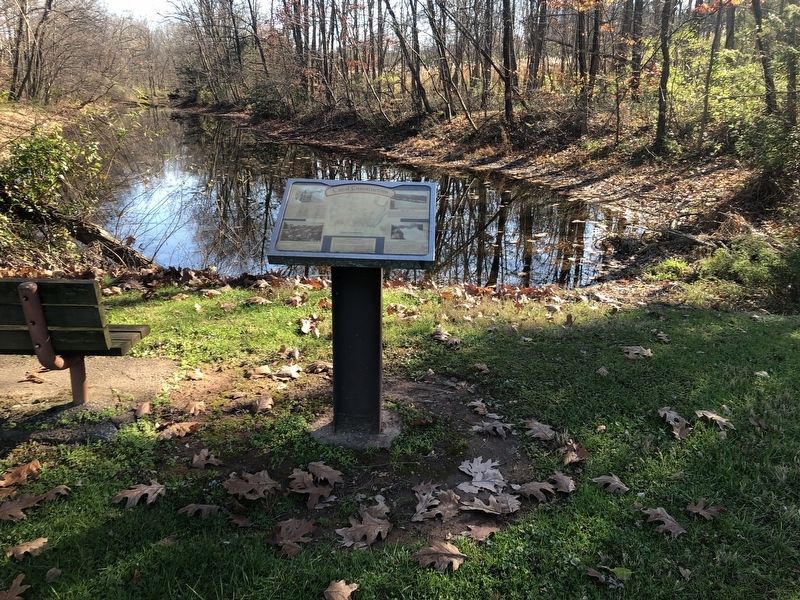
Photographed by Devry Becker Jones (CC0), November 20, 2020
2. Canal Construction Marker
the mules to tow the canal boats the water in each section of the river had to be still. This was accomplished by a series of 32 dams, 23 canals, and 109 lift locks.
Location. 40° 13.368′ N, 75° 36.899′ W. Marker is near Pottstown, Pennsylvania, in Chester County. It is in East Coventry Township. It can be reached from New Schuylkill Road (Pennsylvania Route 724) 0.2 miles east of Peterman Road, on the left when traveling east. This marker is on the grounds of Towpath Park. Touch for map. Marker is at or near this postal address: 1730 New Schuylkill Rd, Pottstown PA 19465, United States of America. Touch for directions.
Regionally, this marker is in Southeast Pennsylvania and in Greater Philadelphia. It is also in the American Northeast and in the Mid-Atlantic. Globally, it is in North America, the Western Hemisphere, the Western World, and the Anglosphere. Historically, it finds itself in what was once the Haudenosaunee (Iroquois) Confederacy, New Netherland, and one of the original Thirteen Colonies.
Credits. This page was last revised on February 7, 2023. It was originally submitted on November 21, 2020, by Devry Becker Jones of Washington, District of Columbia. This page has been viewed 339 times since then and 15 times this year. Photos:1, 2. submitted on November 21, 2020, by Devry Becker Jones of Washington, District of Columbia.