Understanding the Great Sand Dunes System: the Sand Sheet
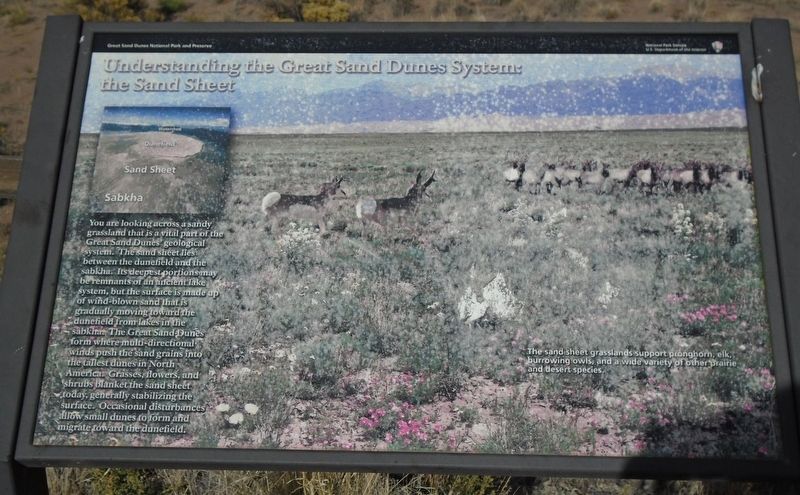
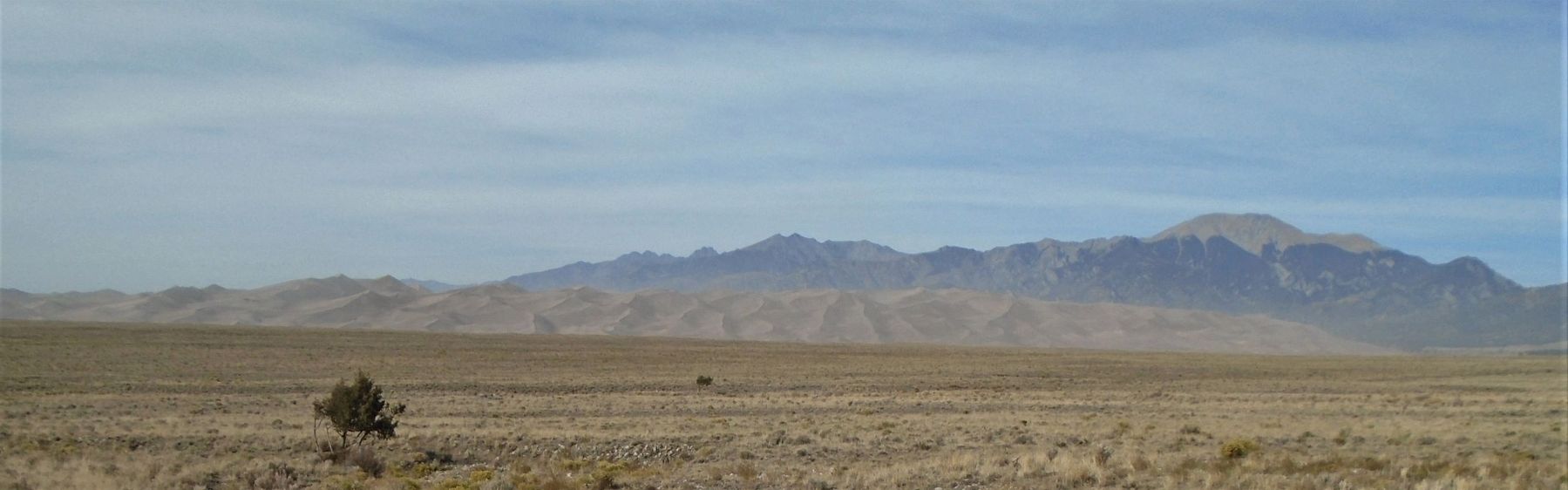
You are looking across a sandy grassland that is a vital part of the Great Sand Dunes geological system. The sand sheet lies between the dunefield and the sabkha. Its deepest portions may be remnants of an ancient lake system, but the surface is made up of wind-blown sand that is gradually moving toward the dunefield from lakes in the sabkha. The Great Sand Dunes form where multi-directional winds push the sand grains into the tallest dunes in North America. Grasses, flowers, and shrubs blanket the sand sheet today, generally stabilizing the surface. Occasional disturbances allow small dunes to form and migrate toward the dunefield.
[Background photo caption reads]
The sand sheet grasslands support pronghorn, elk, burrowing owls, and a wide variety of other prairie and desert species.
Erected by National Park Service.
Topics. This historical marker is listed in this topic list: Natural Features.
Location. 37° 39.738′ N, 105° 36.088′ W. Marker is near Mosca, Colorado, in Alamosa County. It is on Lane 6N 1.2 miles west of State Highway 150, on the left when traveling
this page online

Regionally, this marker is in the San Juan Mountains and in the San Luis Valley. It is also in the American Mountain West. Globally, it is in North America, the Rocky Mountains, the Western Hemisphere, the Western World, and the Anglosphere. Historically, it finds itself in what was once New Spain and also the Republic of Texas.
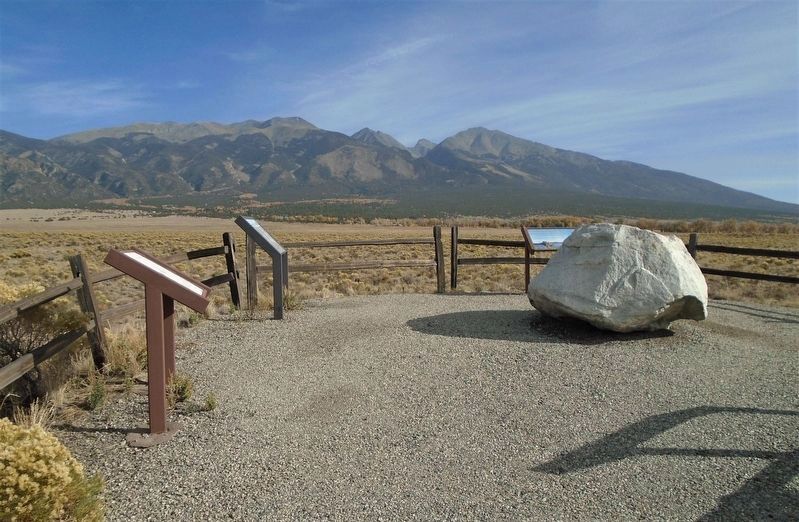
Other nearby markers. At least 8 other markers are within 7 miles of this marker, measured as the crow flies: Sounds of Silence (here, next to this marker); Evidence of a Changing World (here, next to this marker); L.B. "Bill" Casselman (here, next to this marker); Understanding the Great Sand Dunes System: the Sabkha (here, next to this marker); Pike and Southwest Commerce (approx. 1.8 miles away); "Totally Unique and Unexpected" (approx. 3.8 miles away); A Landmark for People (approx. 4.7 miles away); Zebulon Pike's "sand-hills" (approx. 6.7 miles away). Touch for a list and map of all markers in Mosca.
Regarding Understanding the Great Sand Dunes System: the Sand Sheet. The
Also see . . .
1. Great Sand Dunes National Park History & Culture. (Submitted on November 22, 2020, by William Fischer, Jr. of Reynoldsburg, Ohio.)
2. Great Sand Dunes National Park & Preserve Geologic Resource Evaluation Report. (Submitted on November 22, 2020, by William Fischer, Jr. of Reynoldsburg, Ohio.)
Credits. This page was last revised on November 22, 2020. It was originally submitted on November 22, 2020, by William Fischer, Jr. of Reynoldsburg, Ohio. This page has been viewed 362 times since then and 22 times this year. Photos: 1, 2, 3. submitted on November 22, 2020, by William Fischer, Jr. of Reynoldsburg, Ohio.
