
Cumberland Township near Gettysburg in Adams County, Pennsylvania — The American Northeast (Mid-Atlantic)
Artillery Brigade
Second Corps
| — | Army of the Potomac | — |
Photographed by Craig Swain, December 27, 2008
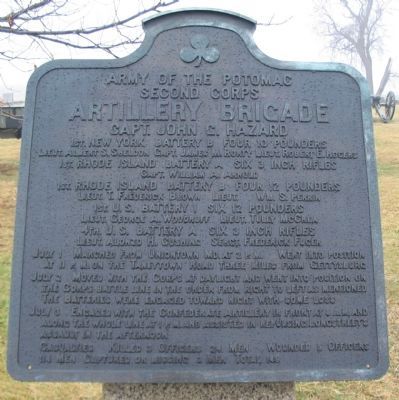
1. Artillery Brigade, Second Corps Tablet
At the top of the tablet is the trefoil symbol of Second Corps.
Second Corps
Artillery Brigade
Capt. John G. Hazard
1st. New York Battery B, Four 10 pounders
Lieut. Albert S. Sheldon, Capt. James M. Rorty, Lieut Robert E. Rodgers
1st. Rhode Island Battery A, Six 3 inch Rifles
Capt. William A. Arnold
1st. Rhode Island Battery B, Four 12 pounders
Lieut. T. Frederick Brown, Lieut. Wm. S. Perrin
1st. U.S. Battery I, Six 12 pounders
Lieut George A. Woodruff, Lieut. Tully McCrea
4th. U.S. Battery A, Six 3 inch Rifles
Lieut. Alonzo H. Cushing, Sergt. Frederick Fuger
July 1 Marched from Uniontown Md. at 2 p.m. Went into position at 11 p.m. on the Taneytown Road three miles from Gettysburg.
July 2 Moved with the Corps at daylight and went into position on the Corps battle line in the order from right to left as mentioned. The Batteries were engaged toward night with some loss.
July 3 Engaged with the Confederate Artillery in front at 8 a.m. and along the whole line at 1 p.m. and assisted in repulsing Longstreet's assault in the afternoon.
Casualties. Killed 3 officers 24 men. Wounded 5 officers 114 men. Missing 3 men. Total 149.
Erected 1912 by Gettysburg National Military Park Commission.
this page online
Topics and series. This historical marker is listed in this topic list: War, US Civil. In addition, it is included in the Gettysburg National Military Park Commission series list. A significant historical date for this entry is July 1, 1863.
Location. 39° 48.79′ N, 77° 14.132′ W. Marker is near Gettysburg, Pennsylvania, in Adams County. It is in Cumberland Township. It is on Hancock Avenue, on the left when traveling north. Located at the "Angle" on Cemetery Ridge in Gettysburg National Military Park. Touch for map. Marker is in this post office area: Gettysburg PA 17325, United States of America. Touch for directions.

Regionally, this marker is in South-Central Pennsylvania. It is also in the American Northeast, in the Mid-Atlantic, in Appalachia, and specifically in Northern Appalachia. Globally, it is in North America, the Western Hemisphere, the Western World, and the Anglosphere. Historically, it finds itself in what was once the Haudenosaunee (Iroquois) Confederacy and also one of the original Thirteen Colonies.
Other nearby markers. At least 8 other markers are within walking distance of this marker: Lt. Alonzo Cushing (a few
Photographed by Craig Swain, December 27, 2008
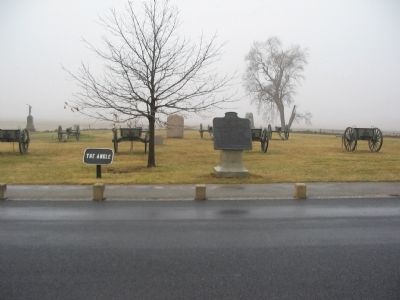
2. Hazard's Brigade Tablet
The tablet stands in behind a set of guns representing Cushing's Battery A, 4th U.S. Artillery.
Other markers no longer nearby. Pettigrew and Trimble's Attack (was a few steps from this marker but has been replaced with another marker now near it); Battlefield Landmarks - West and North (was a few steps from this marker but has been replaced with another marker now near it); Cushing's Union Battery (was within shouting distance of this marker but has been replaced with another marker now near it).
Also see . . . Report of Capt. John G. Hazard. Capt. Hazard described the situation before Longstreet's assault in his report:
The batteries did not at first reply, till the fire of the enemy becoming too terrible, they returned it till all their ammunition, excepting canister, had been expended; they then waited for the anticipated infantry attack of the enemy. Battery B, First New York Artillery, was entirely exhausted; its ammunition expended; its horses and men killed and disabled; the commanding officer, Capt. J. M. Rorty, killed, and senior First Lieut. A. S. Sheldon severely wounded. The other batteries were in similar condition; still, they bided the attack. The rebel lines advanced slowly but surely; half the valley had been passed over by them before the guns dared expend a round of the precious ammunition remaining on hand. The enemy steadily approached, and, when within deadly range, canister was thrown with terrible effect into their ranks. Battery A, First Rhode Island Light Artillery, had expended every round, and the lines of the enemy still advanced. Cushing was killed; Milne had fallen, mortally wounded; their battery was exhausted, their ammunition gone, and it was feared the guns would be lost if not withdrawn.
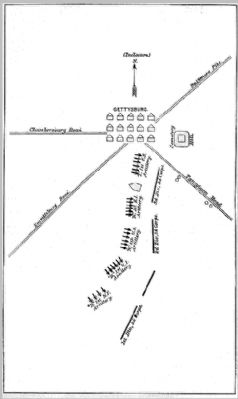
3. Hazard's Diagram of His Brigade Line
Diagram taken from Hazard's Official Report.
Photographed by Craig Swain, December 27, 2008
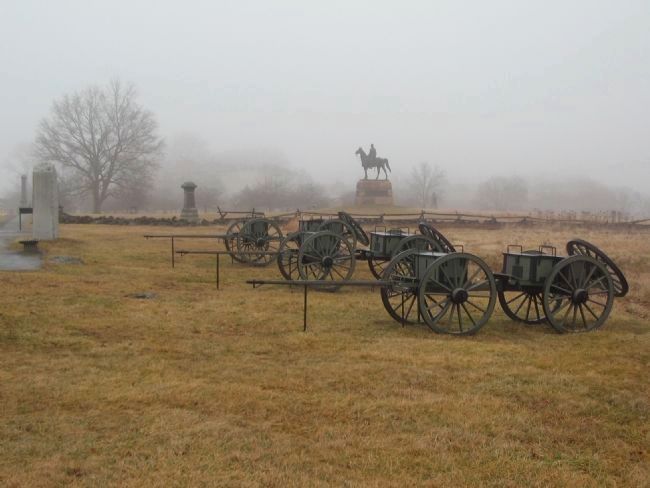
4. Battery Caissons
A set of reproduction caissons stand to the east of Hancock Avenue behind the Angle. These represent those caissons from Hazard's Brigade that supported Cushing's Battery. Similar caissons of other batteries in the brigade were posted between this point and where the statue of General Meade presently stands.
Credits. This page was last revised on February 7, 2023. It was originally submitted on February 14, 2009, by Craig Swain of Leesburg, Virginia. This page has been viewed 1,276 times since then and 16 times this year. Photos: 1, 2, 3, 4. submitted on February 14, 2009, by Craig Swain of Leesburg, Virginia.
