Fort Peck in Valley County, Montana — The American West (Mountains)
Built with Muscle and Muck
Photographed by Barry Swackhamer, August 26, 2020
1. Built with Muscle and Muck Marker
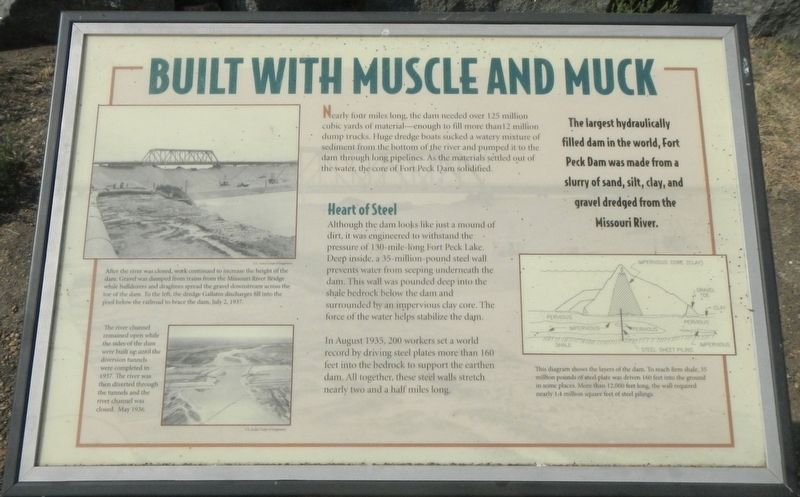
Captions: (upper left) After the river was closed, work continued to increase the height of the dam. Gravel was dumped from trains from the Missouri River Bridge while bulldozers and draglines spread the gravel downstream across the toe of the dam. To the left, the dredge Gallatin discharges fill into the pool below the railroad to brace the dam, July 2, 1937.; (lower left) The river channel remained open while the sides of the dam were built up until the diversion tunnels were completed in 1937. The river was then diverted through the tunnels and the river channel was closed. May 1936.; (lower right) This diagram shows the layers of the dam. To reach firm shale, 35 million pounds of steel plate was driven 160 feet into the ground in some places. More than 12,000 feet long, the wall required nearly 1.4 million square feet of steel pilings.
Nearly four miles long, the dam needed over 125 million cubic yards of material—enough to fill more than 12 million dump trucks. Huge dredge boats sucked a watery mixture of sediment from the bottom of the river and pumped it to the dam through long pipelines. As the material settled out of the water, the core of Fort Peck Dam solidified.
Heart of Steel Although the dam looks like just a mound of dirt, it was engineered to withstand the pressure of 130-mile-long Fort Peck Lake. Deep inside, a 35-million-pound steel wall prevents water from seeping underneath the dam. This wall was pounded deep into the shale bedrock below the dam and surrounded by an impervious clay core. The force of the water helps stabilize the dam.
In August 1935, 200 workers set a world record by driving steel plates more than 160 feet into the bedrock to support the earthen dam. All together, these steel walls stretch nearly two and a half miles long.
Erected by U.S. Army Corps
this page online
Topics. This historical marker is listed in this topic list: Natural Features.
Location. 48° 0.499′ N, 106° 24.016′ W. Marker is in Fort Peck, Montana, in Valley County. It is at the intersection of Yager Road and State Highway 24, on the left when traveling south on Yager Road. Touch for map. Marker is in this post office area: Fort Peck MT 59223, United States of America. Touch for directions.

Regionally, this marker is in Missouri River Country. It is also in the American Mountain West, in the Lewis & Clark Corridor, on the prairies, on the Great Plains, and specifically on the Northern Plains. Globally, it is in North America, the Western Hemisphere, the Western World, and the Anglosphere. Historically, it finds itself in what was once Rupert’s Land and also the Louisiana Purchase.
Other nearby markers. At least 8 other markers are within walking distance of this marker: Fort Peck Dam (here, next to this marker); The Slide of '38 (here, next to this marker); In Memory (here, next to this marker); Lewis & Clark in Missouri River Country (approx. half
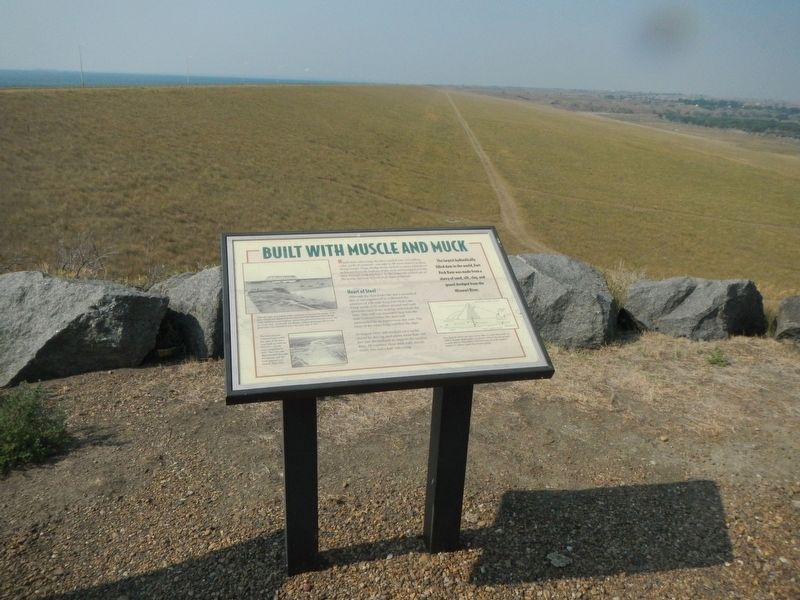
Photographed by Barry Swackhamer, August 26, 2020
2. Built with Muscle and Muck Marker
Credits. This page was last revised on June 28, 2026. It was originally submitted on December 8, 2020, by Barry Swackhamer of Brentwood, California. This page has been viewed 312 times since then and 34 times this year. Photos: 1, 2. submitted on December 8, 2020, by Barry Swackhamer of Brentwood, California.
