Near Hill City in Pennington County, South Dakota — The American Midwest (Upper Plains)
I've Been Working on the Railroad
Photographed by Cosmos Mariner, July 10, 2011
1. I've Been Working on the Railroad Marker
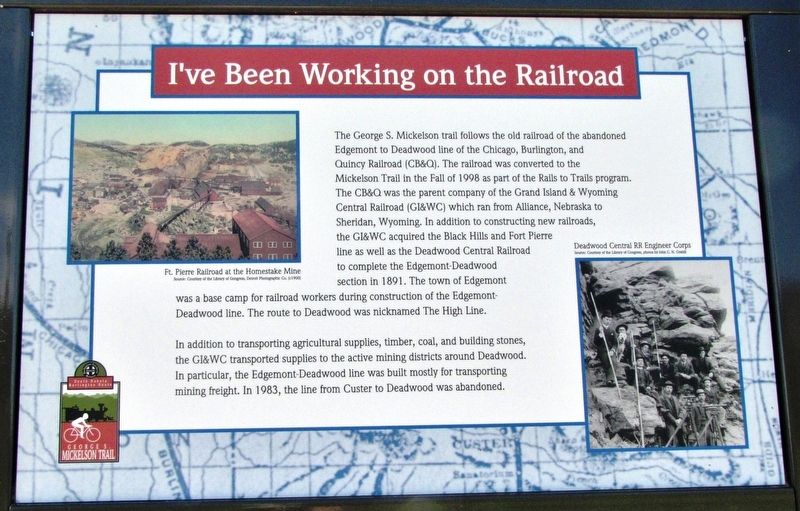
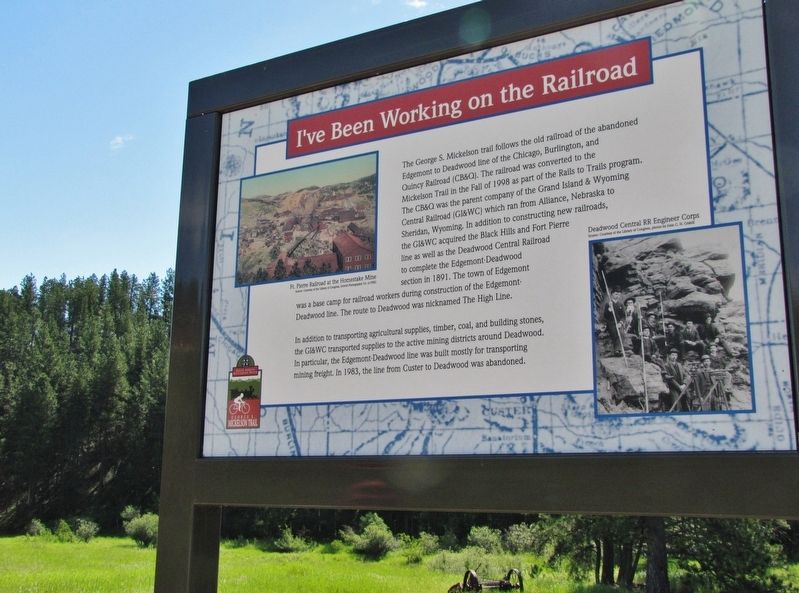
In addition to transporting agricultural supplies, timber, coal, and building stones, the GI&WC transported supplies to the active mining districts around Deadwood. In particular, the Edgemont-Deadwood line was built mostly for transporting mining freight. In 1983, the line from Custer to Deadwood was abandoned.
Topics. This historical marker is listed in these topic lists:
this page online
Location. 43° 54.696′ N, 103° 35.2′ W. Marker is near Hill City, South Dakota, in Pennington County. It can be reached from the intersection of U.S. 385 and Dead Broke Street, on the right when traveling north. Marker is located along the George S. Mickleson Trail Rail, 3/10 mile north of Dead Broke Street. Touch for map. Marker is in this post office area: Hill City SD 57745, United States of America. Touch for directions.

Regionally, this marker is in West River, in the Badlands, and in Greater Rapid City. It is also in the American Black Hills, in the Lewis & Clark Corridor, on the prairies, and on the Northern Plains. Globally, it is in North America, the Western Hemisphere, the Western World, and the Anglosphere. Historically, it finds itself in what was once Rupert’s Land and also the Louisiana Purchase.
Other nearby markers. At least 8 other markers are within 2 miles of this marker, measured as the crow flies: The Little White Church (approx. 1.2 miles away); Dreams Can Come True (approx. 1.3 miles away); Over a Century of Service
Courtesy Library of Congress, Detroit Photographic Co.
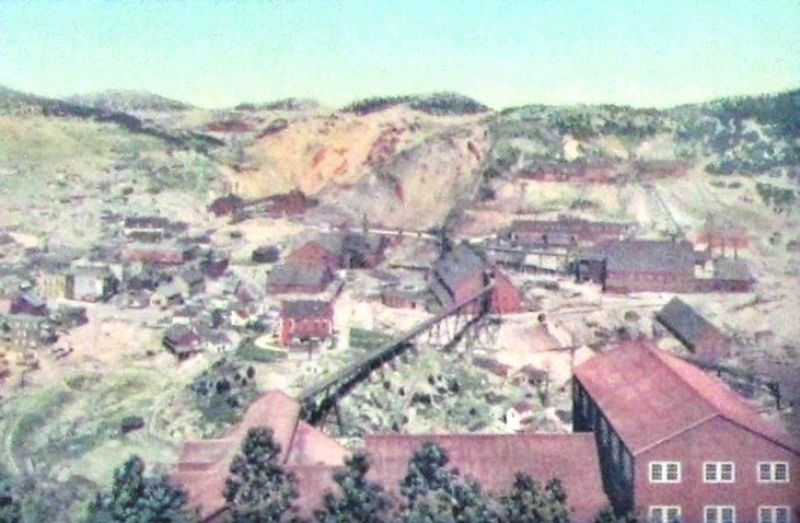
2. Marker detail: Ft. Pierre Railroad at the Homestake Mine, circa 1900
Also see . . .
1. George S. Mickelson Trail (Wikipedia). Nearly all of the trail follows the route of an abandoned railroad branch line constructed by the Chicago, Burlington and Quincy Railroad in 1890-91 and last operated by the Burlington Northern Railroad in 1986. The trail's route is mountainous, forested, and scenic, traversing the heart of the Black Hills and largely within the boundaries of the Black Hills National Forest. The first segment of the trail was opened in 1991, and the entire route was completed in 1998, and is the first rails to trails project in South Dakota. The trail is named after George S. Mickelson, the South Dakota governor who helped spearhead the project. (Submitted on December 18, 2020, by Cosmos Mariner of Cape Canaveral, Florida.)
2. Grand Island and Wyoming Central Railroad (Wikipedia).
Courtesy Library of Congress, by John C. H. Grabill
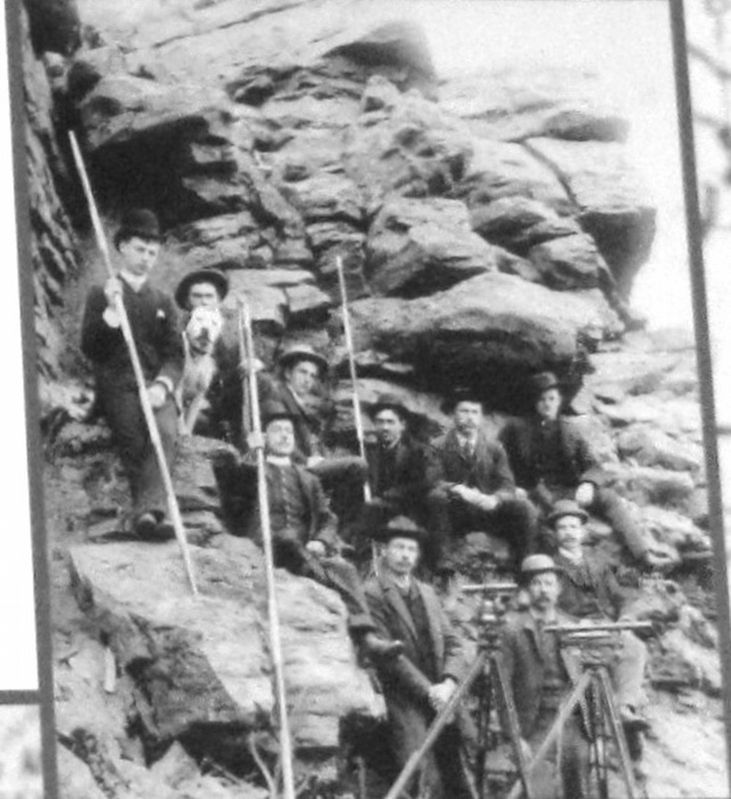
3. Marker detail: Deadwood Central RR Engineer Corps
Photographed by Cosmos Mariner, July 10, 2011
4. I've Been Working on the Railroad Marker
Credits. This page was last revised on December 18, 2020. It was originally submitted on December 18, 2020, by Cosmos Mariner of Cape Canaveral, Florida. This page has been viewed 567 times since then and 43 times this year. Photos: 1, 2, 3, 4. submitted on December 18, 2020, by Cosmos Mariner of Cape Canaveral, Florida.
