Near White Rock in Nelson County, Virginia — The American South (Mid-Atlantic)
Old Mountain Homesite
George Washington National Forest
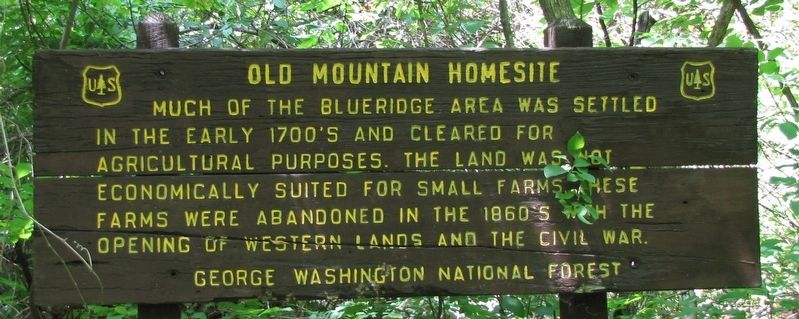
Photographed by Cosmos Mariner, August 2, 2011
1. Old Mountain Homesite Marker
Much of the Blueridge area was settled in the early 1700’s and cleared for agricultural purposes. The land was not economically suited for small farms. These farms were abandoned in the 1860’s with the opening of western lands and the Civil War.
Erected by Forest Service, U.S. Department of Agriculture.
Topics. This historical marker is listed in these topic lists: Parks & Recreational Areas • Settlements & Settlers • War, US Civil.
Location. 37° 53.777′ N, 79° 2.734′ W. Marker is near White Rock, Virginia, in Nelson County. It can be reached from Blue Ridge Parkway (at milepost 18.5). Marker is located on the White Rock Falls Trail, about one mile from the White Rock Gap Parking Area trailhead. Touch for map. Marker is in this post office area: Vesuvius VA 24483, United States of America. Touch for directions.

Regionally, this marker is in the Piedmont and in Central Virginia. It is also in the American South and specifically in the Upper South. Globally, it is in North America, the Western Hemisphere, the Western World, and the Anglosphere.
this page online
Other nearby markers. At least 8 other markers are within 9 miles of this marker, measured as the crow flies: 20-Minute Cliff (approx. half a mile away); Big Levels (approx. 6½ miles away); Stone Fences (approx. 7.3 miles away); Hurricane Camille (approx. 7.6 miles away); Christian Balsley (approx. 7.6 miles away); Old Providence Church (approx. 8.4 miles away); Thomas Massie (approx. 8.7 miles away); a different marker also named Hurricane Camille (approx. 8.7 miles away).
Also see . . . The Role of the Blue Ridge. In the 1730's-1750's, refugees from religious wars in Europe were able to enter the tolerant Quaker colony at Philadelphia, walk westward through the limestone valleys along modern-day US Route 30, and follow the Great Valley to enter Virginia from the north. That route avoided the climb up and over the mountains. Colonial settlers moved into Virginia counties by walking up the Shenandoah Valley. ("Up the valley"
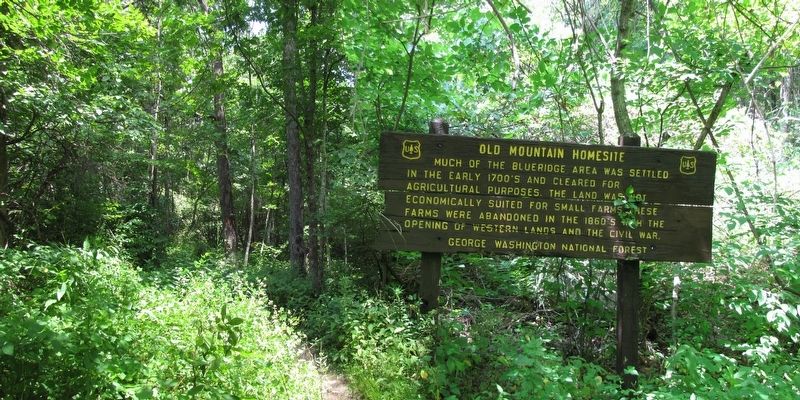
Photographed by Cosmos Mariner, August 2, 2011
2. Old Mountain Homesite Marker
Credits. This page was last revised on November 3, 2024. It was originally submitted on December 18, 2020, by Cosmos Mariner of Cape Canaveral, Florida. This page has been viewed 261 times since then and 24 times this year. Photos: 1, 2. submitted on December 18, 2020, by Cosmos Mariner of Cape Canaveral, Florida.
