Holt Cemetery
2
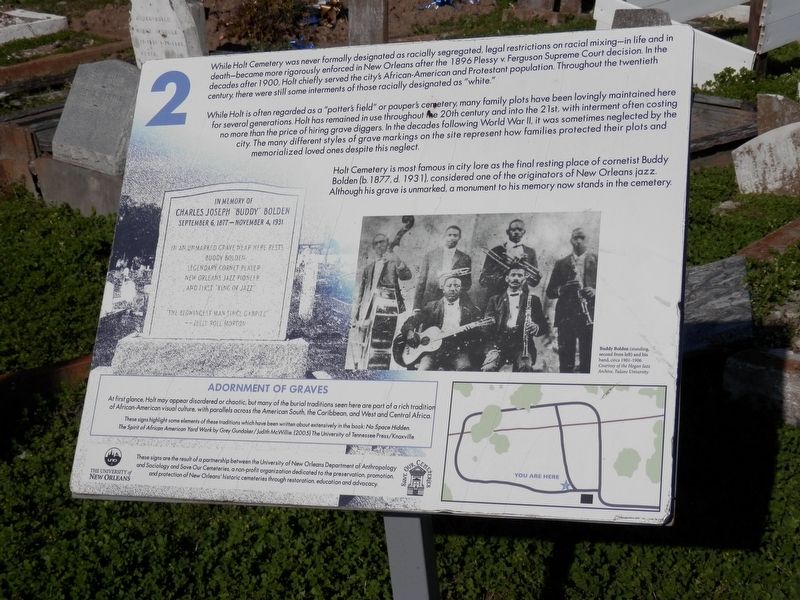
While Holt Cemetery was never formally designated as racially segregated, legal restrictions on racial mixing - in life and death - became more rigorously enforced in New Orleans after the 1896 Plessy v. Ferguson Supreme Court decision. In the decades after 1900, Holt chiefly served the city's African-American and Protestant population. Throughout the twentieth century, there were still some internments of those racially designated as "white".
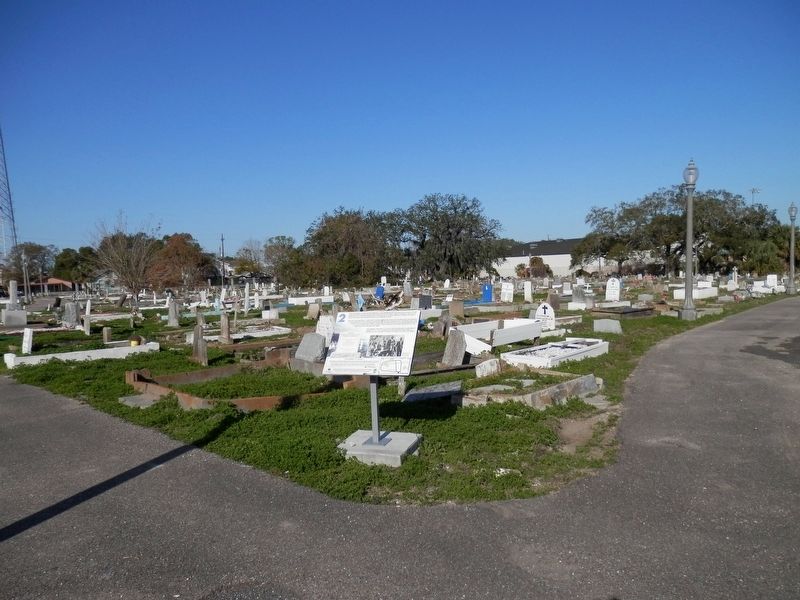
While Holt is often regarded as a "potter's field" or pauper's cemetery, many family plots have been lovingly maintained here for several generations. Holt has remained in use throughout the 20th century and into the 21st, with internment often costing no more than the price of hiring grave diggers, In the decades following World War II, it was sometimes neglected by the city. The many different styles of grave markings on the site represent how families protected their plots and memorialized loved ones despite this neglect.
Holt Cemetery is most famous in city lore as the final resting place of cornetist Buddy Bolden (b. 1877, d. 1931), considered one of the originators of New Orleans
this page online
Adornment of Graves
At first glance, holt may appear disordered or chaotic, but many of the burial traditions seen here are part of the rich tradition of African-American visual culture, with parallels across the American South, the Caribbean and West and Central Africa.
These signs are the result of a partnership between the University of New Orleans Department of Anthropology and Sociology and Save Our Cemeteries, a non-profit organization dedicated to the preservation, promotion and protection of New Orleans' historic cemeteries through restoration, education and advocacy.
Erected by University of New Orleans and Save Our Cemeteries. (Marker Number 2.)
Topics. This historical marker is listed in this topic list: Cemeteries & Burial Sites.
Location. 29° 59.076′ N, 90° 6.349′ W. Marker is in New Orleans, Louisiana, in Orleans Parish. It is in Navarre. It is on Buddy Bolden Place north of City Park Avenue when traveling north. Touch for map. Marker is at or near this postal address: 527 City

Regionally, this marker is in one of Louisiana’s River Parishes. It is also in the American South, specifically in the Deep South, on the Gulf Coast, and in the Great River Road Region. Globally, it is in North America, a Gulf of Mexico state, the Western Hemisphere, the Western World, and the Anglosphere. Historically, it finds itself in what was once New Spain, the Viceroyalty of New France, the territory of the Mississippian Culture, the Louisiana Purchase, one of the Confederate States of America, and the Antebellum South.
Other nearby markers. At least 8 other markers are within walking distance of this marker: A different marker also named Holt Cemetery (here, next to this marker); a different marker also named Holt Cemetery (within shouting distance of this marker); a different marker also named Holt Cemetery (within shouting distance of this marker); a different marker also named Holt Cemetery (within shouting distance of this marker); a different marker also named Holt Cemetery (within shouting distance of this marker); Site Of Higgins' Industries at Delgado Trade School (about 300 feet away, measured in a direct line); a different marker also named Holt Cemetery (about 400 feet away); Marvin E. Thames (about 600 feet away). Touch for a list and map of all markers in New Orleans.
Credits. This page was last revised on February 12, 2023. It was originally submitted on January 2, 2021, by Cajun Scrambler of Assumption, Louisiana. This page has been viewed 723 times since then and 62 times this year. Photos: 1, 2. submitted on January 2, 2021, by Cajun Scrambler of Assumption, Louisiana.
