Near Winchester in Frederick County, Virginia — The American South (Mid-Atlantic)
The Third Battle of Winchester
The Union Rear
Photographed by Craig Swain, August 26, 2007
1. The Third Battle of Winchester Marker
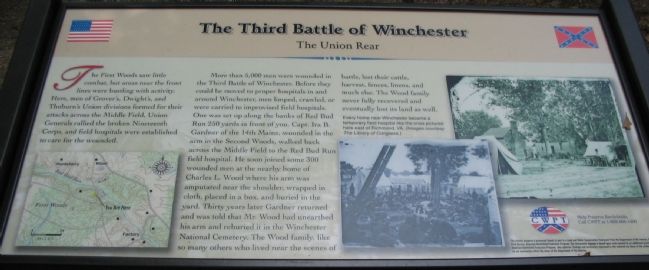
More than 5,000 men were wounded in the Third Battle of Winchester. Before they could be moved to proper hospitals in and around Winchester, men limped, crawled, or were carried to improvised field hospitals. One was set up along the banks of Red Bud Run 250 yards in front of you. Capt. Ira B. Gardner of the 14th Maine, wounded in the arm in the Second Woods, walked back across the Middle Field to the Red Bud Run field hospital. He soon joined some 300 wounded men at the nearby home of Charles L. Wood where his arm was amputated near the shoulder, wrapped in cloth, placed in a box, and buried in the yard. Thirty years later Gardner returned and was told Mr. Wood had unearthed his arm and reburied it in the Winchester National Cemetery. The Wood family, like so many others who lived near the scenes of
this page online
Erected by Civil War Preservation Trust.
Topics. This historical marker is listed in this topic list: War, US Civil.
Location. Marker has been reported permanently removed. It was located near 39° 11.76′ N, 78° 6.97′ W. Marker was near Winchester, Virginia, in Frederick County. It could be reached from Redbud Road, on the right when traveling east. Located at the Union Rear Wayside, along the Union Trail, inside the CWPT Third Winchester Battlefield site. The closest access site is a trail head on the west side of the Frederick County School complex parking lot. Touch for map. Marker was in this post office area: Winchester VA 22603, United States of America.
We have been informed that this marker is no longer there and will not be replaced. This page is an archival view of what was.
Regionally, this marker was in the Shenandoah Valley. It was also in the American South, specifically in the Upper South, and in the Mid-Atlantic.


2. Help Preserve 3rd Winchester
Details of CWPT efforts to save this battlefield.
Click for more information.
Click for more information.
Other nearby markers. At least 8 other markers are within walking distance of this location: Sheridan Moves To Battle (about 600 feet away); The Union Attacks (approx. 0.2 miles away); a different marker also named Third Battle of Winchester (approx. 0.2 miles away); a different marker also named The Third Battle of Winchester (approx. 0.3 miles away); Grover's Attack (approx. 0.3 miles away); Trying To Silence The Guns (approx. 0.4 miles away); Fury On The Fence Line (approx. 0.4 miles away); Ash Hollow (approx. 0.4 miles away). Touch for a list and map of all markers in Winchester.
Other markers no longer nearby. The Third Battle of Winchester (was about 500 feet away, measured in a direct line but has been permanently removed); a different marker also named The Third Battle of Winchester (was about 700 feet away but has been
Photographed by Craig Swain, August 26, 2007
3. Map of the Union Rear
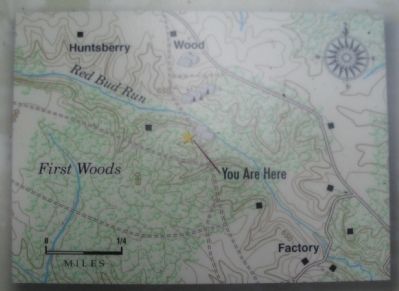
More about this marker. On the lower right of the marker is a map pointing out the location of the marker, with the location of the Wood house indicated. In the lower center and on the right are photographs showing a wartime field hospital, captioned "Every home near Winchester became a temporary field hospital like the ones pictured here east of Richmond, VA."
Photographed by Craig Swain, August 26, 2007
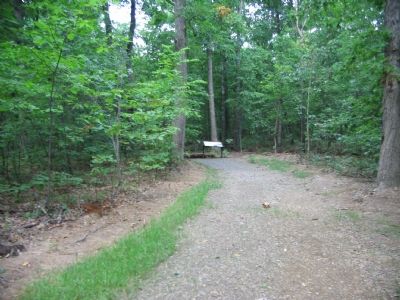
4. The Union Rear Wayside
Photographed by Craig Swain, August 26, 2007
5. The Historical Edge of the First Woods
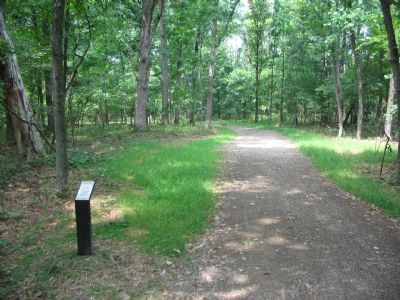
The sign indicates the historical west edge of the First Woods. The sign is about a quarter mile from the Union Rear marker, giving some appreciation for the distance casualties such as Captain Gardner had to travel before arriving at the field hospitals.
Credits. This page was last revised on January 28, 2021. It was originally submitted on October 27, 2007, by Craig Swain of Leesburg, Virginia. This page has been viewed 2,082 times since then and 22 times this year. Last updated on January 4, 2021, by Bradley Owen of Morgantown, West Virginia. Photos: 1. submitted on October 27, 2007, by Craig Swain of Leesburg, Virginia. 2. submitted on March 13, 2009, by Craig Swain of Leesburg, Virginia. 3, 4, 5. submitted on October 27, 2007, by Craig Swain of Leesburg, Virginia. • J. Makali Bruton was the editor who published this page.
