A Landscape Changed Forever
Some called it "The Great American Desert"
| — | Scotts Bluff National Monument, National Park Service, U.S. Department of the Interior | — |
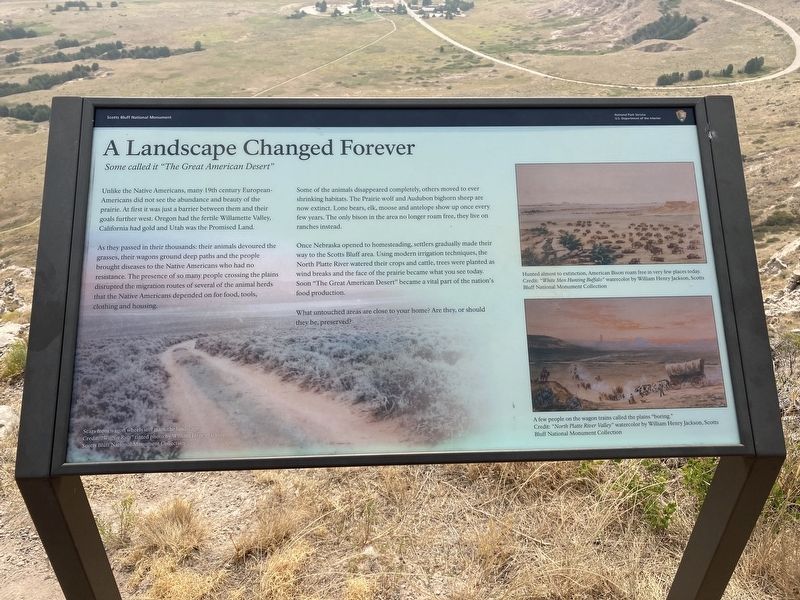
Unlike the Native Americans, many 19th century European-Americans did not see the abundance and beauty of the prairie. At first it was just a barrier between them and their goals further west. Oregon had the fertile Willamette Valley, California had gold and Utah was the Promised Land.
As they passed in their thousands: their animals devoured the grasses, their wagons ground deep paths and the people brought diseases to the Native Americans who had no resistance. The presence of so many people crossing the plains disrupted the migration routes of several of the animal herds that the Native Americans depended on for food, tools, clothing and housing.
Some of the animals disappeared completely, others moved to ever shrinking habitats. The Prairie wolf and Audubon bighorn sheep are now extinct. Lone bears, elk, moose and antelope show up once every few years. The only bison in the area no longer roam free, they live on ranches instead.
Once Nebraska opened to homesteading, settlers gradually made their way to the Scotts Bluff area. Using modern irrigation techniques, the North Platte River watered their crops and
this page online
What untouched areas are close to your home? Are they, or should they be, preserved?
[Captions:]
Scars from wagon wheels still mark the landscape.
Hunted almost to extinction, American Bison roam free in very few places today.
A few people on the wagon trains called the plains "boring."
Erected by National Park Service, U.S. Department of the Interior.
Topics. This historical marker is listed in these topic lists: Indigenous Peoples and Communities • Parks & Recreational Areas • Settlements & Settlers.
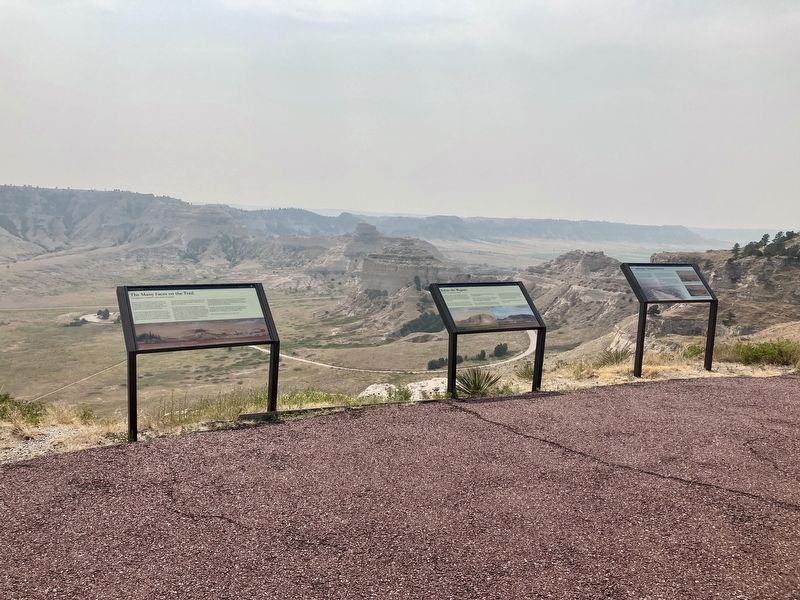
Location. 41° 50.091′ N, 103° 41.981′ W. Marker is near Gering, Nebraska, in Scotts Bluff County. It can be reached from Old Oregon Trail Road (County Road K) 3 miles west of Meadowlark Boulevard, on the right when traveling west. The marker is located at the South Overlook. Touch for map. Marker is at or near this postal address: 190276 Old Oregon Trail Road, Gering

Regionally, this marker is in the Nebraska Panhandle. It is also in the American Midwest, in the Corn Belt, and on the prairies. Globally, it is in North America, the Western Hemisphere, the Western World, and the Anglosphere. Historically, it finds itself in what was once the Louisiana Purchase.
Other nearby markers. At least 8 other markers are within walking distance of this marker: Before the Wagons (here, next to this marker); The Many Faces of the Trail (a few steps from this marker); Remnant Highlands (within shouting distance of this marker); A Landmark for the Ages (approx. 0.2 miles away); Saddle Rock Trail (approx. 0.2 miles away); Eroding Landmark (approx. ¼ mile away); Scott Memorial (approx. ¼ mile away); The Way West (approx. 0.4 miles away). Touch for a list and map of all markers in Gering.
Other markers no longer nearby. Pony Express (was here, next to this marker but has been permanently removed); The Overland Experience (was here, next to this marker but has been permanently removed); Scotts Bluff (was here, next to this marker but has been permanently removed).
Credits. This page was last revised on January 6, 2021. It was originally submitted on January 5, 2021, by Connor Olson of Menomonee Falls, Wisconsin. This page has been viewed 389 times since then and 23 times this year. Photos: 1, 2. submitted on January 5, 2021, by Connor Olson of Menomonee Falls, Wisconsin. • Devry Becker Jones was the editor who published this page.
