Holt Cemetery
4
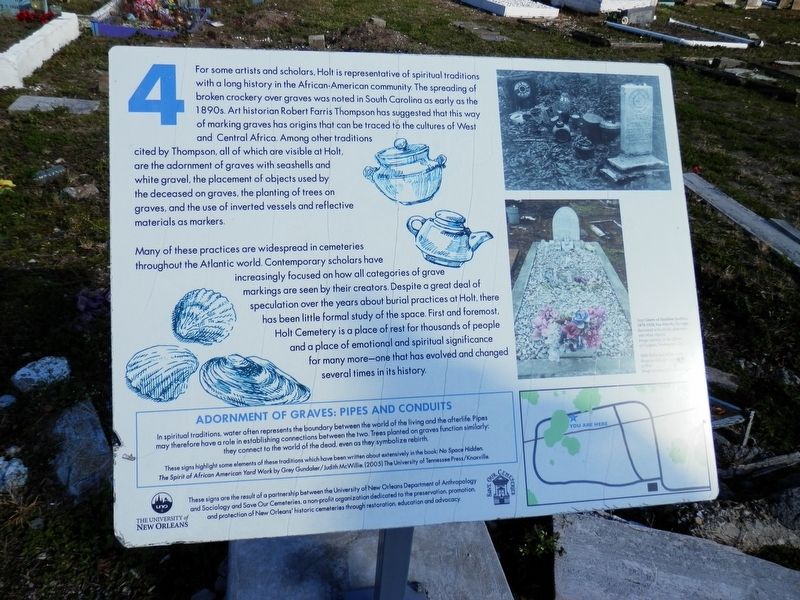
For some artists and scholars, Holt is representative of spiritual traditions with a long history in the African-American community. The spreading of broken crockery over graves was noted in South Carolina as early as the 1890s. Art historian Robert Farris Thompson has suggested that this way of marking graves has origins that can be traced to the cultures of West and Central Africa. Among other traditions cited by Thompson, all of which are visible at Holt, are the adornment of graves with seashells and white gravel, the placement of objects used by the deceased on graves, the planting of trees on graves, and the use of inverted vessels and reflective materials as markers.
Many of these practices are widespread in cemeteries throughout the Atlantic world. Contemporary scholars have increasingly focused on how all categories of grave markings are seen by their creators. Despite a great deal of speculation over the years about burial practices at Holt, there has been little formal study of the space. First and foremost, Holt Cemetery is a place of rest for thousands of people and a place of emotional and
this page online
Adornment Of Graves: Pipes And Conduits
In spiritual traditions, water often represents the boundary between the world of the living and the afterlife. Pipes
may therefore have a role in establishing connections between the two. Trees planted on graves function similarly:
they connect to the world of the dead, even as they symbolize rebirth.
These signs highlight some elements of these traditions which have been written about extensively in the book; No Space Hidden.
The Spirit of African American Yard Work by Grey Gundaker/Judith McWillie. (2005) The University of Tennessee Press/Knoxville.
These signs are the result of a partnership between the University of New Orleans Department of Anthropology
and Sociology and Save Our Cemeteries, a non-profit organization dedicated to the preservation, promotion,
and protection of New Orleans' historic cemeteries through restoration, education and advocacy.
Erected by University of New Orleans and Save Our Cemeteries. (Marker Number 4.)
Topics. This historical marker is listed
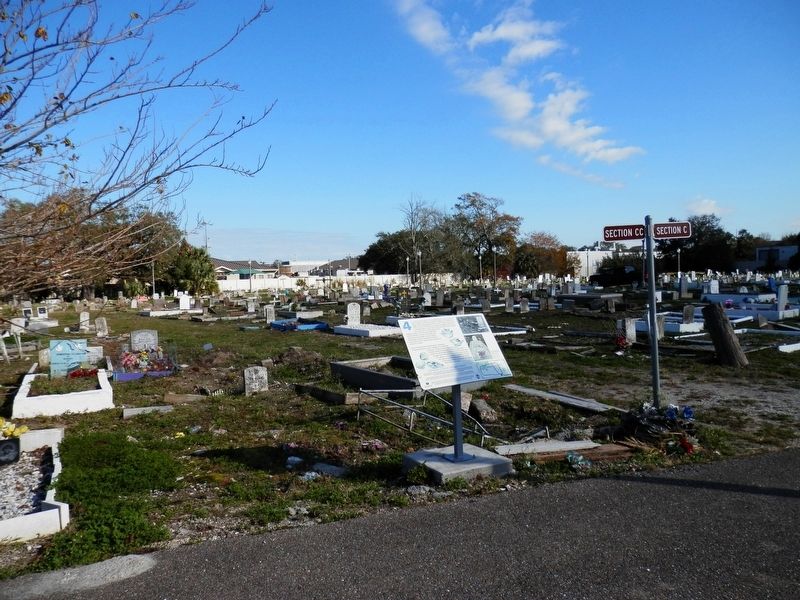
Location. 29° 59.08′ N, 90° 6.395′ W. Marker is in New Orleans, Louisiana, in Orleans Parish. It is in Navarre. It can be reached from Buddy Bolden Place north of City Park Avenue. Touch for map. Marker is at or near this postal address: 635 City Park Avenue, New Orleans LA 70119, United States of America. Touch for directions.

Regionally, this marker is in one of Louisiana’s River Parishes. It is also in the American South, specifically in the Deep South, on the Gulf Coast, and in the Great River Road Region. Globally, it is in North America, a Gulf of Mexico state, the Western Hemisphere, the Western World, and the Anglosphere. Historically, it finds itself in what was once New Spain, the Viceroyalty of New France, the territory of the Mississippian Culture, the Louisiana Purchase, one of the Confederate States of America, and the Antebellum South.
Other nearby markers. At least 8 other markers are within walking distance of this marker: A different marker also named Holt Cemetery (within shouting distance of this marker); a different marker also named Holt Cemetery (within shouting distance of this marker); a different marker also named Holt Cemetery (within shouting distance of this marker); a different marker also named Holt Cemetery (within shouting distance of this marker); a different marker also named Holt Cemetery (about 300 feet away, measured in a direct line); Site Of Higgins' Industries at Delgado Trade School (about 400 feet away); a different marker also named Holt Cemetery (about 400 feet away); Marvin E. Thames (about 700 feet away). Touch for a list and map of all markers in New Orleans.
More about this marker. Located in the cemetery, accessible sun up to sun down.
Credits. This page was last revised on February 12, 2023. It was originally submitted on January 8, 2021, by Cajun Scrambler of Assumption, Louisiana. This page has been viewed 336 times since then and 20 times this year. Photos: 1, 2. submitted on January 8, 2021, by Cajun Scrambler of Assumption, Louisiana.
