
Naples in Collier County, Florida — The American South (South Atlantic)
Landmark Cypress № 4 — "Roosevelt"
Corkscrew Swamp Sanctuary

Photographed by Cosmos Mariner, March 4, 2015
1. Landmark Cypress № 4 — "Roosevelt" Marker
He was a member of Florida Audubon during the nationwide campaign to end plume hunting. Protecting birds from plume hunters sparked the creation of the first Audubon Societies.
The Roosevelt tree stands near the edge of the horseshoe marsh. Its edge position gives it additional afternoon sunlight, but it also endures direct gusts from South Florida's powerful storms. This explains the ladder of lower branches on the west-facing trunk and is the cause of the main trunk splitting long ago into three sub-trunks reaching ever skyward. A ring of ferns adorns its broad buttressing base, as resurrection ferns blanket the largest of the lateral branches. Look closely and you can see mats of orchids populating these same branches.
Topics and series. This historical marker is listed in these topic lists: Environment • Horticulture & Forestry • Parks & Recreational Areas. In addition, it is included in the Former U.S. Presidents: #26 Theodore Roosevelt,
this page online
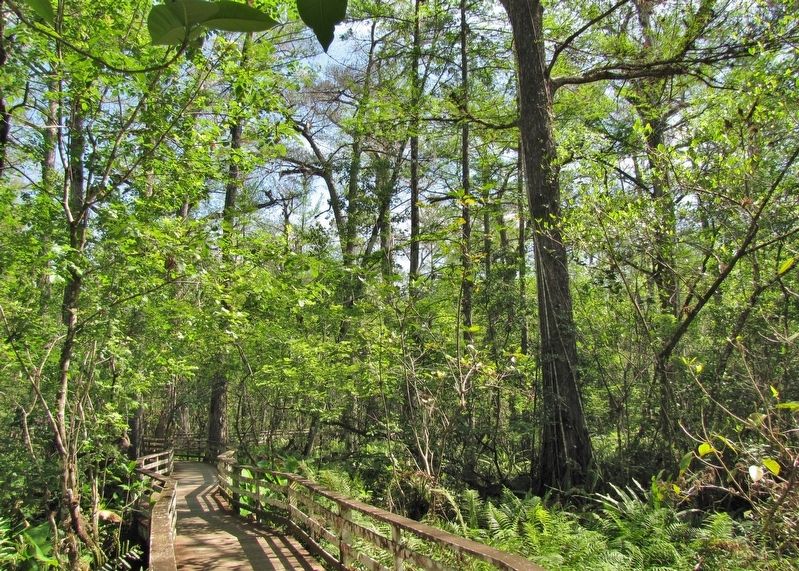
Location. 26° 22.315′ N, 81° 36.678′ W. Marker is in Naples, Florida, in Collier County. It can be reached from the intersection of Sanctuary Road West and Rookery Lane. Marker and subject tree are located along the cypress swamp boardwalk in Corkscrew Swamp Sanctuary. Touch for map. Marker is at or near this postal address: 375 Sanctuary Road West, Naples FL 34120, United States of America. Touch for directions.

Regionally, this marker is on Florida’s Gulf Coast. It is also in the American South and on the Gulf Coast. Globally, it is in the North Atlantic Region, North America, a Gulf of Mexico state, the Western Hemisphere, the Western World, and the Anglosphere. Historically, it finds itself in what was once New Spain, the territory of the Mississippian Culture, one of the Confederate States of America, and the Antebellum South.
Other nearby markers. At least 8 other markers are within walking distance of this marker: Landmark Cypress № 6 — "Guy Bradley" (within shouting distance of this marker); Landmark Cypress № 7 — "Rhett Green"
Photographed by Cosmos Mariner, February 22, 2012
2. Landmark Cypress № 4 — "Roosevelt" (on right)
Related markers. Click here for a list of markers that are related to this marker. Corkscrew Swamp Sanctuary
Also see . . .
1. Public Lands Established by Theodore Roosevelt. The conservation legacy of Theodore Roosevelt is found in the 230 million acres of public lands he helped establish during his presidency. Much of that land - 150 million acres - was set aside as national forests. Roosevelt created the present-day USFS in 1905, an organization within the Department of Agriculture. Roosevelt was also the first president to create a Federal Bird Reserve, and he would establish 51 of these during his administration. (Submitted on January 18, 2021, by Cosmos Mariner of Cape Canaveral, Florida.)
2. A Brief History of Corkscrew Swamp. Up until the early 1900's few people outside of southern Florida had ever heard of Corkscrew. It was around this period when egret and heron plumes were in high demand for use in the fashion industry. Plume hunters could make a fortune in a well timed weekend hunt, and were quickly devastating rookeries throughout Florida and in the southeastern United States. The rookery at Corkscrew was among those targeted. (Submitted on January 18, 2021, by Cosmos Mariner of Cape Canaveral, Florida.)
3. About Corkscrew's Boardwalk. A 2.25-mile boardwalk meanders through pine flatwood, wet prairie, around a marsh, and finally into the largest old-growth bald cypress forest in North America. These impressive trees, relatives of the redwood, tower 130 feet into the sky and have a girth of 25 feet. Their massive branches are draped with mosses, lichens, bromeliads, and ferns. (Submitted on January 18, 2021, by Cosmos Mariner of Cape Canaveral, Florida.)
Credits. This page was last revised on January 18, 2021. It was originally submitted on January 18, 2021, by Cosmos Mariner of Cape Canaveral, Florida. This page has been viewed 304 times since then and 25 times this year. Photos: 1, 2. submitted on January 18, 2021, by Cosmos Mariner of Cape Canaveral, Florida.
