Dollars from Decoys
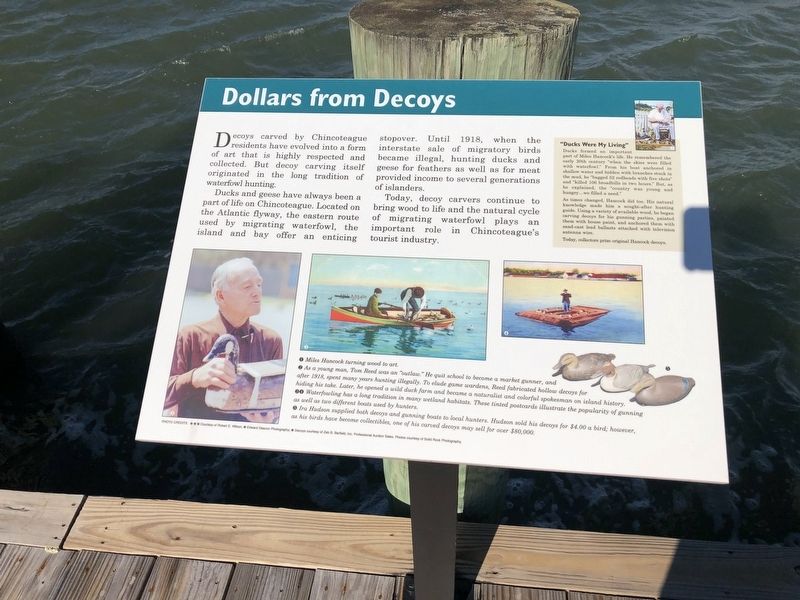
Decoys carved by Chincoteague residents have evolved into a form of art that is highly respected and collected. But decoy carving itself originated in the long tradition of waterfowl hunting.
Ducks and geese have always been a part of life on Chincoteague. Located on the Atlantic flyway, the eastern route used by migrating waterfowl, the island and bay offer an enticing stopover. Until 1918, when the interstate sale of migratory birds became illegal, hunting ducks and geese for feathers as well as for meat provided income to several generations of islanders.
Today, decoy carvers continue to bring wood to life and the natural cycle of migrating waterfowl plays an important role in Chincoteague's tourist industry.
[Sidebar:]
"Ducks Were My Living"
Ducks formed an important part of Miles Hancock's life. He remembered early 20th century "when the skies were filled with waterfowl." From his boat anchored in shallow and hidden with branches stuck in the mud, he "bagged 52 redheads with five shots" and "killed 106 broadbills in two hours." But, as he explained, the country was young and hungry…we filled a need."
As times changed, Hancock did too. His natural knowledge made him a sought-after hunting guide. Using a variety of available wood, he began carving decoys for his gunning parties, painted them with house paint, and anchored them with sand-cast lead ballasts attached with television antenna wire.
Today, collectors prize original Hancock decoys.
[Captions:]
Miles Hancock turning wood to art.
As a young man, Tom Reed was an "outlaw." He quit school to become a market gunner, and after 1918, spent many years hunting illegally. To elude game wardens, Reed fabricated hollow decoys for hiding his take. Later, he opened a wild duck farm and became a naturalist and colorful spokesman on island history.
Waterfowling has a long tradition in many wetland habitats. These tinted postcards illustrate the popularity of gunning as well as two different boats used by hunters.
Ira Hudson supplied both decoys and gunning boats to local hunters. Hudson sold his decoys for $4.00 a bird; however, as his birds have become collectibles, one of his carved decoys may sell for over $80,000.
Topics.
this page online
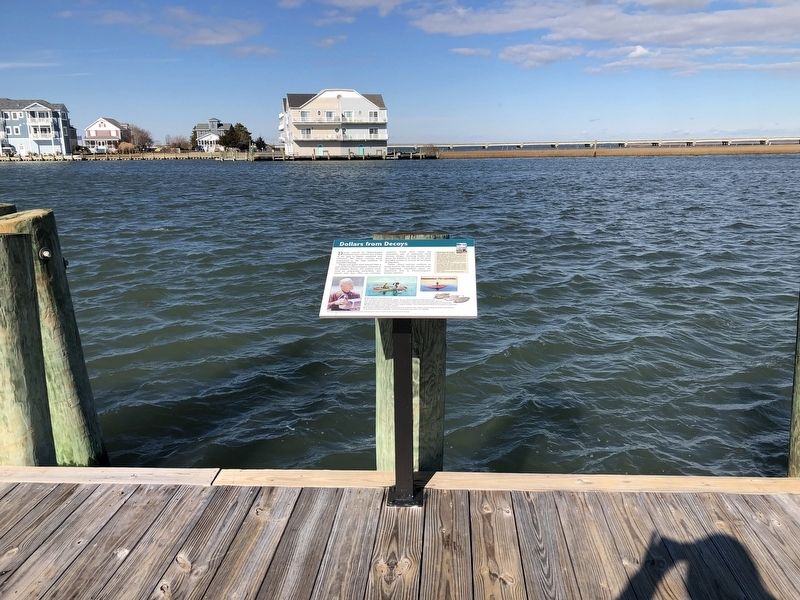
Location. 37° 56.095′ N, 75° 22.615′ W. Marker is in Chincoteague, Virginia, in Accomack County. It is on Main Street just west of Post Office Street, on the right when traveling west. Touch for map. Marker is at or near this postal address: 4095 Main St, Chincoteague Island VA 23336, United States of America. Touch for directions.

Regionally, this marker is on the Eastern Shore. It is also in the American South, specifically in the Upper South, on the Delmarva Peninsula, in the Tidewater, and on the Eastern Seaboard. Globally, it is in the North Atlantic Region, North America, the Western Hemisphere, the Western World, and the Anglosphere. Historically, it finds itself in what was once the territory of the Mississippian Culture, one of the original Thirteen Colonies, one of the Confederate States of America, and the Antebellum South.
Other nearby markers. At least 8 other markers are within walking distance of this marker: Fish So Fine
Credits. This page was last revised on January 19, 2021. It was originally submitted on January 19, 2021, by Devry Becker Jones of Washington, District of Columbia. This page has been viewed 434 times since then and 23 times this year. Photos: 1, 2. submitted on January 19, 2021, by Devry Becker Jones of Washington, District of Columbia.
