Lochhaven in Norfolk, Virginia — The American South (Mid-Atlantic)
The Norfolk Facility
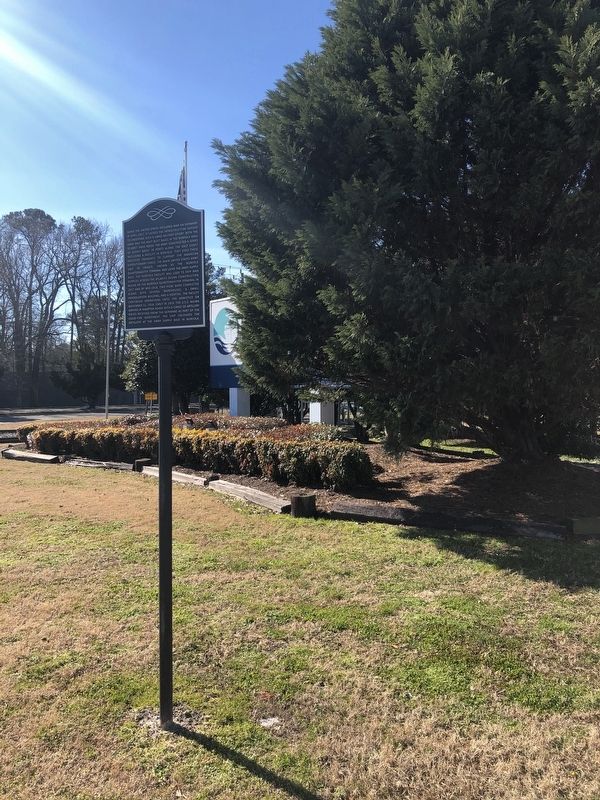
Photographed by Devry Becker Jones (CC0), January 30, 2021
1. The Norfolk Facility Marker
Inscription.
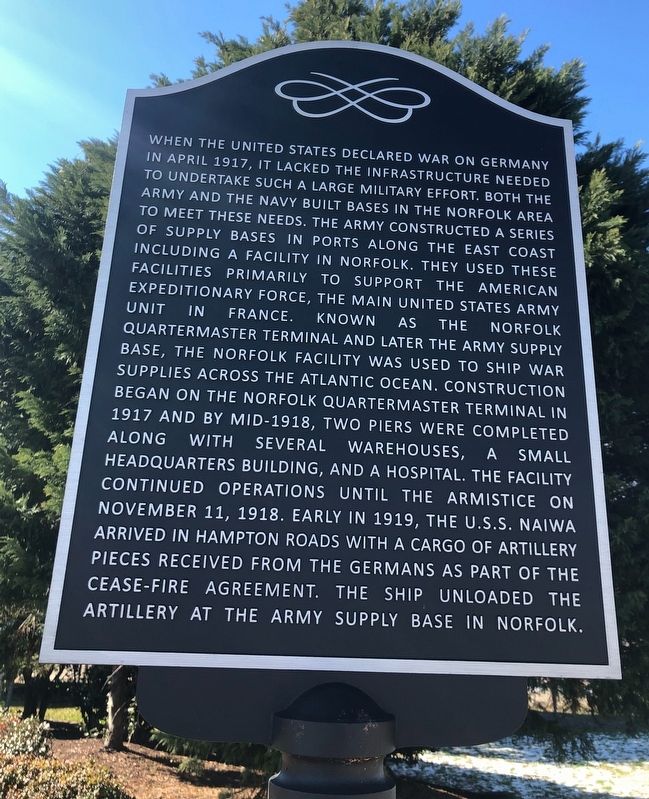
The Norfolk Facility. . When the United States declared war on Germany in April 1917, it lacked the infrastructure needed to undertake such a large military effort. Both the Army and the Navy built bases in the Norfolk area to meet these needs. The Army constructed a series of supply bases in ports along the East Coast including a facility in Norfolk. They used these facilities primarily to support the American Expeditionary Force, the main United States Army unit in France. Known as the Norfolk Quartermaster Terminal and later the Army Supply Base, the Norfolk facility was sued to ship war supplies across the Atlantic Ocean. Construction began on the Norfolk Quartermaster terminal in 1917 and by mid-1918, two piers were completed along with several warehouses, a small headquarters building, and a hospital. The facility continued operations until the armistice on November 11, 1918. Early in 1919, the U.S.S. Naiwa arrived in Hampton Roads with a cargo of artillery pieces received from the Germans as part of the cease-fire agreement. The ship unloaded the artillery at the Army Supply Base in Norfolk.
When the United States declared war on Germany in April 1917, it lacked the infrastructure needed to undertake such a large military effort. Both the Army and the Navy built bases in the Norfolk area to meet these needs. The Army constructed a series of supply bases in ports along the East Coast including a facility in Norfolk. They used these facilities primarily to support the American Expeditionary Force, the main United States Army unit in France. Known as the Norfolk Quartermaster Terminal and later the Army Supply Base, the Norfolk facility was sued to ship war supplies across the Atlantic Ocean. Construction began on the Norfolk Quartermaster terminal in 1917 and by mid-1918, two piers were completed along with several warehouses, a small headquarters building, and a hospital. The facility continued operations until the armistice on November 11, 1918. Early in 1919, the U.S.S. Naiwa arrived in Hampton Roads with a cargo of artillery pieces received from the Germans as part of the cease-fire agreement. The ship unloaded the artillery at the Army Supply Base in Norfolk.
Location. 36° 55.073′ N, 76° 18.643′ W. Marker is in Norfolk, Virginia. It is in Lochhaven. It is at the intersection of Hampton Boulevard (Route 337) and Terminal Boulevard, on the right when traveling south on Hampton Boulevard. Touch for map. Marker is at or near this postal address: 7814 Hampton Blvd, Norfolk VA 23511, United States of America. Touch for directions.
Regionally, this marker is in Virginia’s Hampton Roads, specifically in Coastal Virginia, and in the Hampton Roads Metropolitan Area. It is also in the American South, specifically in the Upper South, in the Tidewater, and on the Eastern Seaboard. Globally, it is in the North Atlantic Region, North America, the Western Hemisphere, the Western World, and the Anglosphere. Historically, it finds itself in what was once the territory of the Mississippian Culture, one of the original Thirteen Colonies, one of the Confederate States of America, and the Antebellum South.
Other nearby markers. At least 8 other markers are
Photographed by Devry Becker Jones (CC0), January 30, 2021
Credits. This page was last revised on February 1, 2023. It was originally submitted on January 31, 2021, by Devry Becker Jones of Washington, District of Columbia. This page has been viewed 683 times since then and 69 times this year. Photos:1, 2. submitted on January 31, 2021, by Devry Becker Jones of Washington, District of Columbia.