The TVA System of Multi-Purpose Dams
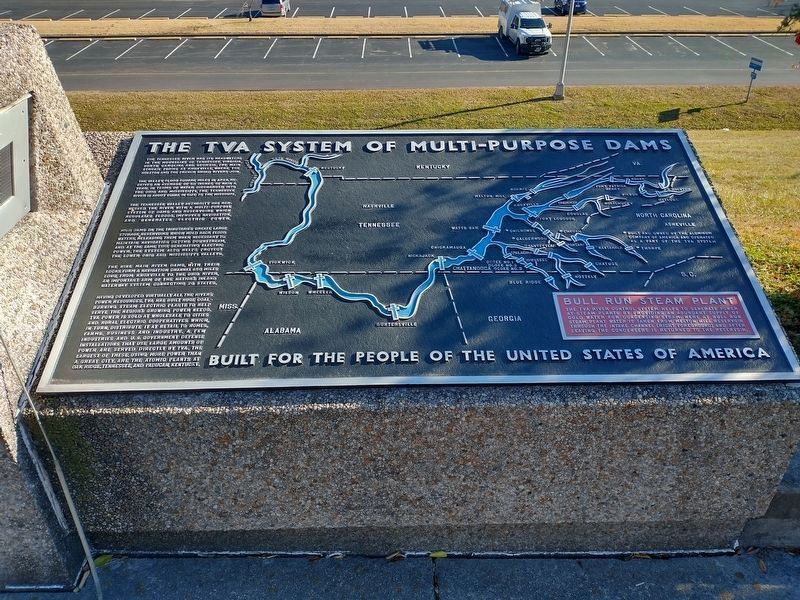
The Tennessee River has its headwaters in the mountains of Tennessee, Virginia, North Carolina, and Georgia. The main stream forms at Knoxville, where the Holston and the French Broad Rivers join.
The Valley, 41,000 square miles in area, receives an average of 52 inches of rain a year. In terms of water discharged into the Ohio and Mississippi, the Tennessee River is about equal in size to the Missouri.
The Tennessee Valley Authority has harnessed the river with a multi-purpose system of dams and reservoirs which regulates floods, improves navigation, ad generates electric power.
High dams on the tributaries create large storage reservoirs which hold back flood waters, releasing them when necessary to maintain navigation depths downstream, ad at the same time generating electric power. The system also helps protect the lower Ohio and Mississippi Valleys.
The nine main river dams, with their locks, form a navigation channel 650 miles long, from Knoxville to the Ohio River, an important arm of the nation’s inland waterway system connecting 20 states.
Having developed virtually all the river’s power resources,
this page online
[Sidebar:]
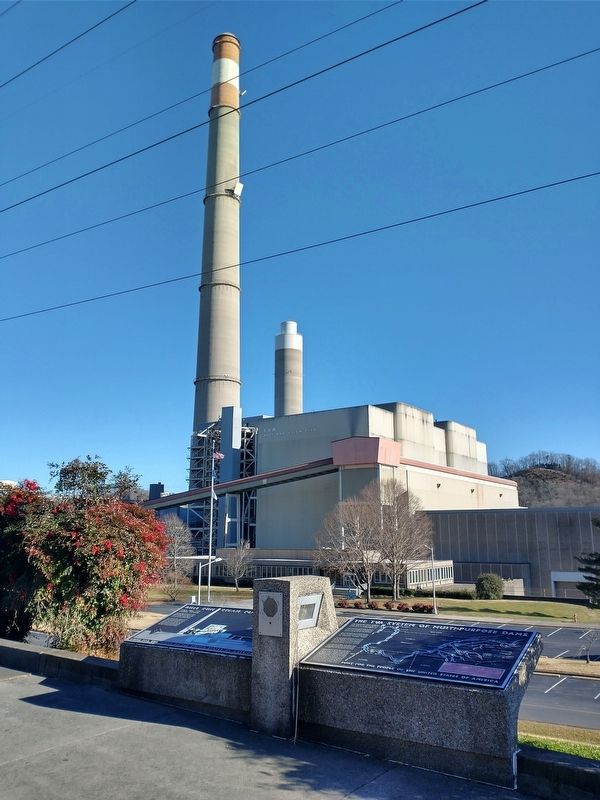
Bull Run Steam Plant. The TVA River Control System helps to generate power at steam plants by providing an abundant supply of cold water for condensing steam. Here at Bull Run Steam Plant water is taken from Melton Hill Reservoir through the intake channel (right foreground) and after leaving the condensers is returned to the reservoir.
Topics. This historical marker is listed in these topic lists: Charity & Public Work • Industry & Commerce • Waterways & Vessels.
Location. 36° 1.292′ N, 84° 9.552′ W. Marker is in Clinton, Tennessee, in Anderson County. It is on Edgemoor

Regionally, this marker is in East Tennessee and in Greater Knoxville. It is also in the American South, specifically in the Upper South, in Appalachia, and specifically in Southern Appalachia. Globally, it is in North America, the Western Hemisphere, the Western World, and the Anglosphere. Historically, it finds itself in what was once the original Cherokee Nation, the territory of the Mississippian Culture, one of the Confederate States of America, and the Antebellum South.
Other nearby markers. At least 8 other markers are within 5 miles of this marker, measured as the crow flies: Bull Run Steam Plant (here, next to this marker); David Hall Cabin (approx. 1.2 miles away); The Anderson County Poor Farm (approx. 2 miles away); Elza Gate (approx. 3.2 miles away); a different marker also named Elza Gate (approx. 3.2 miles away); Oak Ridge (approx. 4 miles away); Byington (approx. 4.3 miles away); The Scarboro Community (approx. 4.3 miles away). Touch for a list and map of all markers in Clinton.
Credits. This page was last revised on February 1, 2021. It was originally submitted on February 1, 2021, by Tom Bosse of Jefferson City, Tennessee. This page has been viewed 395 times since then and 36 times this year. Photos: 1, 2. submitted on January 31, 2021, by Tom Bosse of Jefferson City, Tennessee. • Devry Becker Jones was the editor who published this page.
Editor’s want-list for this marker. A wide shot of the marker in context. • Can you help?
