San Benito in Cameron County, Texas — The American South (West South Central)
Getsemani Presbyterian Church
Photographed by James Hulse, January 27, 2021
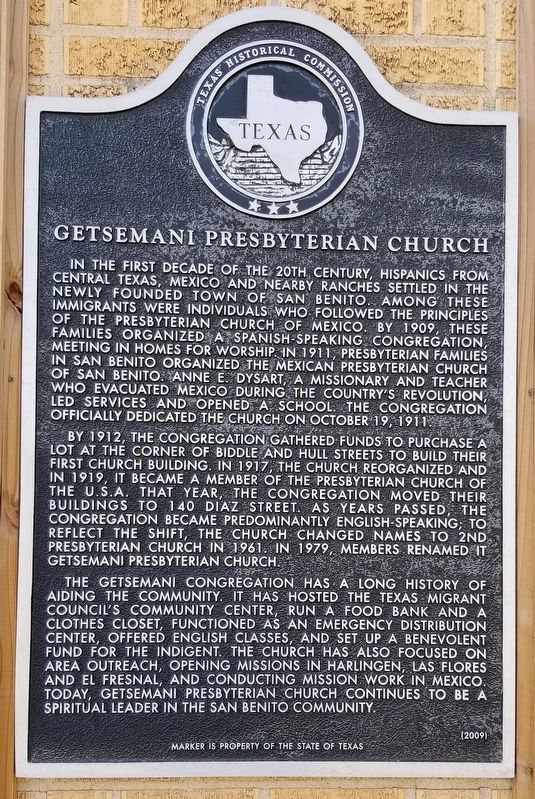
1. Getsemani Presbyterian Church Marker
In the first decade of the 20th century, Hispanics from central Texas, Mexico and nearby ranches settled in the newly founded town of San Benito. Among these immigrants were individuals who followed the principles of the Presbyterian Church of Mexico. By 1909, these families organized a Spanish speaking congregation, meeting in homes for worship. In 1911, Presbyterian families in San Benito organized the Mexican Presbyterian Church of San Benito. Anne E. Dysart, a missionary and teacher who evacuated Mexico during the country's revolution, led services and opened a school. The congregation officially dedicated the church on October 19, 1911.
By 1912, the congregation gathered funds to purchase a lot at the corner of Biddle and Hull Streets to build their first church building. In 1917, the church reorganized and in 1919, it became a member of the Presbyterian Church of the U.S.A. that year, the congregation moved their buildings to 140 Diaz Street. As years passed, the congregation became predominantly english-speaking; to reflect the shift, the church changed names to 2nd Presbyterian Church in 1961. In 1979, members renamed it Getsemani Presbyterian Church.
The Getsemani congregation has a long history of aiding the community. It has hosted the Texas Migrant Council's Community Center, run a food bank and a clothes closet, functioned as an emergency distribution center, offered english classes, and set up a benevolent fund for the indigent. The church has also focused on area outreach, opening missions in Harlingen, Las Flores and El Fresnal and conducting mission work in Mexico. Today, Getsemani Presbyterian Church continues to be a spiritual leader in the San Benito community.
Erected 2009 by Texas Historical Commission. (Marker Number 16022.)
Topics. This historical marker is listed
this page online
Location. 26° 8.099′ N, 97° 38.192′ W. Marker is in San Benito, Texas, in Cameron County. It is at the intersection of Diaz Street and Montezuma Street, on the left when traveling north on Diaz Street. Touch for map. Marker is in this post office area: San Benito TX 78586, United States of America. Touch for directions.

Regionally, this marker is in South Texas. It is also in the American Borderlands, in the South, and on the Gulf Coast. Globally, it is in North America, a Gulf of Mexico state, the Western Hemisphere, the Western World, and the Anglosphere. Historically, it finds itself in what was once New Spain, the Republic of Texas, and one of the Confederate States of America.
Other nearby markers. At least 8 other markers are within walking distance of this marker: Baldemar "Freddy Fender" Garza Huerta (approx. 0.2 miles away); St. Benedict’s Church (approx. 0.3 miles away); The San Benito Bank and Trust Company (approx. 0.4 miles away); Water District Building (approx. 0.4 miles away);

Photographed by James Hulse, January 27, 2021
2. Getsemani Presbyterian Church and Marker
Also see . . . Getsemani. is a garden at the foot of the Mount of Olives in Jerusalem where, according to the four Gospels of the New Testament, Jesus underwent the agony in the garden and was arrested the night before his crucifixion. It is a place of great resonance in Christianity. There are several small olive groves in church property, all adjacent to each other and identified with biblical Gethsemane. Source: Wikipedia (Submitted on February 5, 2021, by James Hulse of Medina, Texas.)
Photographed by James Hulse, January 27, 2021
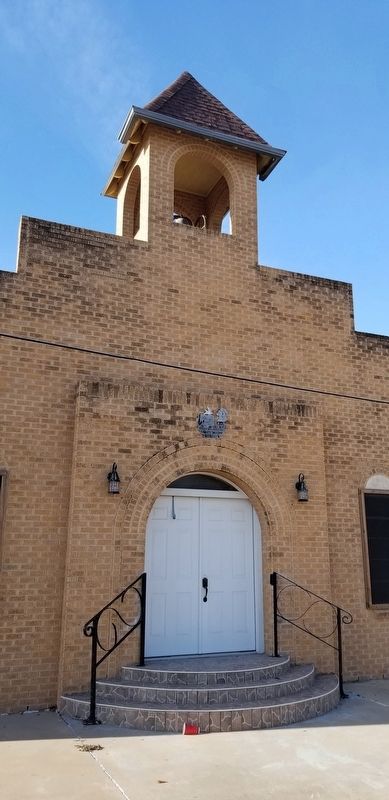
3. The front entrance to the Getsemani Presbyterian Church
Credits. This page was last revised on March 17, 2026. It was originally submitted on February 4, 2021, by James Hulse of Medina, Texas. This page has been viewed 459 times since then and 27 times this year. Photos: 1, 2, 3. submitted on February 5, 2021, by James Hulse of Medina, Texas. • J. Makali Bruton was the editor who published this page.
