Joliet in Will County, Illinois — The American Midwest (Great Lakes)
Hickory Creek in the 1830's
Photographed by Jason Voigt, September 30, 2020
1. Hickory Creek in the 1830's Marker
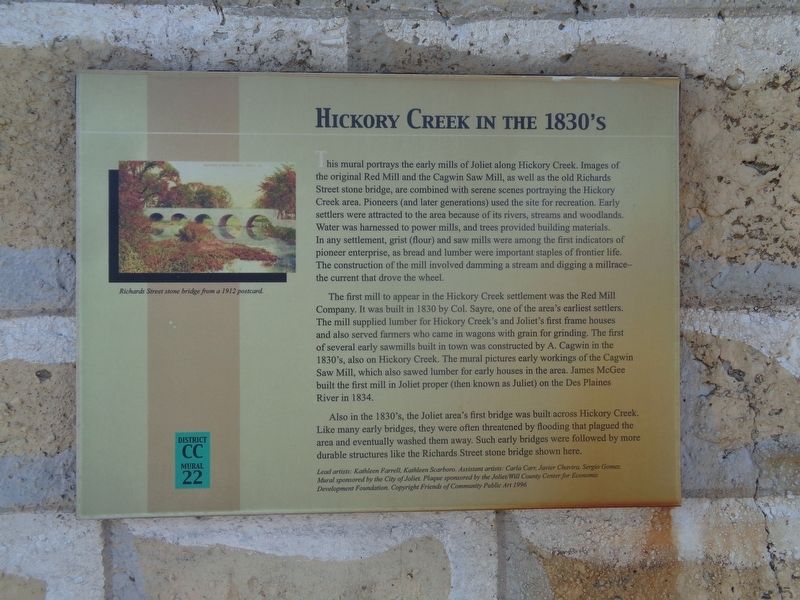
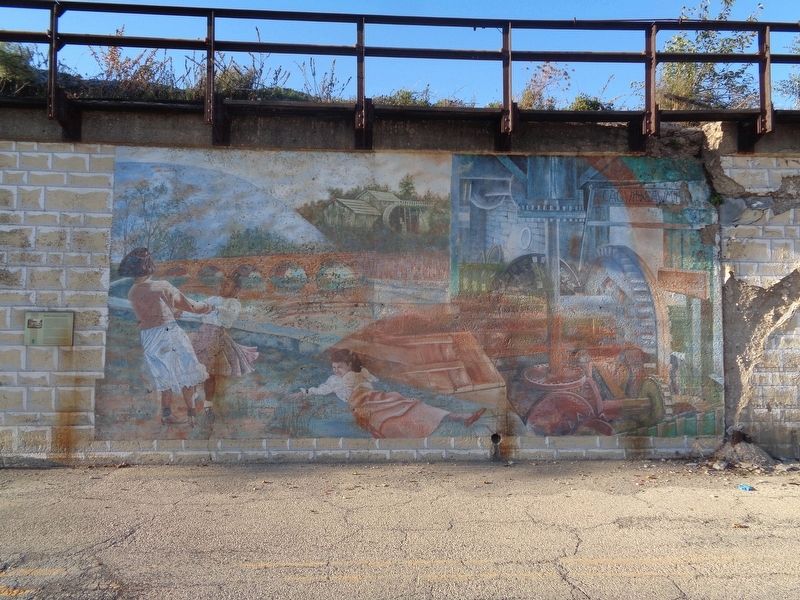
The first mill to appear in the Hickory Creek settlement was the Red Mill Company. It was built in 1830 by Col. Sayre, one of the area's earliest settlers. The mill supplied lumber for Hickory Creek's and Joliet's first frame houses and also served farmers who came in wagons with grain for grinding. The first of several early sawmills built in town was constructed by A. Cagwin in the 1830's,
this page online
Also in the 1830's, the Joliet area's first bridge was built across Hickory Creek. Like many early bridges, they were often threatened by flooding that plagued the area and eventually washed them away. Such early bridges were followed by more durable structures like the Richards Street stone bridge shown here.
Lead artists: Kathleen Farrell, Kathleen Scarboro. Assistant artist: Carla Carr, Javier Chavira, Sergio Gomez. Mural sponsored by the City of Joliet. Plaque sponsored by the Joliet/Will County Center for Economic Development Foundation. Copyright Friends of Community Public Art 1996
Erected by the Joliet/Will County Center for Economic Development Foundation. (Marker Number CC,22.)
Topics. This historical marker is listed in these topic lists: Bridges & Viaducts • Industry & Commerce • Waterways & Vessels.
Location. 41° 31.434′ N, 88° 4.809′ W.
Photographed by Jason Voigt, September 30, 2020
2. Hickory Creek in the 1830's Marker
Marker is next to its mural, which is on a wall outside Joliet's Amtrak station.

Regionally, this marker is in Greater Chicago. It is also in the American Midwest. Globally, it is in North America, on the Great Lakes, in the Western Hemisphere, in the Western World, and in the Anglosphere. Historically, it finds itself in what was once the territory of the Mississippian Culture and also the Northwest Territory.
Other nearby markers. At least 8 other markers are within walking distance of this marker: Joliet Steam Train (here, next to this marker); Sauk Trail (within shouting distance of this marker); Union Station (within shouting distance of this marker); Katherine Dunham: Pioneer in African Dance (within shouting distance of this marker); Bartleson Post No. 6 Memorial Tree (about 500 feet away, measured in a direct line); World War I Memorial Tree (about 500 feet away); Samuel Benedict Reed (about 500 feet away); Roswell P. Flower (about 500 feet away). Touch for a list and map of all markers in Joliet.
Credits. This page was last revised on February 23, 2021. It was originally submitted on February 23, 2021, by Jason Voigt of Glen Carbon, Illinois. This page has been viewed 1,425 times since then and 56 times this year. Photos: 1, 2. submitted on February 23, 2021, by Jason Voigt of Glen Carbon, Illinois.
