Culpeper in Culpeper County, Virginia — The American South (Mid-Atlantic)
William "Extra Billy" Smith
1797-1887
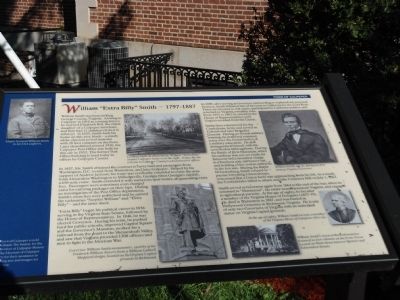
Photographed by Don Morfe, October 29, 2011
1. William "Extra Billy" Smith Marker
In 1827, Mr. Smith obtained the contract to carry mail and passengers from Washington, D.C. to and from Warrenton, and later Culpeper. Helped by his support of Andrew Jackson, his route was eventually extended to cover the area from Alexandria/Washington to Milledgeville, Georgia (then Georgia’s capital), a 650-mile route. Smith extended it with numerous spur routes, all generating extra fees. Passengers were sometimes even charged extra for carrying packages on their laps. During an investigation of the Post Office department, Smith’s extra fees were publicized and he earned the nicknames “Surplus William” and “Extra
this page online
“Extra Billy” began his political career in 1836 serving in the Virginia State Senate, followed by the House of Representatives. In 1846, he was elected Governor. During his term, he pushed hard for public schools, improved Capitol Square and the Governor’s Mansion, worked for a railroad from the coast to the Shenandoah Valley, and saw that Virginia provided 1300 officers and men to fight in the Mexican War.
In 1849, after serving as Governor and needing to replenish his personal finances, Smith followed two of his sons to California for the Gold Rush. There, he invested in real estate, participated in California politics, and returned to Virginia a wealthy man. From 1853 to 1861 he served in the House of Representatives until Virginia seceded from the Union.
Smith then volunteered for the Confederate Army and served as Colonel and later Brigadier General. Having no formal military training, he preferred common sense over the formal tactics of a military education. He also distinguished himself with his unorthodox field uniform. During the Battle of First Manassas, when his uniform was not yet ready,

Photographed by Evan Dwyer, January 7, 2026
2. William "Extra Billy" Smith House Site
The marker is to the left, just out of frame next to the tree. Extra Billy Smith's home took up this entire block of Main Street. It was, ironically, replaced by a Post Office - providing the very service that he did.
Smith served as Governor again from 1864 to the end of the war, when he returned to “Monterosa”, his estate near Warrenton, Virginia, and engaged in agricultural pursuits. At the age of eighty, he became a member of the Virginia House of Delegates (1877-79). He died in Warrenton in 1887, and was buried in Hollywood Cemetery in Richmond, Virginia. He is one of only two Governors of Virginia with an individual statue on Virginia Capitol grounds.
(captions)
Major General William Smith in his CSA uniform.
Looking south on Main Street, William "Extra Billy" Smith's Culpeper home is on the right. Today the site is home to Culpeper County's administrative offices.
Governor William Smith monument c.1906 by artist Frederick William Sievers from a William Ludwell Sheppard design, located on the Virginia Capitol grounds in Richmond.
William Smith, age 50, during his term as Virginia governor.
At the age of eighty, William Smith became a member of the Virginia House of Delegates (1877-79).
William Smith's classical Revival mansion featured 20 foot columns on the front. It was located on Main Street between Spencer and Edmondson Streets.
Erected by Town

Photographed by Evan Dwyer, October 25, 2025
3. William "Extra Billy" Smith Marker
Marker has sustained damage from the weather over its years on the corner.
Topics and series. This historical marker is listed in these topic lists: Government & Politics • War, US Civil. In addition, it is included in the Postal Mail and Philately series list. A significant historical month for this entry is July 1969.
Location. 38° 28.484′ N, 77° 59.747′ W. Marker is in Culpeper, Virginia, in Culpeper County. It is at the intersection of North Main Street (Business U.S. 15) and West Spencer Street, on the left when traveling north on North Main Street. Touch for map. Marker is in this post office area: Culpeper VA 22701, United States of America. Touch for directions.

Regionally, this marker is in the Washington Metropolitan Area and in Northern Virginia. It is also in the American South, specifically in the Upper South, and in the Mid-Atlantic. Globally, it is in North America, the Western Hemisphere, the Western World, and the Anglosphere. Historically, it finds itself in what was once the territory of the Mississippian Culture, one of the original Thirteen Colonies, one of the Confederate States of America, and the Antebellum South.
Other nearby markers. At least 8 other markers

Photographed by Evan Dwyer, January 7, 2026
4. William "Extra Billy" Smith House Columns
The portico columns from Extra Billy's house were saved during the dismantling of the house, and used to erect this portico on Woodland United Methodist Church (northwest of town up Sperryville Pike towards Salem). As evidenced here, the ornate columns contrast strongly with the restrained construction features of the 1884 chapel.
Another marker is no longer nearby. A.P. Hill's Boyhood Home (was about 500 feet away but has been confirmed missing).
Credits. This page was last revised on August 1, 2026. It was originally submitted on November 25, 2012, by Don Morfe of Baltimore, Maryland. This page has been viewed 1,767 times since then and 167 times this year. Last updated on August 19, 2025, by Evan Dwyer of Richmond, Virginia. Photos: 1. submitted on November 25, 2012, by Don Morfe of Baltimore, Maryland. 2, 3, 4. submitted on January 11, 2026, by Evan Dwyer of Richmond, Virginia. • Bernard Fisher was the editor who published this page.
