Martinsburg in Berkeley County, West Virginia — The American South (Appalachia)
Civil War Martinsburg
Focus of Contention
Photographed by Don Morfe, July 30, 2012
1. Civil War Martinsburg Marker
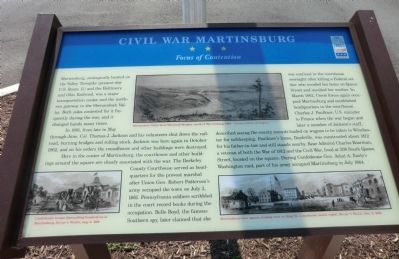
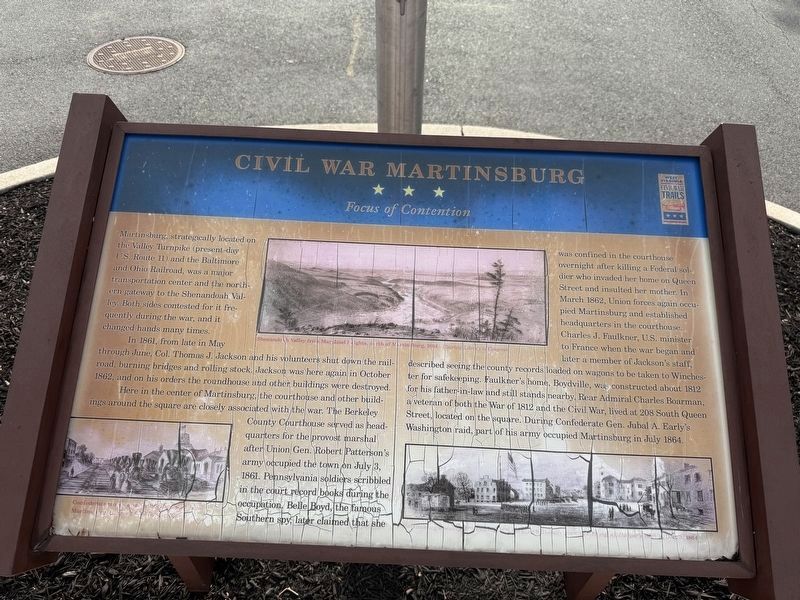
Martinsburg, strategically located on the Valley Turnpike (present day U.S. Route 11) and the Baltimore and Ohio Railroad, was a major transportation center and the northern gateway to the Shenandoah Valley. Both sides contested for it frequently during the war, and it changed hands many times.
In 1861, from late in May through June, Col. Thomas J. Jackson and his volunteers shut down the railroad, burning bridges and rolling stock. Jackson was here again in October 1862, and on his orders the roundhouse and other buildings were destroyed.
Here in the corner of Martinsburg, the courthouse and other buildings around the square are closely associated with the war. The Berkeley County Courthouse served as headquarters for the provost marshal after Union Gen. Robert Patterson’s army occupied the town on July 3, 1861. Pennsylvania soldiers scribbled in the court record books during the occupation. Belle Boyd, the famous Southern spy, later claimed that she was confined in the courthouse overnight after killing a Federal soldier who invaded her home on Queen Street and insulted her mother. In March 1862, Union forces
this page online
Erected by West Virginia Civil War Trails.
Topics and series. This historical marker is listed in these topic lists: Railroads & Streetcars • War, US Civil. In addition, it is included in the Baltimore and Ohio Railroad (B&O), and the West Virginia Civil War Trails series lists. A significant historical month for this entry is March 1862.
Location. 39° 27.377′ N, 77° 57.847′ W. Marker is in Martinsburg, West Virginia, in Berkeley County. It is at the intersection of West King Street (U.S. 11) and South Queen Street (State
Photographed by Devry Becker Jones (CC0), April 1, 2025
2. Civil War Martinsburg Marker
This marker has weathered but remains generally legible.

Regionally, this marker is in the Eastern Panhandle. It is also in the American South, specifically in the Upper South, in Appalachia, and specifically in Northern Appalachia. Globally, it is in North America, the Western Hemisphere, the Western World, and the Anglosphere. Historically, it finds itself in what was once the territory of the Mississippian Culture and also the Antebellum South.
Other nearby markers. At least 8 other markers are within walking distance of this marker: Welcome to the City of Martinsburg (within shouting distance of this marker); Boarman House (within shouting distance of this marker); Avenue of Flags Monument (within shouting distance of this marker); St. Joseph's Catholic Church (about 300 feet away, measured in a direct line); Market House (about 500 feet away); Girlhood Home of Belle Boyd (about 600 feet away); 224 - 226 West King Street (about 600 feet away); Old Methodist Church (about 600 feet away). Touch for a list and map
Photographed by Don Morfe, July 30, 2012
3. Civil War Martinsburg Marker
Credits. This page was last revised on April 1, 2025. It was originally submitted on August 22, 2012, by Don Morfe of Baltimore, Maryland. This page has been viewed 2,712 times since then and 88 times this year. Last updated on February 27, 2021, by Carl Gordon Moore Jr. of North East, Maryland. Photos: 1. submitted on August 22, 2012, by Don Morfe of Baltimore, Maryland. 2. submitted on April 1, 2025, by Devry Becker Jones of Washington, District of Columbia. 3. submitted on August 28, 2012, by Don Morfe of Baltimore, Maryland. • Bernard Fisher was the editor who published this page.
