Monteagle in Grundy County, Tennessee — The American South (East South Central)
Trail of Tears
Bell Removal Route
Photographed by Duane and Tracy Marsteller, February 27, 2021
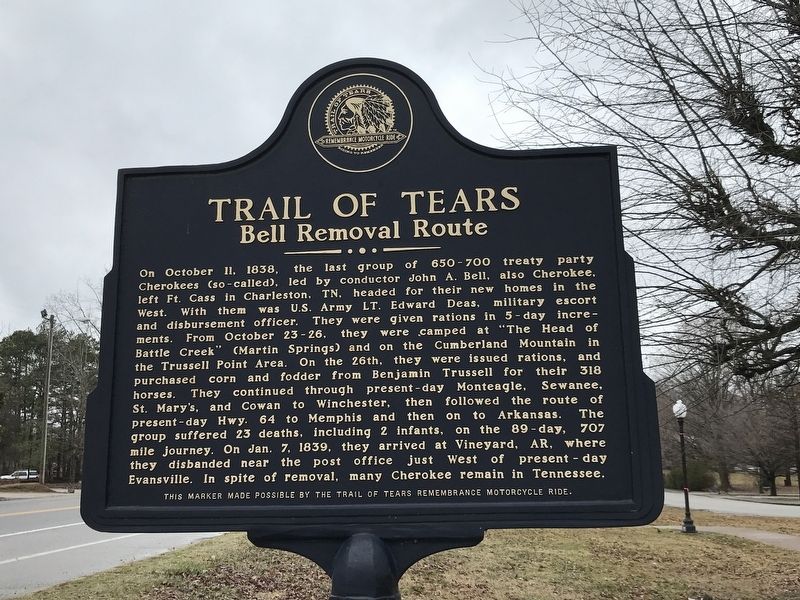
1. Trail of Tears Marker
Inscription.
On October 11, 1838, the last group of 650-700 treaty party Cherokees (so-called), led by conductor John A. Bell, also Cherokee, left Ft. Cass in Charleston, TN, headed for their new homes in the West. With them was U.S. Army LT. Edward Deas, military escort
and disbursement officer. They were given rations in 5-day increments. From October 23 - 26, they were camped at “The Head of Battle Creek” (Martin Springs) and on the Cumberland Mountain in the Trussell Point Area. On the 26th, they were issued rations, and purchased corn and fodder from Benjamin Trussell for their 318 horses. They continued through present-day Monteagle, Sewanee, St. Mary's, and Cowan to Winchester, then followed the route of present-day Hwy. 64 to Memphis and then on to Arkansas. The
group suffered 23 deaths, including 2 infants, on the 89-day, 707-mile journey. On Jan. 7, 1839, they arrived at Vineyard, AR, where they disbanded near the post office just West of present-day Evansville. In spite of removal, many Cherokee remain in Tennessee.
Erected by The Trail of Tears Remembrance Motorcycle Ride.
Topics and series. This historical
Click or scan to see this page online
marker is listed in this topic list: Indigenous Peoples and Communities. In addition, it is included in the Trail of Tears series list. A significant historical date for this entry is October 11, 1838.
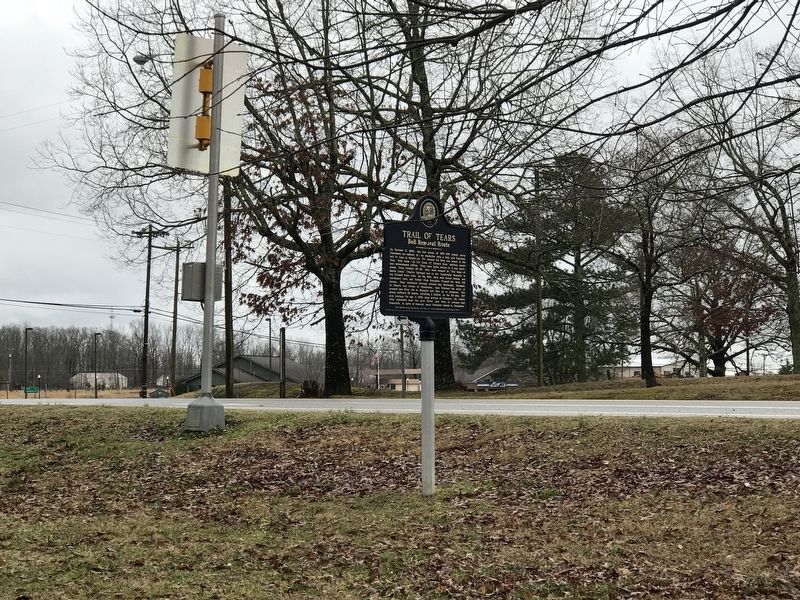
Location. 35° 14.4′ N, 85° 49.723′ W. Marker is in Monteagle, Tennessee, in Grundy County. It is at the intersection of Main Street (U.S. 41) and Fairmont Avenue, on the right when traveling west on Main Street. Touch for map. Marker is in this post office area: Monteagle TN 37356, United States of America. Touch for directions.
Regionally, this marker is in the Cumberland Plateau and in the Highland Rim. It is also in the American South, specifically in the Upper South, in Appalachia, and specifically in Southern Appalachia. Globally, it is in North America, the Western Hemisphere, the Western World, and the Anglosphere. Historically, it finds itself in what was once the territory of the Mississippian Culture, one of the Confederate States of America, and the Antebellum South.
Other nearby markers. At least 8 other markers are within walking distance of this marker: The Mabee Homeplace (within shouting distance of this marker); RyeMabee 1930
Photographed by Duane and Tracy Marsteller, February 27, 2021
Credits. This page was last revised on November 10, 2024. It was originally submitted on February 28, 2021, by Duane and Tracy Marsteller of Murfreesboro, Tennessee. This page has been viewed 1,605 times since then and 95 times this year. Photos:1, 2. submitted on February 28, 2021, by Duane and Tracy Marsteller of Murfreesboro, Tennessee.