
Near Broad Run in Fauquier County, Virginia — The American South (Mid-Atlantic)
Thoroughfare Gap
A “Dark, Gloomy Cleft”
| — | Mosby’s Confederacy and Second Manassas Campaign | — |
Photographed by Roger Dean Meyer, June 3, 2006
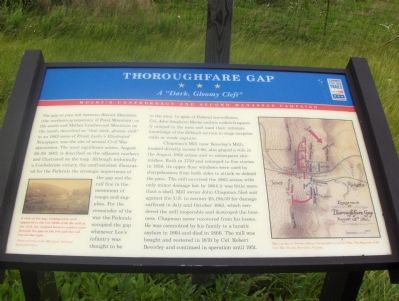
1. Thoroughfare Gap
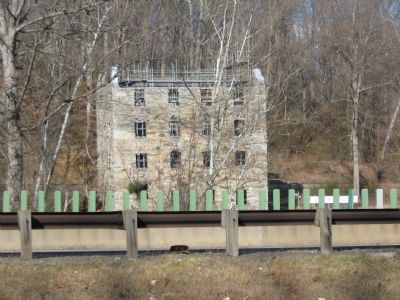
Chapman’s Mill (now Beverley’s Mill), located directly across I-66, also played a role in the August 1862 action and in subsequent skirmishes. Built in 1759 and enlarged to five stories in 1858, its upper floor
this page online
Sidebar under picture: A view of the gap, looking west, as it appeared in the late 1800s with the mill in the clef, the original farm-to-market road through the gap on the left and the rail line on the right. (Photo courtesy of the Manassas National Battlefield Park)
Sidebar under map: Map courtesy of Terrence Haney, Cartographer, and Civil War, The Magazine of the Civil War Society, Berryville, Virginia.
Erected by Civil War Trails.
Topics and series. This historical marker is listed in these topic lists: Notable Buildings • War, US Civil.
Photographed by Craig Swain, February 4, 2007
2. Thoroughfare Gap
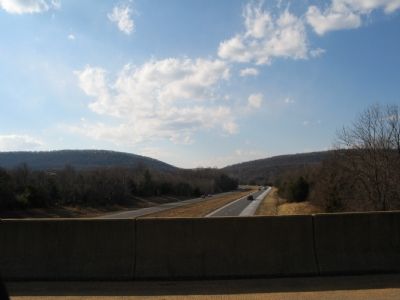
A view of the gap from the East side, looking down I-66, from an overpass approximately 1 mile East of the marker site.
Location. This marker has been replaced by another marker nearby. It was located near 38° 49.411′ N, 77° 42.653′ W. Marker was near Broad Run, Virginia, in Fauquier County. It was at the intersection of John Marshall Highway (Virginia Route 55) and Beverleys Mill Road, on the right when traveling west on John Marshall Highway. Touch for map. Marker was at or near this postal address: 17504 Beverly Mill Dr, Broad Run VA 20137, United States of America. Touch for directions.

Regionally, this marker was in the Washington Metropolitan Area and in Northern Virginia. It was also in the American South, specifically in the Upper South, and in the Mid-Atlantic. Globally, it was in North America, the Western Hemisphere, the Western World, and the Anglosphere. Historically, it found itself in what was once the territory of the Mississippian Culture, one of the original Thirteen Colonies, one of the Confederate States of America, and the Antebellum South.
Other nearby markers. At least 8 other markers are within
Photographed by Craig Swain, February 4, 2007
3. Chapman's Mill
Looking across I-66 from the marker pull off, the original mill burned in 1998, but is currently being reconstructed.
Other markers no longer nearby. Chapman's Mill (was approx. ¼ mile away but has been replaced with another marker now near it); a different marker also named Bull Run Mountains Natural Area Preserve (was approx. ¼ mile away but has been replaced with another marker now near it).
Related marker. Click here for another marker that is related to this marker. This marker has been replaced with the linked marker.
Also see . . . Culpeper National Cemetery. Union soldiers from the Thoroughfare Gap fighting are interred here. (Submitted on August 3, 2007, by Craig Swain of Leesburg, Virginia.)
Additional commentary.
1.
November 17, 2006
4. Quarry Trench
This place is of interest to me as my great great-uncle John Berry was killed here serving in the 11th Pa. on August 28th, 1862. I plan on spending some time looking around when I can get down there.
I am a reenactor in the 5th Va. Co. H. Thanks for the information I have seen on this site.
Are there any Union grave sites in the area? From what I have studied not many soldiers were removed from the battlefield that day.
— Submitted August 2, 2007, by Howard D Berner of Rural Valley, Pennsylvania.
2. Thoroughfare Gap Union Grave Sites
I could not locate any reference to existing grave sites at Thoroughfare Gap. Most likely the solders who were buried at the Gap immediately following the fighting were reinterred at Culpeper National Cemetery. That cemetery was established in 1867 for the purpose of consolidating the Union dead scattered about Northern and Central Virginia. More details on that cemetery are at the “Also See” link No. 1 on this page.
Since the bulk of the fighting at Thoroughfare Gap, and in particular the 11th PA’s fighting, occurred right where modern I-66 runs, much of
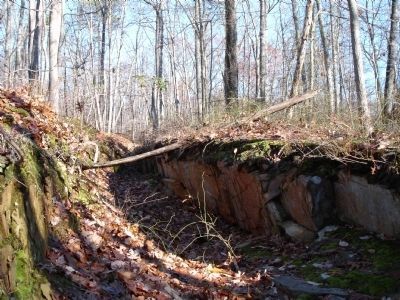
November 17, 2006
5. Photo of the Quarry Trench
— Submitted August 3, 2007, by Craig Swain of Leesburg, Virginia.
3. Quarry Trench
Transcription of text on interpretative sign on photo No. 4
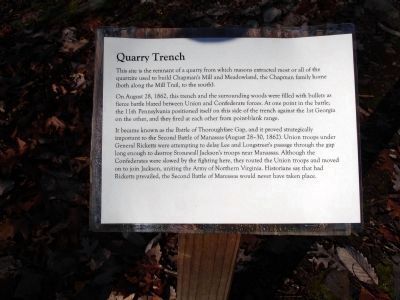
This site is the remnant of a quarry from which masons extracted most or all of the quartzite used to build Chapman’s Mill and Meadowland, the Chapman family home (both along the Mill Trail, to the south).
On August 28, 1862, this trench and the surrounding woods were filled with bullets as fierce battle blazed between Union and Confederate forces. At one point in the battle, the 11th Pennsylvania positioned itself on this side of the trench against the 1st Georgia on the other, and they fired at each other from point-blank range.
It became known as the Battle of Thoroughfare Gap, and it proved strategically important to the Second Battle of Manassas (August 28-30, 1862). Union troops under General Ricketts were attempting to delay Lee and Longstreet’s passage through the gap long enough to destroy Stonewall Jackson’s troops near Manassas. Although the Confederates were slowed by the fighting here, they routed the Union troops and moved on to join Jackson, uniting the Army of Northern Virginia. Historians say that had Ricketts prevailed, the Second Battle of Manassas would never have taken place.
— Submitted October 24, 2009.
Credits. This page was last revised on May 1, 2021. It was originally submitted on October 13, 2006, by Roger Dean Meyer of Yankton, South Dakota. This page has been viewed 6,287 times since then and 66 times this year. Last updated on March 1, 2021, by Carl Gordon Moore Jr. of North East, Maryland. Photos: 1. submitted on October 13, 2006, by Roger Dean Meyer of Yankton, South Dakota. 2, 3. submitted on June 6, 2007, by Craig Swain of Leesburg, Virginia. 4, 5. submitted on December 1, 2008. • J. Makali Bruton was the editor who published this page.
