
Near West Augusta in Highland County, Virginia — The American South (Mid-Atlantic)
Fort Edward Johnson

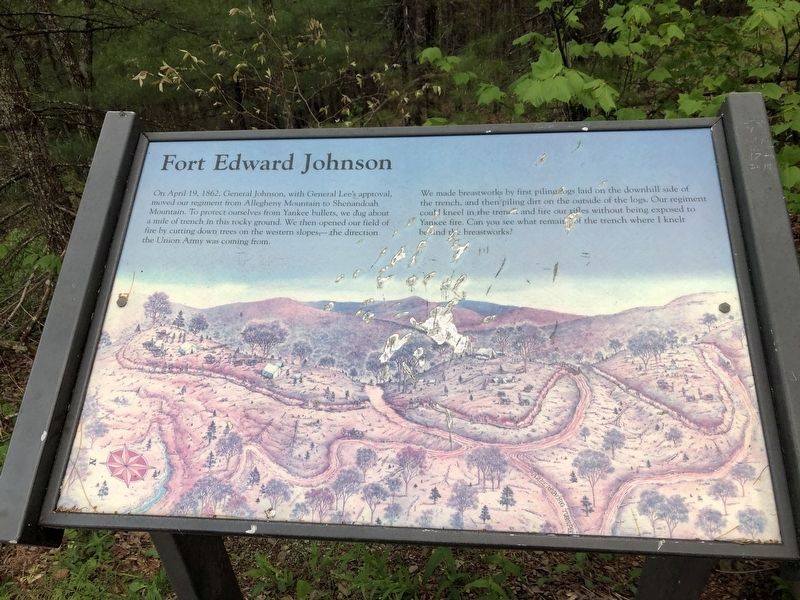
On April 19, 1862, General Johnson, with General Lee’s approval, moved our regiment from Allegheny Mountain to Shenandoah Mountain. To protect ourselves from Yankee bullets, we dug about a mile of trench in this rocky ground. We then opened our field of fire by cutting down trees on the western slopes – the direction the Union Army was coming from.
We made breastworks by first piling logs laid on the downhill side of the trench, and then piling dirt on the outside of the logs. Our regiment could kneel in the trench and fire our rifles without being exposed to Yankee fire. Can you see what remains of the trench where I knelt behind the breastworks?
Erected by Forest Service, U.S. Department of Agriculture.
Topics and series. This historical marker is listed in these topic lists: Forts and Castles • War, US Civil. In addition, it is included in the Battlefield Trails - Civil War series list. A significant historical month for this entry is April 1873.
Location. 38° 18.706′ N, 79° 23.044′ W. Marker is near West Augusta, Virginia, in Highland County. It can be reached from U.S. 250, on the right when traveling west.
this page online

Regionally, this marker is in Virginia’s Shenandoah Valley, in the Alleghany Highlands, and specifically in the Potomac Highlands. It is also in the American South, specifically in the Upper South, in Appalachia, and specifically in Southern Appalachia. Globally, it is in North America, the Western Hemisphere, the Western World, and the Anglosphere. Historically, it finds itself in what was once the territory of the Mississippian Culture, one of the original Thirteen Colonies, one of the Confederate States of America, and the Antebellum South.
Other nearby markers. At least 13 other markers are within 2 miles of this marker, measured as the crow flies: “It was cold business…” (a few steps from this marker); Welcome to Fort Johnson (a few steps from this marker); Confederate Breastworks Trail (within shouting distance of this marker); “The Shenandoah Mountain Pass is grand indeed…” (within shouting distance of this marker);

Photographed by Robert H. Moore, II, February 27, 2009
2. Fort Edward Johnson Marker
This is a previous iteration of the marker. It has been replaced with one with an identical inscription.
Another marker is no longer nearby. Confederate Breastworks Interpretive Trail (was within shouting distance of this marker but has been replaced with another marker now near it).
More about this marker. The background of the marker is an illustration depicting the breastworks along the mountain crest.
Related markers. Click here for a list of markers that are related to this marker. Fort Edward Johnson virtual tour by markers.
Photographed by Devry Becker Jones (CC0), May 8, 2021
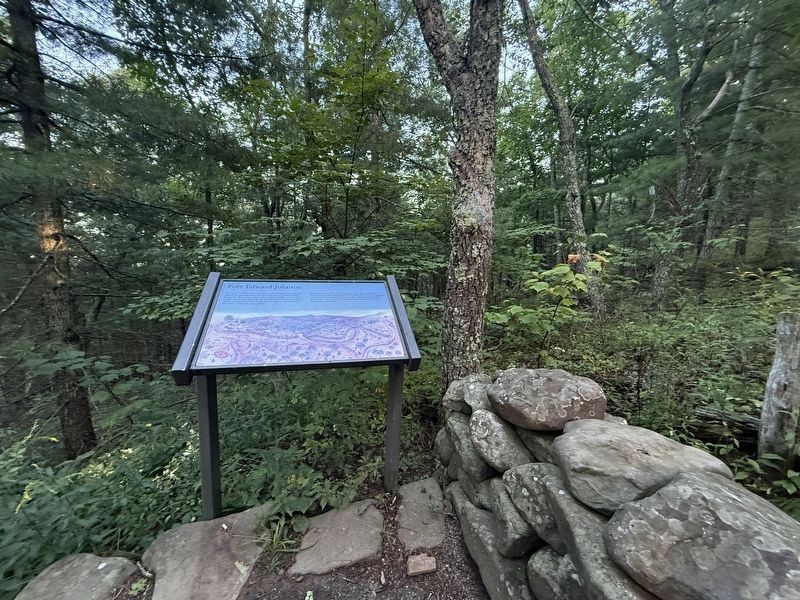
3. Fort Edward Johnson Marker
The marker has been damaged.
Photographed by J. J. Prats, May 2, 2010
5. Fort Edward Johnson Marker
Credits. This page was last revised on August 8, 2026. It was originally submitted on March 6, 2009, by Robert H. Moore, II of Winchester, Virginia. This page has been viewed 1,778 times since then and 28 times this year. Photos: 1. submitted on August 8, 2026, by Devry Becker Jones of Washington, District of Columbia. 2. submitted on March 6, 2009, by Robert H. Moore, II of Winchester, Virginia. 3. submitted on May 8, 2021, by Devry Becker Jones of Washington, District of Columbia. 4. submitted on August 8, 2026, by Devry Becker Jones of Washington, District of Columbia. 5. submitted on May 5, 2010, by J. J. Prats of Powell, Ohio. • Craig Swain was the editor who published this page.
