
Perryville in Boyle County, Kentucky — The American South (East South Central)
Simonson’s Battery
Perryville • The Battle For Kentucky
| — | October 8, 1862 | — |

Photographed by Bradley Owen, October 18, 2025
1. Simonson’s Battery Marker
Prior to the Confederate attack, Southern artillery posted on the far hills in front of you fired on Simonson’s battery and Captain Cyrus Loomis’s Union artillery, which was deployed to your right. Simonson’s rifled guns could shoot farther than the Confederates’ smoothbore cannon, and the Rebel guns were quickly silenced.
At 3:00 pm., more than an hour after the artillery duel ended, Confederate infantry commanded by Colonel Thomas M. Jones advanced against the Union center. Simonson’s guns blasted the attacking Southerners with canister rounds, which turned the cannon into giant shotguns. Although Simonson’s gunners and supporting Union infantry stifled the initial Confederate advance in this area, Jones’s troops hit the artillerymen hard. As Union soldiers to your right fell back, Simonson’s guns were in danger. The battery was then ordered to a position 300 yards behind you
this page online
At that new location, Simonson’ battery again endured waves of attacking Confederate infantry. Furthermore, a Confederate artillery round struck one of Simonson’s limbers, which held an ammunition box. Union Private Ormond Hupp wrote that “a shell from the enemy struck me on the left arm and passing on, struck the ammunition chest, exploded and caused the cartridges in the chest to explode. It was all done in an instant and resulted in the instant death of [soldier Frederick Ehrich] who was struck in the head with a piece of shell and the wounding of four others, C. Miller, burnt, [Abraham Forry], arm broken and badly burnt on head and face; A. Pettit, lip cut and wounded slightly in the head and myself cut in the left arm, right arm, and face. When the chest blew up it took me in the air about ten feet… I jumped up and saw that I was badly wounded, my clothes were all torn off, and the burn from the powder set me near crazy.”
The battery ran out of ammunition after firing 755 rounds. They then retired from the

Photographed by Bradley Owen, October 18, 2025
2. Simonson’s Battery Marker
Shot & shell from Rebel Batteries howled and shrieked over & around, now tearing up the dry earth and again ‘ricocheting’ with a wild unearthly shriek again [to] strike or explode with terrible effect. This was our first real battle and we soon began to realize what a battle means . . .
Daniel H. Chandler, 5th Battery, Indiana Light Artillery
(Sidebar)
At the Battle of Perryville, the rolling terrain frequently put enemy regiments in close proximity to one another. When the troops were a short distance apart, Union and Confederate artillery fired canister rounds. Canister is an artillery projectile that consists of a tin can packed with many (usually thirty to fifty) lead or iron balls. When fired, the balls scatter out of the cannon’s muzzle. The blast from a canister round would cut down large swaths of advancing infantry.
Robert C. Carden, a member of the 16th Tennessee Infantry, fought in the fields off to your left. At Perryville, Carden witnessed firsthand the savage results when Simonson’s battery fired
Photographed by Brandon Fletcher, March 31, 2012
3. Simonson’s Battery Marker
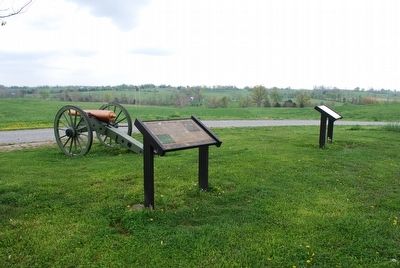
Marker on right
Canister was a short-range projectile, with a maximum effective range of about 400 yards. It was used effectively at Perryville.
(Captions)
Captain Peter Simonson, 5th Battery, Indiana Light Artillery
A cutaway view of a round of canister.
Erected by PNC Bank.
Topics. This historical marker is listed in this topic list: War, US Civil. A significant historical date for this entry is October 8, 1862.
Location. 37° 40.084′ N, 84° 58.339′ W. Marker is in Perryville, Kentucky, in Boyle County. It can be reached from Park Road 0.3 miles west of Battlefield Road (Kentucky Route 1920). Marker is located on the Jones Trail at the Perryville Battlefield State Historic Site. Touch for map. Marker is at or near this postal address: 1825 Battlefield Road, Perryville KY 40468, United States of America. Touch for directions.

Regionally,
Photographed by Brandon Fletcher, March 31, 2012
4. Simonson’s Battery Marker
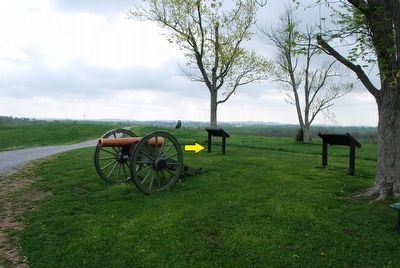
Marker on left (yellow arrow).
Other nearby markers. At least 8 other markers are within walking distance of this marker: “For God’s Sake, Save That Battery” The 38th Indiana at Perryville (here, next to this marker); Defense of the Union Center (a few steps from this marker); Artillery Duel at Loomis Heights (about 500 feet away, measured in a direct line); Cleburne's Attack (about 500 feet away); Michigan at Perryville (about 700 feet away); Palmer's GA Battery (approx. 0.2 miles away); Jones' Ridge (approx. 0.2 miles away); Assault From The Bottom House (approx. 0.2 miles away). Touch for a list and map of all markers in Perryville.
Other markers no longer nearby. Defense of Loomis’ Heights (was a few steps from this marker but has been replaced with another marker now near it); Assault from the Bottom House
Photographed by Brandon Fletcher, March 31, 2012
5. Simonson’s Battery Marker
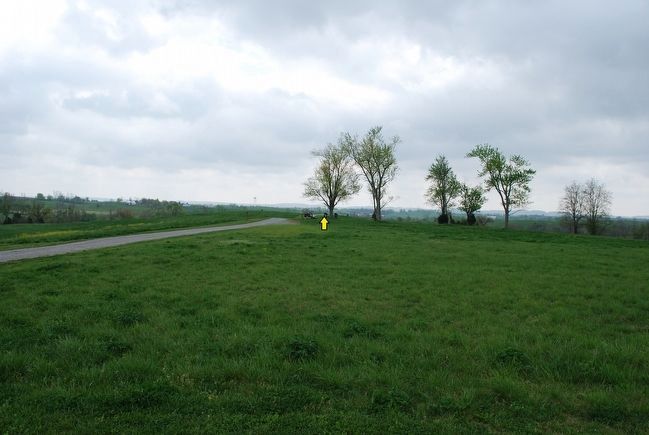
Marker in far distance (yellow arrow).
Photographed by Bernard Fisher, August 18, 2011
6. Simonson’s Battery Marker
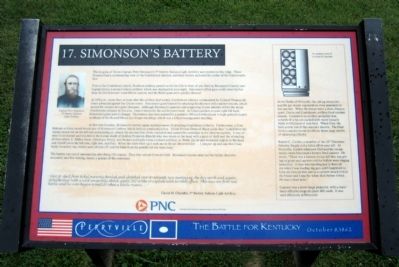
Simonson’s Battery Marker in 2011.
Credits. This page was last revised on December 5, 2025. It was originally submitted on August 25, 2011, by Bernard Fisher of Richmond, Virginia. This page has been viewed 1,534 times since then and 64 times this year. Last updated on March 6, 2021, by Bradley Owen of Morgantown, West Virginia. Photos: 1. submitted on December 4, 2025, by Bradley Owen of Morgantown, West Virginia. 2. submitted on December 5, 2025, by Bradley Owen of Morgantown, West Virginia. 3, 4, 5. submitted on September 14, 2015, by Brandon Fletcher of Chattanooga, Tennessee. 6. submitted on August 25, 2011, by Bernard Fisher of Richmond, Virginia.
