
Millen in Jenkins County, Georgia — The American South (South Atlantic)
Millen Junction
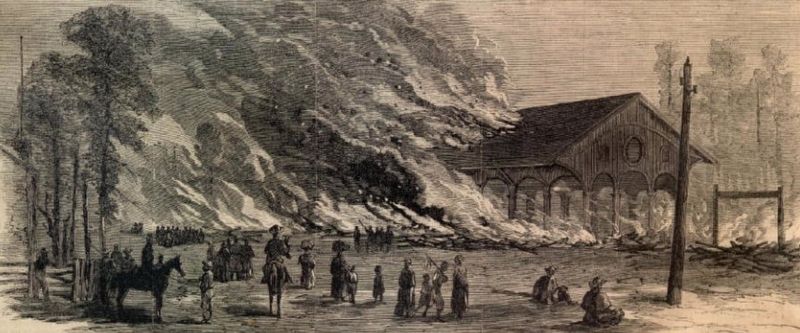
"...its destruction was a brilliant spectacle."
| — | March to the Sea Heritage Trail | — |
Photographed by Mark Hilton, April 30, 2017
1. Millen Junction Marker
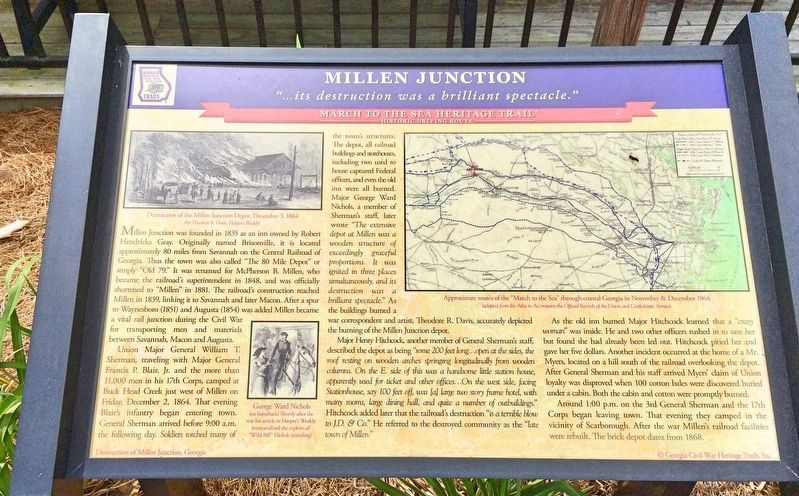
Union Major General William T. Sherman, traveling with Major General Francis Blair, Jr. and the more than 11,000 men in his 17th Corps, camped at Buck Head Creek just west of Millen on Friday, December 2, 1864. That evening Blair's infantry began entering town. General Sherman arrived before 9:00 a.m the following day. Soldiers torched many of the town's structures. The depot, all railroad buildings and storehouses, including
this page online
Major Henry Hitchcock, another member of General Sherman's staff, described the depot as being "some 200 feet long...open at the sides, the roof resting on wooden arches springing longitudinally from wooden columns. On the E. side of this was a handsome little station house, apparently used for ticket and other offices...On the west side, apparently used for ticket and other offices...On the west side, facing Stationhouse, say 100 feet off was [al] large two story frame hotel, with many rooms, large dining hall, and quite a number of outbuildings." Hitchcock added later that the railroad's destruction "is a terrible blow to JD & Co." He referred to the destroyed
Photographed by Mark Hilton, April 30, 2017
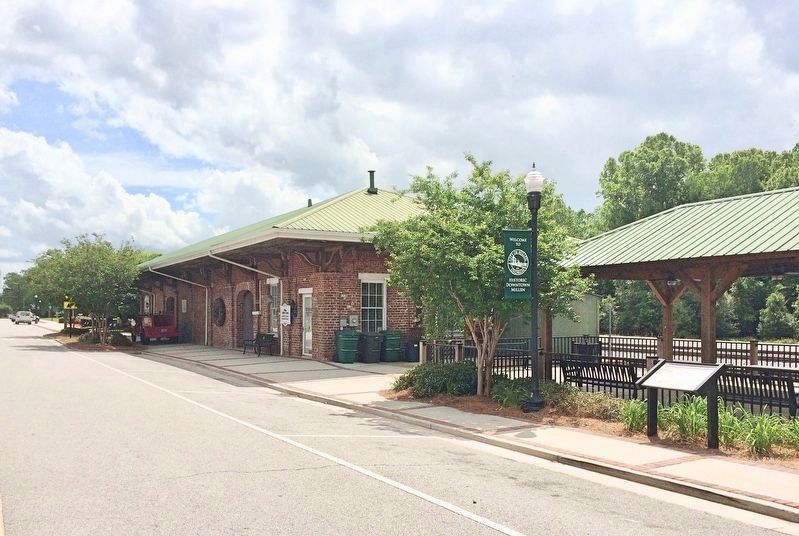
2. Millen Junction Marker & former train depot.
Around 1:00 p.m. on the 3rd General Sherman and the 17th Corps began leaving town. That evening they camped in the vicinity of Scarborough. After the war Millen's railroad facilities were rebuilt. The brick depot dates from 1868.
[Photo captions]
Top left: Destruction of the Millen Junction Depot, December 3, 1864
(by Theodore R. Davis, Harper's Weekly)
Bottom left: George Ward Nichols (on horseback) Shortly after the war his article in Harper's Weekly immortalized the exploits of "Wild Bill" Hickok (standing)
Top right: Approximate routes of the "March to the Sea" through coastal Georgia in November & December 1864
(adopted from the Atlas to Accompany the Official Records of the Union and Confederate Armies)
Background watermark: Destruction of Millen Junction, Georgia
Erected by Georgia
Photographed by Mark Hilton, April 30, 2017
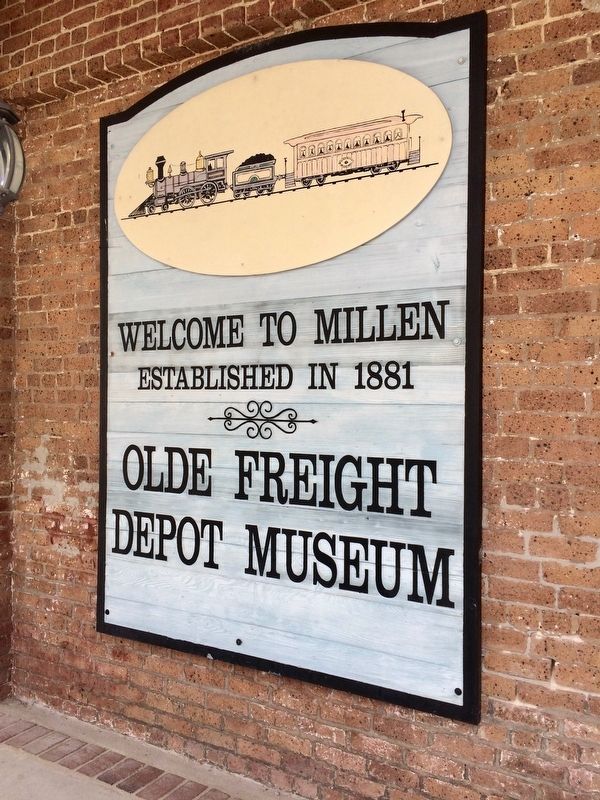
3. Part of the building is used as the Olde Freight Depot Museum.
Topics and series. This historical marker is listed in these topic lists: Railroads & Streetcars • War, US Civil. In addition, it is included in the Georgia Civil War Trails, and the Sherman’s March to the Sea series lists. A significant historical date for this entry is December 2, 1864.
Location. 32° 48.138′ N, 81° 56.379′ W. Marker is in Millen, Georgia, in Jenkins County. It is on Cotton Avenue west of North Daniel Street, on the right when traveling east. Touch for map. Marker is at or near this postal address: 548 Cotton Avenue, Millen GA 30442, United States of America. Touch for directions.

Regionally, this marker is in Georgia’s Coastal Plain. It is also in the American South and specifically in the Deep South. Globally, it is in North America, the Western Hemisphere, the Western World, and the Anglosphere. Historically, it finds itself in what was once the territory of the Mississippian Culture, one of the original Thirteen Colonies, one of the Confederate States of America, and the Antebellum South.
Other nearby markers. At least 8 other markers are within 2 miles
Photographed by Mark Hilton, April 30, 2017
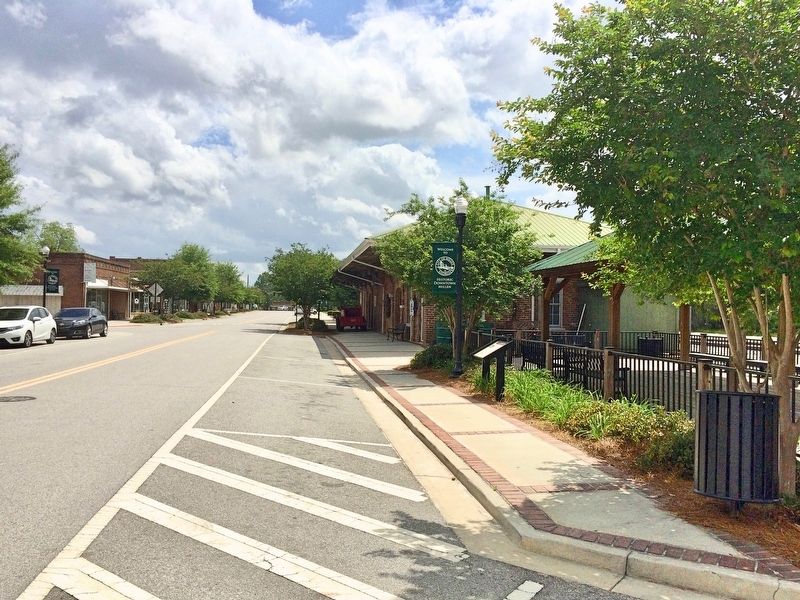
4. The view east on Cotton Avenue.
Also see . . . Wikipedia article on the History of Millen. (Submitted on May 8, 2017, by Mark Hilton of Montgomery, Alabama.)
Photographed by Mark Hilton
5. Destruction of Millen Junction
Credits. This page was last revised on March 22, 2021. It was originally submitted on May 8, 2017, by Mark Hilton of Montgomery, Alabama. This page has been viewed 1,560 times since then and 55 times this year. Last updated on March 21, 2021, by Carl Gordon Moore Jr. of North East, Maryland. Photos: 1, 2, 3, 4, 5. submitted on May 8, 2017, by Mark Hilton of Montgomery, Alabama. • Bill Pfingsten was the editor who published this page.
