Marietta in Washington County, Ohio — The American Midwest (Great Lakes)
Schoonover Shanty Boat
Ohio River Museum
Photographed by Cosmos Mariner, September 18, 2015
1. Schoonover Shanty Boat Marker
Inscription.
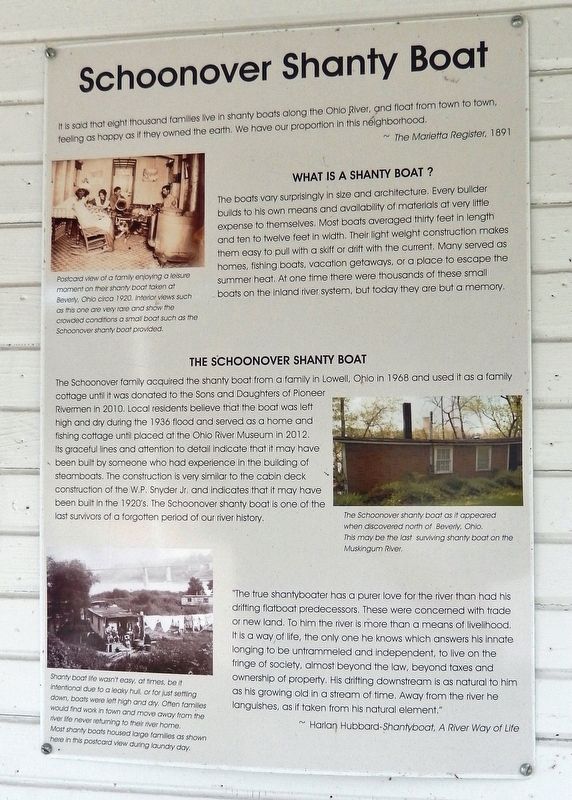
Schoonover Shanty Boat. Ohio River Museum. It is said that eight thousand families live in shanty boats along the Ohio River, and float from town to town, feeling as happy as if they owned the earth. We have our proportion in this neighborhood. , ~The Marietta Register, 1891,
What is a Shanty Boat?. The boats vary surprisingly in size and architecture. Every builder builds to his own means and availability of materials at very little expense to themselves. Most boats averaged thirty feet in length and ten to twelve feet in width. Their light weight construction makes them easy to pull with a skiff or drift with the current. Many served as homes, fishing boats, vacation getaways, or a place to escape the summer heat. At one time there were thousands of these small boats on the inland river system, but today they are but a memory.,
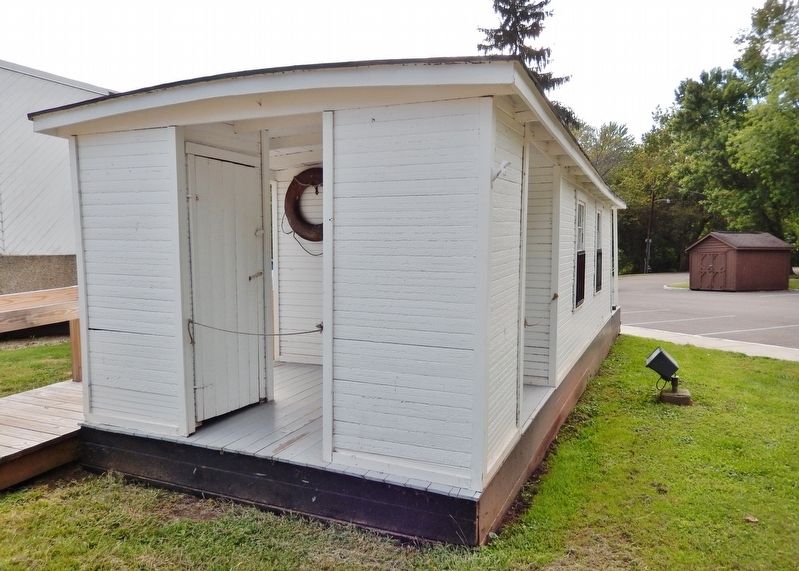
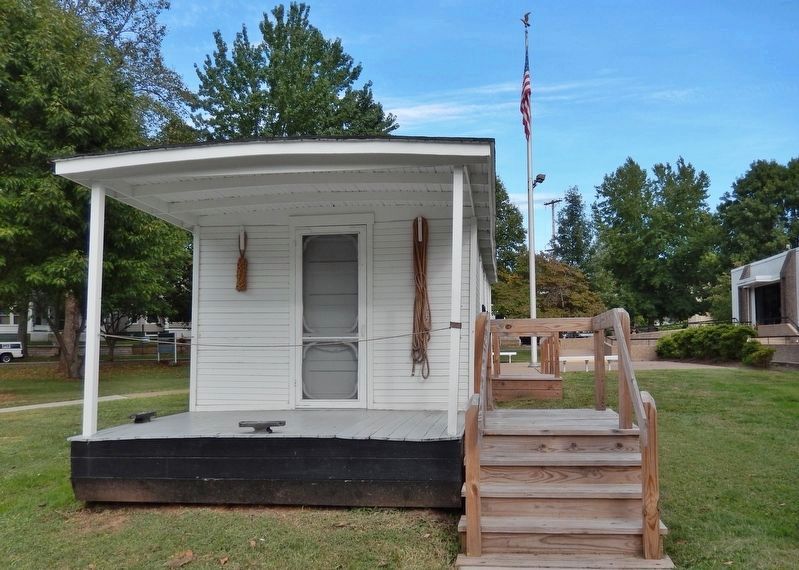
The Schoonover Shanty Boat. The Schoonover family acquired the shanty boat from a family in Lowell, Ohio in 1968 and used it as a family cottage until it was donated to the Sons and Daughters of Pioneer Rivermen in 2010. Local residents believe that the boat was left high and dry during the 1936 flood and served as a home and fishing cottage until placed at the Ohio River Museum in 2012. Its graceful lines and attention to detail indicate that it may have been built by someone who had experience in the building of steamboats. The construction is very similar to the cabin deck construction of the W.P. Snyder Jr. and indicates that it may have been built in the 1920's. The Schoonover shanty boat is one of the last survivors of a forgotten period of our river history., "The true shantyboater has a purer love for the river than had his drifting flatboat predecessors. These were concerned with trade or new land. To him the river is more than a means of livelihood. It is a way of life, the only one he knows which answers his innate longing to be untrammeled and independent, to live on the fringe of society, almost beyond the law, beyond taxes and ownership of property. His drifting downstream is as natural to him as his growing old in a stream of time. Away from the river he languishes, as if taken from his natural element." , ~Harlan Hubbard , Shantyboat, A River Way of Life
It is said that eight thousand families live in shanty boats along the Ohio River, and float from town to town, feeling as happy as if they owned the earth. We have our proportion in this neighborhood. ~The Marietta Register, 1891
What is a Shanty Boat?
The boats vary surprisingly in size and architecture. Every builder builds to his own means and availability of materials at very little expense to themselves. Most boats averaged thirty feet in length and ten to twelve feet in width. Their light weight construction makes them easy to pull with a skiff or drift with the current. Many served as homes, fishing boats, vacation getaways, or a place to escape the summer heat. At one time there were thousands of these small boats on the inland river system, but today they are but a memory.
The Schoonover Shanty Boat
The Schoonover family acquired the shanty boat from a family in Lowell, Ohio in 1968 and used it as a family cottage until it was donated to the Sons and Daughters of Pioneer Rivermen in 2010. Local residents believe that the boat was left high and dry during the 1936 flood and served as a home and fishing cottage until placed at the Ohio River Museum in 2012. Its graceful lines and attention to detail indicate that it may have been built by someone who had experience
Click or scan to see this page online
in the building of steamboats. The construction is very similar to the cabin deck construction of the W.P. Snyder Jr. and indicates that it may have been built in the 1920's. The Schoonover shanty boat is one of the last survivors of a forgotten period of our river history.
"The true shantyboater has a purer love for the river than had his drifting flatboat predecessors. These were concerned with trade or new land. To him the river is more than a means of livelihood. It is a way of life, the only one he knows which answers his innate longing to be untrammeled and independent, to live on the fringe of society, almost beyond the law, beyond taxes and ownership of property. His drifting downstream is as natural to him as his growing old in a stream of time. Away from the river he languishes, as if taken from his natural element." ~Harlan Hubbard — Shantyboat, A River Way of Life
Topics. This historical marker is listed in this topic list: Waterways & Vessels.
Location. 39° 25.245′ N, 81° 27.772′ W. Marker is in Marietta, Ohio, in Washington County. It can be reached from the intersection of Front Street and Allen Street. Marker and Schoonover Shanty Boat are on exhibit just south of the Ohio River Museum parking lot. Touch for map. Marker is at or near this postal address: 601 Front Street, Marietta OH 45750, United States of America. Touch for directions.
Regionally, this marker is in the American Midwest, in the Ohio River Valley, in Appalachia, and specifically in Northern Appalachia. Globally, it is in North America, the Western Hemisphere, the Western World, and the Anglosphere. Historically, it finds itself in what was once the Viceroyalty of New France, the Haudenosaunee (Iroquois) Confederacy, the territory of the Mississippian Culture, and the Northwest Territory.
Other nearby markers.
2. Marker detail: Shanty Boat Interior
Postcard view of a family enjoying a leisure moment on their shanty boat taken at Beverly, Ohio circa 1920. Interior views such as this one are very rare and show the crowded conditions a small boat such as the Schoonover shanty boat provided.

Also see . . . A Secret History of American River People. There is a long forgotten history in America of people living in homemade shantyboats, a reasonable and cost-free solution for displaced people in rural areas and workers in urban areas. In the fallout from the U.S. economic collapse in 1893, thousands of families left their homes in the upper Mississippi Valley in home-built shantyboats to look for work along the more industrialized lower Mississippi River and Ohio River Valleys. During the 19th century into the 1930s, itinerant workers lived in shantyboats along the canals and rivers of industrial American towns. (Submitted on March 28, 2021, by Cosmos Mariner of Cape Canaveral, Florida.)
3. Marker detail: Schoonover Shanty Boat
The Schoonover shanty boat as it appeared when discovered north of Beverly, Ohio. This may be the last surviving shanty boat on the Muskingum River.
4. Marker detail: Shanty Boat Life
Shanty boat life wasn't easy, at times, be it intentional due to a leaky hull, or for just settling down, boats were left high and dry. Often families would find work in town and move away from the river life never returning to their river home. Most shanty boats housed large families as shown here in this postcard view during laundry day.
Photographed by Cosmos Mariner, September 18, 2015
5. Schoonover Shanty Boat
Photographed by Cosmos Mariner, September 18, 2015
6. Schoonover Shanty Boat
Photographed by Cosmos Mariner, September 18, 2015
7. Schoonover Shanty Boat
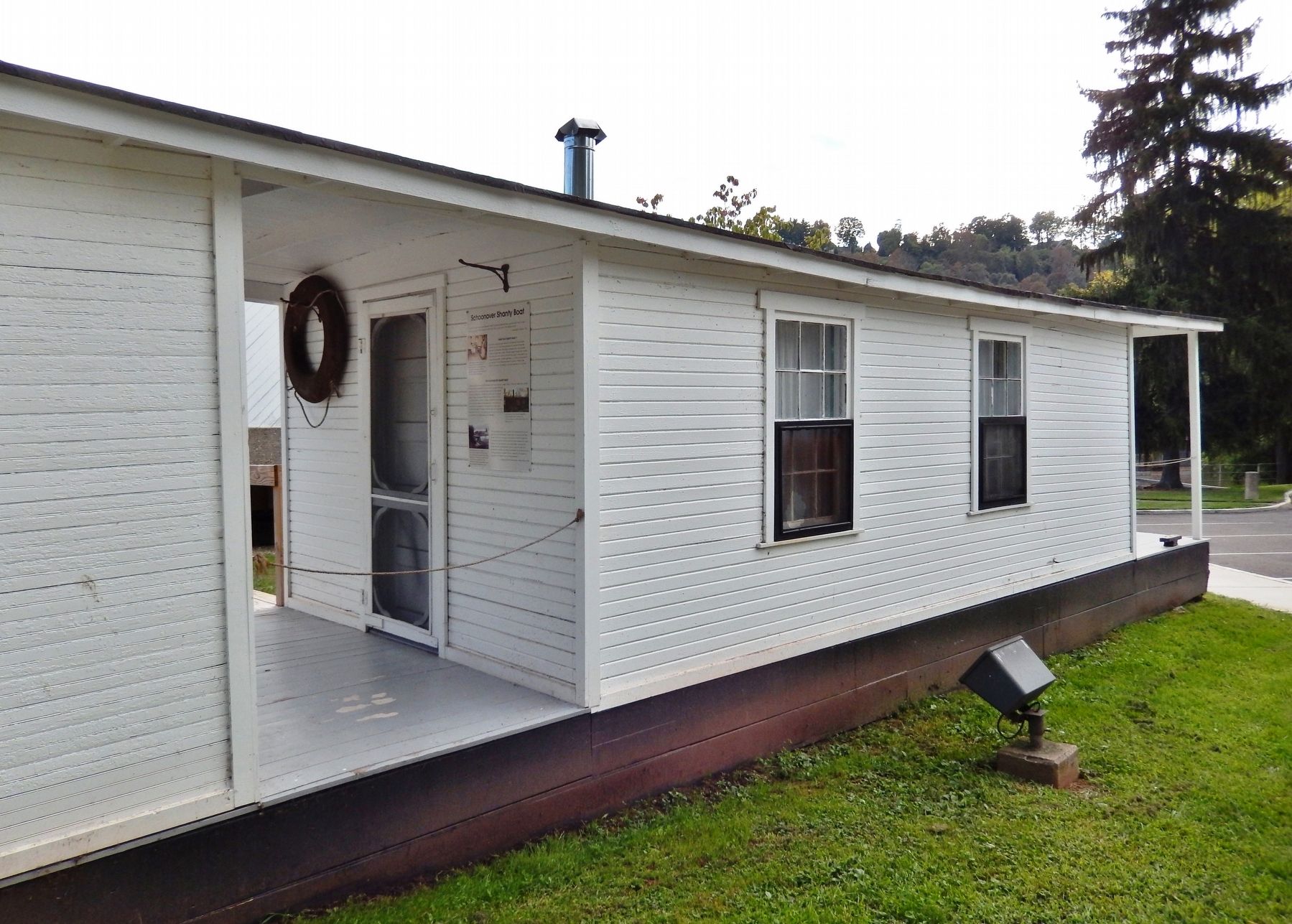
(marker visible just to the right of the door)
Credits. This page was last revised on March 28, 2021. It was originally submitted on March 28, 2021, by Cosmos Mariner of Cape Canaveral, Florida. This page has been viewed 1,023 times since then and 35 times this year. Photos:1, 2, 3, 4, 5, 6, 7. submitted on March 28, 2021, by Cosmos Mariner of Cape Canaveral, Florida.