
Albemarle High School near Charlottesville in Albemarle County, Virginia — The American South (Mid-Atlantic)
“The Albemarle 26”
Pioneers of Equality in Education
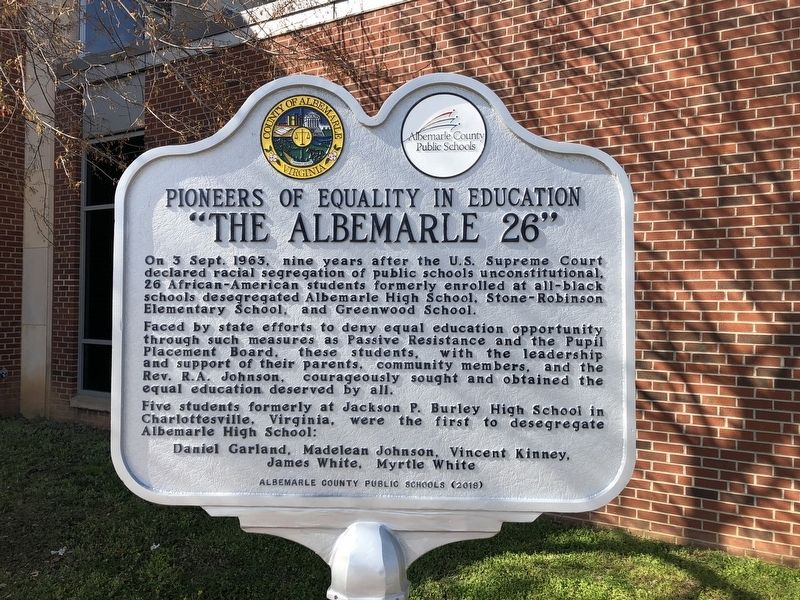
On 3 Sept. 1963, nine years after the U.S. Supreme Court declared racial segregation of public schools unconstitutional, 26 African-American students formerly enrolled at all-black schools desegregated Albemarle High School, Stone-Robinson Elementary School, and Greenwood School.
Faced by state efforts to deny equal education opportunity through such measures such as Passive Resistance and the Pupil Placement Board, these students, with the leadership and support of their parents, community members, and the Rev. R.A. Johnson, courageously sought and obtained the equal education deserved by all.
Five students formerly at Jackson P. Burley High School in Charlottesville, Virginia, were the first to desegregate Albemarle High School:
Daniel Garland, Madelean Johnson, Vincent Kinney, James White, Myrtle White
Erected 2018 by Albemarle County Public Schools.
Topics. This historical marker is listed in these topic lists: African Americans • Civil Rights • Education. A significant historical date for this entry is September 3, 1963.
Location. 38° 4.505′ N, 78° 29.991′ W. Marker is near Charlottesville, Virginia,
this page online

Regionally, this marker is in the Piedmont and in Central Virginia. It is also in the American South and specifically in the Upper South. Globally, it is in North America, the Western Hemisphere, the Western World, and the Anglosphere. Historically, it finds itself in what was once the territory of the Mississippian Culture, one of the original Thirteen Colonies, one of the Confederate States of America, and the Antebellum South.
Other nearby markers. At least 8 other markers are within 2 miles of this marker, measured as the crow flies: The Origins of Ivy Creek Natural Area (approx. 1.2 miles away); Legacy of Hugh Carr / The Village of Hydraulic Mills (approx. 1.2 miles away); Six Miles of Trails (approx. 1.2 miles away); Old Springs (approx. 1.3 miles away); Rio Hill 1864 Skirmish
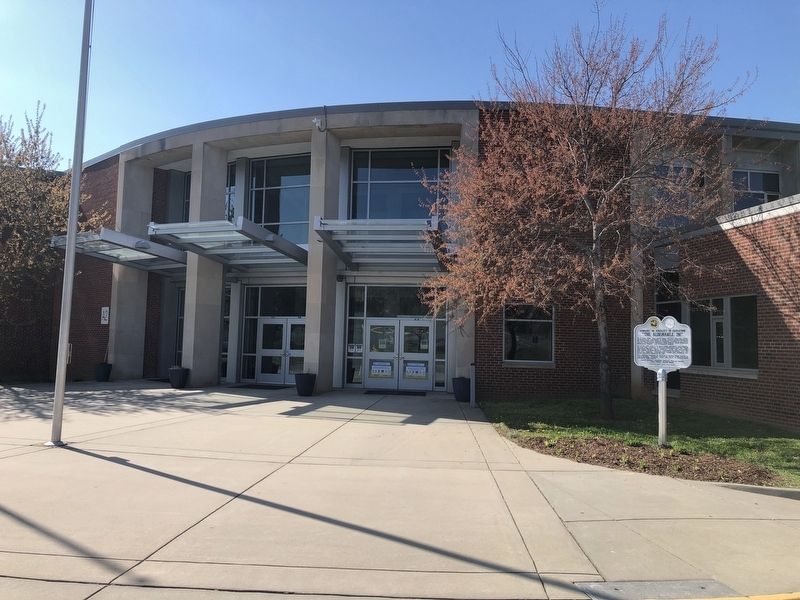
Another marker is no longer nearby. Albemarle Barracks Burial Site (was approx. 1.7 miles away but has been confirmed missing).
Related markers. Click here for a list of markers that are related to this marker. There are three historical markers in Albemarle County with this title. For all three markers, the first paragraph is the same.
Additional commentary.
1. Passive Resistance
In opposition to the 1954 Supreme Court ruling outlawing school segregation, Virginia’s government instituted a policy of Massive Resistance, resulting in the closure of schools in the City of Charlottesville, Norfolk, Warren County, and Prince Edward County. Schools in Albemarle County were not subject to Massive Resistance and remained open. Instead, integration was subverted through tactics such as the use of pupil placement boards and the construction of new schools for black students. These strategies were known as Passive Resistance, a term previously used to describe the protest method advocated by Ghandi in the early 1900s. Ghandi later abandoned the use of the term Passive Resistance in favor of Satyagraha (Truth-force). Note To Editor only visible by Contributor and editor
— Submitted April 24, 2026, by Karen Waters of Charlottesville, Virginia.
Additional keywords. Massive Resistance
Credits. This page was last revised on May 8, 2026. It was originally submitted on April 4, 2021, by Devry Becker Jones of Washington, District of Columbia. This page has been viewed 1,412 times since then and 79 times this year. Photos: 1, 2. submitted on April 4, 2021, by Devry Becker Jones of Washington, District of Columbia.
