Native American Culture
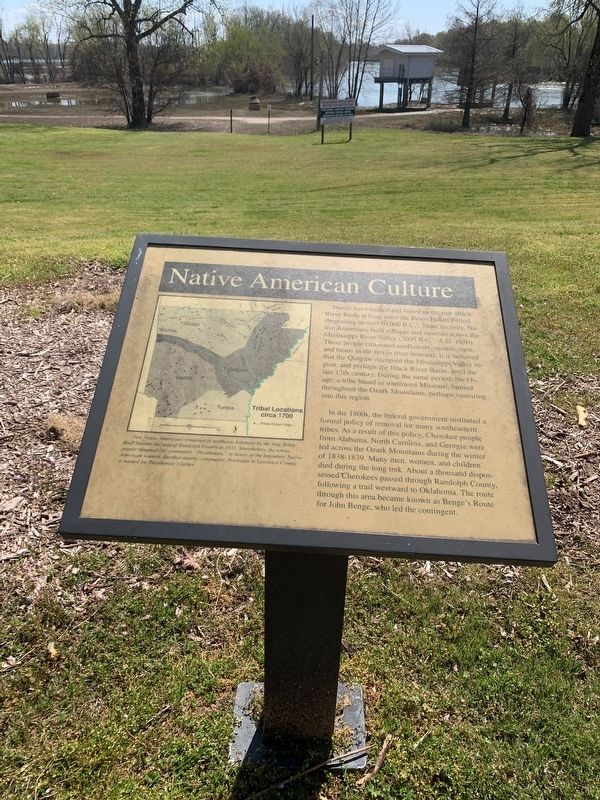
People have hunted and fished in the rich Black River Basin at least since the Paleo Indian Period (beginning around 10,000 B.C.). More recently, Native American built villages and mounds across the Mississippi River valley (3000 B.C.-A.D.1650). These people cultivated sunflowers, squash, corn, and beans in the fertile river bottoms. It is believed that the Quapaw occupied the Mississippi Valley region, and perhaps the Black River Basin, until the late 17th century. During the same period, the Osage, a tribe based in southwest Missouri, hunted throughout the Ozark Mountain, perhaps venturing into this region.
In the 1800s, the federal government instituted a formal policy of removal for many southeastern tribes. As a result of this policy. Cherokee people from Alabama, north Carolina, and Georgia were led across the Ozark Mountains during the winter of 1838-1839. Many men, women, and children died during the long trek. About a thousand disposed Cherokees passed though Randolph County, following a trail westward to Oklahoma. The route through this area became know as Benge's Route for John Benge, who led the contingent.
[Caption:]
Few Native Americans remained in northeast Arkansas by the time Bettis Bluff became the seat of Randolph County in 1835. Nonetheless, the townspeople renamed the community "Pocahontas," in honor of the legendary Native American woman. Another nearby community, Powhatan in Lawrence County, is named for Pocahontas's father.
Erected by City
this page online
Topics. This historical marker is listed in these topic lists: Anthropology & Archaeology • Indigenous Peoples and Communities. A significant historical year for this entry is 1838.
Location. 36° 15.599′ N, 90° 58.152′ W. Marker is in Pocahontas, Arkansas, in Randolph County. It is on U.S. 62/67 north of South Bettis Street, on the right when traveling north. Touch for map. Marker is at or near this postal address: 109 Hwy 67, Pocahontas AR 72455, United States of America. Touch for directions.

Regionally, this marker is in the American South, specifically in the Upper South, and in the Ozarks. Globally, it is in North America, the Western Hemisphere, the Western World, and the Anglosphere. Historically, it finds itself in what was once the territory of the Mississippian Culture, the Louisiana Purchase, one of the Confederate States of America, and the Antebellum South.
Other nearby markers. At least 8 other markers are within walking distance of this marker: The River Basin (a few steps from this marker); Settlement (a few steps from this marker); A Shipping Route (a few steps from this marker);
Additional keywords. forced relocation; genocide
Credits. This page was last revised on April 10, 2021. It was originally submitted on April 7, 2021, by Thomas Smith of Waterloo, Ill. This page has been viewed 1,020 times since then and 30 times this year. Photos: 1. submitted on April 7, 2021, by Thomas Smith of Waterloo, Ill. 2. submitted on April 8, 2021, by Mark Hilton of Montgomery, Alabama. • Devry Becker Jones was the editor who published this page.
