
Blue Dome District in Tulsa in Tulsa County, Oklahoma — The American South (West South Central)
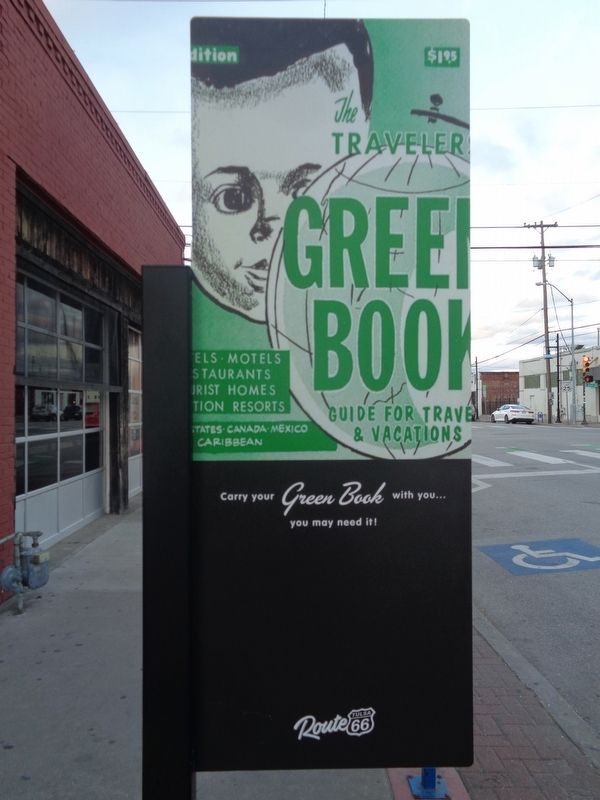
The Green Book
| — | Tulsa's Historic Route 66 | — |

Photographed by Jason Voigt, April 7, 2021
1. The Green Book Marker
Route 66 and the businesses that lined the Mother Road reflected American culture of the period. A free-spirited sense of adventure and opportunity was part of American life, but there was also very serious racial discrimination. African American travelers in particular faced significantly limited options when it came time to eat, stop for the night, fuel up or service their car. While Route 66 maps and travel guides were widely available, they did not accurately reflect the options available to African American travelers.
Between 1936 and 1964, postal worker Victor H. Green published "the Green Book" (officially the Negro Motorist Green Book or the Negro Traveler's Green Book) to help African American travelers find welcoming businesses on the road away from home. The guide included hotels and tourist homes, restaurants, and service stations, as well as beauty parlors and beauty shops, tailors, night clubs, and more.
During the heyday of Route 66, Tulsa was a segregated city with an African American commercial district located on Greenwood Avenue just north of downtown. As you might expect, most of the Tulsa businesses
this page online
Erected 2019 by Tulsa Route 66 Commission. (Marker Number 17.)
Topics and series. This historical marker is listed in these topic lists: African Americans • Communications • Industry & Commerce • Roads & Vehicles. In addition, it is included in the U.S. Route 66 series list. A significant historical year for this entry is 1936.
Location. 36° 9.36′ N, 95° 59.23′ W. Marker is in Tulsa, Oklahoma, in Tulsa County. It is in the Blue Dome District. It is on East 2nd Street west of South Elgin Avenue. Touch for map. Marker is at or near this postal address: 323 E 2nd St, Tulsa OK 74120, United States of America. Touch for directions.

Regionally, this marker is in Oklahoma’s Muscogee Nation and specifically in the Cherokee Nation. It is also in the American South, specifically on the prairies, and on the Southern Plains. Globally, it is in North America, the Western
Photographed by Jason Voigt, April 7, 2021
2. The Green Book Marker Reverse
Other nearby markers. At least 8 other markers are within walking distance of this marker: Blue Dome District (a few steps from this marker); Tulsa Union Depot (approx. 0.2 miles away); Tulsa Municipal Building (approx. 0.2 miles away); Tulsa (approx. ¼ mile away); U-Haul of “Downtown” (approx. ¼ mile away); 504 E. Archer (at Greenwood) (approx. ¼ mile away); The Mid-Continent Building (approx. ¼ mile away); 100 Block North Greenwood Avenue (approx. ¼ mile away). Touch for a list and map of all markers in Tulsa.
More about this marker. Unlike most of the markers in this series (Tulsa's Route 66), this did not have a map to go with it (in 2021).
Also see . . . The Negro Motorist Green Book on Wikipedia. From 1936 to 1966, this was published annually, mostly targeting middle-class African Americans. (Submitted on April 7, 2021, by Jason Voigt of Glen Carbon, Illinois.)
Photographed by Jason Voigt, April 7, 2021
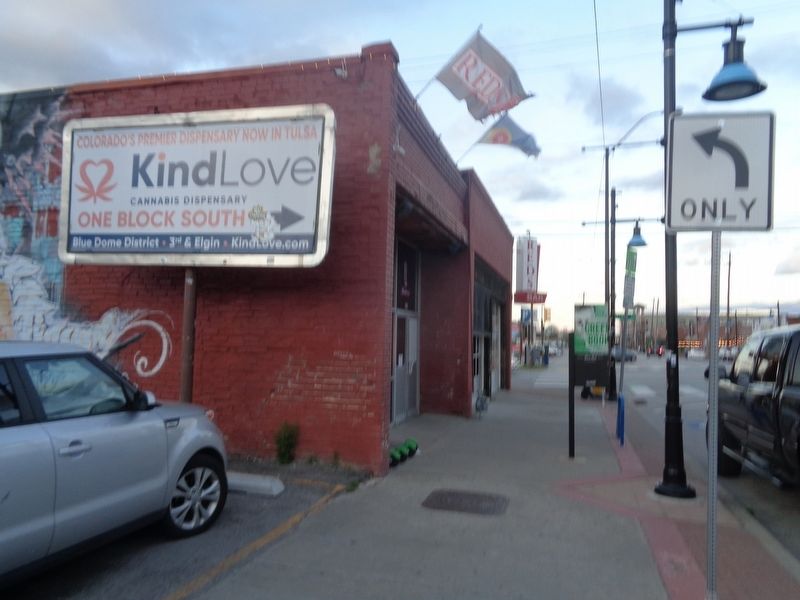
3. The Green Book Marker
Outside Red's Bar
Credits. This page was last revised on April 26, 2026. It was originally submitted on April 7, 2021, by Jason Voigt of Glen Carbon, Illinois. This page has been viewed 998 times since then and 60 times this year. Photos: 1, 2, 3. submitted on April 7, 2021, by Jason Voigt of Glen Carbon, Illinois.
