Trade helped the Indians develop ties with Hernando de Soto

The Europeans brought beads, metal bells, horses, pigs and a variety of fruits and vegetables to trade with the Southeastern Indians.
Beads and bells were the first items traded here
De Soto offered glass beads and metal bells to tribal
leaders during his expedition. The Indians often responded
with gifts of fish, maize, or animal skins. Despite this polite
exchange, Southeastern Indians were wary of the Spaniards.
What does a bell mean?
When a bell like this is found in
the southern United States, it is
considered evidence for Indian
trade with European expeditions
such as that of Hernando de Soto.
Did you know that the Spanish brought horses
to the New World?
America's first horses arrived with
Spanish explorers in the 1500s.
When the Indians saw men on
horseback, they thought the man
and horse were one creature.
Food crossed continents in trade with the Indians
These foods grew in the Old World and
were brought to the Americas: Apples,
Broccoli, Coffee, Lemons, Lettuce,
Olives, Peaches, Wheat
Spanish pigs became the First Barbecue
De Soto was the first documented European to see the Mississippi
Proof of a Spanish visit?
The Europeans changed the Indian way of life
with trade, but their greatest impact came from
the diseases they brought with them. Because
Indians had no resistance to diseases that were
of European origin, contact with the explorers
proved deadly. Entire villages perished
this page online
These foods originated in the Americas
and were taken to the Old World: Avocado,
Beans, Cocoa, Corn, Peanuts, Potatoes,
Squash, Tomatoes
Pigs were unknown in America before de Soto
arrived here with hundreds of swine intended for
food and trade. Southeastern Indians, who liked
the tasty pork, smoked the meat over a raised grill
that the Spaniards called a "barbacoa"—from
which the term barbecue is derived. This culinary
exchange is referred to as the "First Barbecue"
and it happened right here in Mississippi!
After two years navigating the Southeast's swamps and
forests in search of gold, Spanish explorer Hernando de
Soto reached the banks of the Mississippi River in 1541.
He and his 650 men were the first documented
non-Native people to see and cross the great river.
This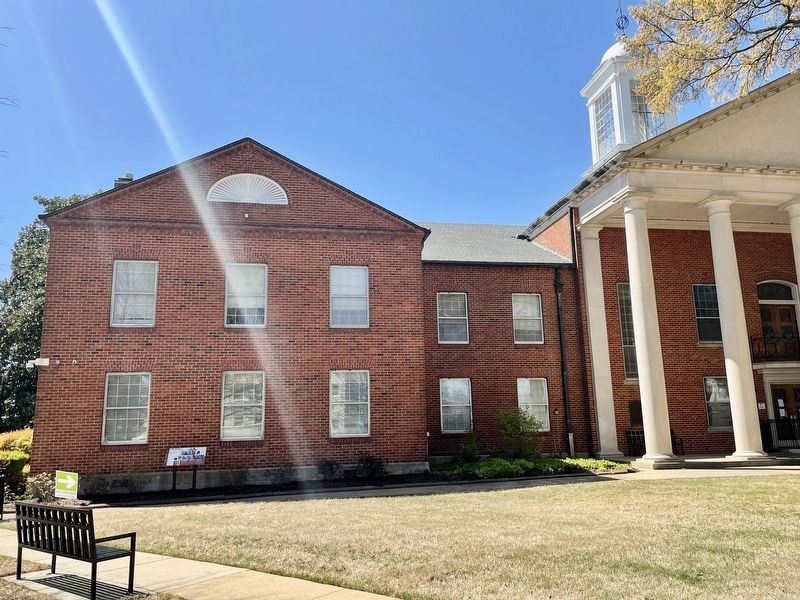
Erected by Mississippi Delta National Heritage Area, National Park Service.
Topics. This historical marker is listed in these topic lists: Exploration • Indigenous Peoples and Communities. A significant historical year for this entry is 1541.
Location. 34° 49.37′ N, 89° 59.676′ W. Marker is in Hernando, Mississippi, in DeSoto County. It is on U.S. 51 south of West Commerce Street, on the right when traveling south. Located at the DeSoto County Courthouse. Touch for map. Marker is at or near this postal address: 2535 US-51, Hernando MS 38632, United States of America. Touch for directions.
Regionally, this marker is in the American South, specifically in the Deep South, in the Mississippi Delta, and in the Great River Road Region. Globally, it is in North America, a Gulf of Mexico state, the Western Hemisphere, the Western World, and the Anglosphere. Historically, it finds itself in what was once the territory of
Other nearby markers. At least 8 other markers are within walking distance of this marker: Historic artwork in this courthouse portrays our regions past (within shouting distance of this marker); Hernando (within shouting distance of this marker); The Dickinson Family (about 400 feet away, measured in a direct line); 421 Commerce Street (about 600 feet away); 449 Commerce Street (approx. 0.2 miles away); "Beale Town Bound" (approx. 0.2 miles away); Baptist Industrial College (approx. 0.4 miles away); Springhill Cemetery (approx. 0.6 miles away). Touch for a list and map of all markers in Hernando.
Credits. This page was last revised on April 9, 2021. It was originally submitted on April 9, 2021, by Mark Hilton of Montgomery, Alabama. This page has been viewed 1,159 times since then and 109 times this year. Photos: 1, 2, 3. submitted on April 9, 2021, by Mark Hilton of Montgomery, Alabama.
