Resaca in Gordon County, Georgia — The American South (South Atlantic)
Did You Know That Both Sides Used Red, White and Blue Flags?
Photographed by Duane and Tracy Marsteller, April 11, 2021
1. Did You Know That Both Sides Used Red, White and Blue Flags? Marker
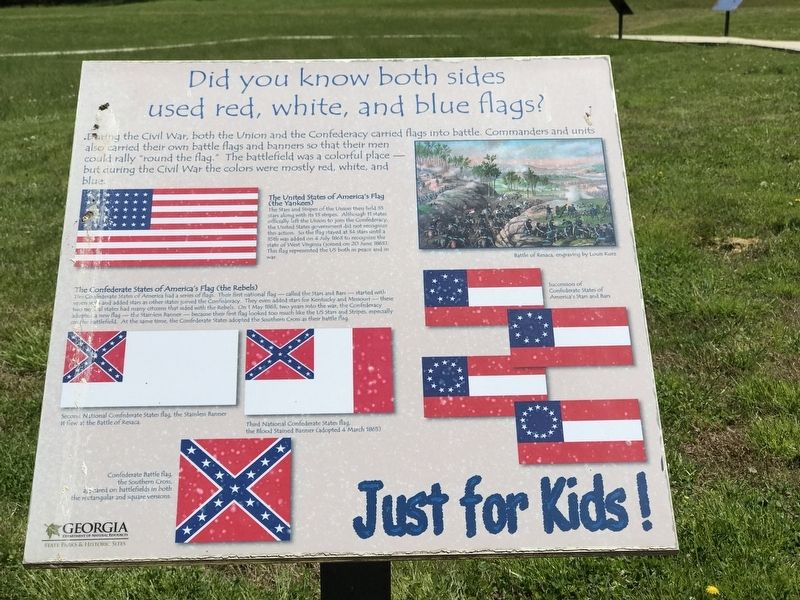
The United States of America's Flag (the Yankees)
The Stars and Stripes of the Union then held 35 stars along with its 13 stripes. Although 11 states officially left the Union to join the Confederacy, the United States government did not recognize this action. So the flag stayed at 34 stars until a 35th was added on 4 July 1863 to recognize the state of West Virginia (joined on 20 June 1863). This flag represented the US both in peace and in war.
The Confederate States of America's Flag (the Rebels)
The Confederate States of America had a series of flags. Their first national flag – called the Stars and Bars — started with seven stars and added stars as other states joined the Confederacy. They even added stars for Kentucky and Missouri — these two neutral states had many citizens
this page online
Captions:
Bottom left, clockwise from top left:
• Second National Confederate States flag, the Stainless Banner. It flew at the Battle of Resaca.
• Third National Confederate States flag, the Blood Stained Banner (adopted 4 March 1865)
• Confederate Battle flag, the Southern Cross, appeared on battlefields in both the rectangular and square versions.
Top right: Battle of Resaca, engraving by Louis Kurz
Bottom right: Succession of Confederate States of America's Stars and Bars
Erected by Georgia Department of Natural Resources - State Parks and Historic Sites.
Topics and series. This historical marker is listed in this topic list: War, US Civil. In addition, it is included in the Vexillology series list.
Location. 34° 35.733′ N, 84° 57.73′ W. Marker
Photographed by Duane and Tracy Marsteller, April 11, 2021
2. Did You Know That Both Sides Used Red, White and Blue Flags? Marker

Regionally, this marker is in the Mountains. It is also in the American South, specifically in the Deep South, in Appalachia, and specifically in Southern Appalachia. Globally, it is in North America, the Western Hemisphere, the Western World, and the Anglosphere. Historically, it finds itself in what was once the original Cherokee Nation, the territory of the Mississippian Culture, one of the original Thirteen Colonies, one of the Confederate States of America, and the Antebellum South.
Other nearby markers. At least 8 other markers are within walking distance of this marker: Site of Action — Judah's Division (here, next to this marker); Picturing a 19th-century Battle (a few steps from this marker); Resaca Battlefield State Historic Site (within shouting distance of this marker); Enduring the Battle of Resaca (within shouting distance of this marker); Stories from the Wild Hills of Resaca (within shouting distance of this marker); Site of Action — Carlin's Brigade (approx. ¼ mile away); How to Tell the Yankees from the Rebels! (approx. ¼ mile away); 103rd O.V.I. (approx. 0.4 miles away). Touch for a list and map of all markers in Resaca.
Credits. This page was last revised on April 14, 2021. It was originally submitted on April 14, 2021, by Duane and Tracy Marsteller of Murfreesboro, Tennessee. This page has been viewed 352 times since then and 48 times this year. Photos: 1, 2. submitted on April 14, 2021, by Duane and Tracy Marsteller of Murfreesboro, Tennessee.
