
French Quarter in New Orleans in Orleans Parish, Louisiana — The American South (West South Central)
Sugar Wharves at the Port
Photographed by Cosmos Mariner, May 10, 2018
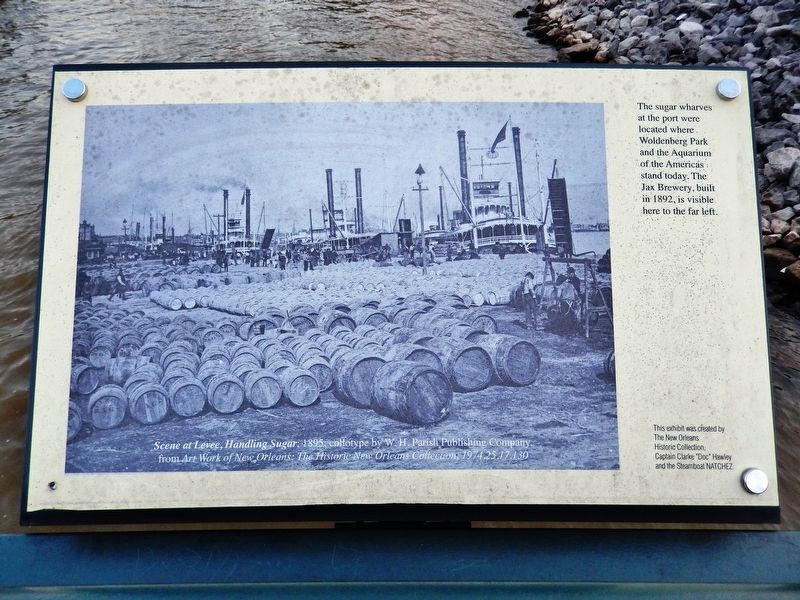
1. Sugar Wharves at the Port Marker
The sugar wharves at the port were located where Woldenberg Park and the Aquarium of the Americas stand today. The Jax Brewery, built in 1892, is visible here to your far left.
Erected by The New Orleans Historic Collection, Captain Clarke "Doc" Hawley and the Steamboat Natchez.
Topics. This historical marker is listed in these topic lists: Industry & Commerce • Waterways & Vessels. A significant historical year for this entry is 1892.
Location. 29° 57.302′ N, 90° 3.756′ W. Marker is in New Orleans, Louisiana, in Orleans Parish. It is in the French Quarter. It can be reached from Toulouse Street east of Decatur Street, on the right when traveling east. Marker is located along the Mississippi Riverwalk, on the Mississippi River Pier at Woldenberg Park. Touch for map. Marker is at or near this postal address: 400 Toulouse Street, New Orleans LA 70130, United States of America. Touch for directions.

Regionally, this marker is in Louisiana’s River Parishes. It is also in the American South, specifically in the Deep South, on the Gulf Coast, and in the Great River Road Region. Globally, it is in North America,
this page online
Other nearby markers. At least 8 other markers are within walking distance of this marker: Riverboat Cotton Bales (here, next to this marker); Natchez Steamboats (here, next to this marker); Picayune Pier (within shouting distance of this marker); Work Begins on New Orleans, Spring 1718 (about 400 feet away, measured in a direct line); Monument to the Immigrant (about 500 feet away); Transatlantic Slave Trade to Louisiana (about 500 feet away); Execution of Jean Baptiste Baudrau II (about 600 feet away); Importer's Bonded Warehouses - Henry Howard, Architect (about 600 feet away). Touch for a list and map of all markers in New Orleans.
Also see . . . The Sugar Landing Era: 1830-1870. One 11 Hotel website entry:
In the mid to late 18th century, the cultivation of sugarcane was so intertwined with New
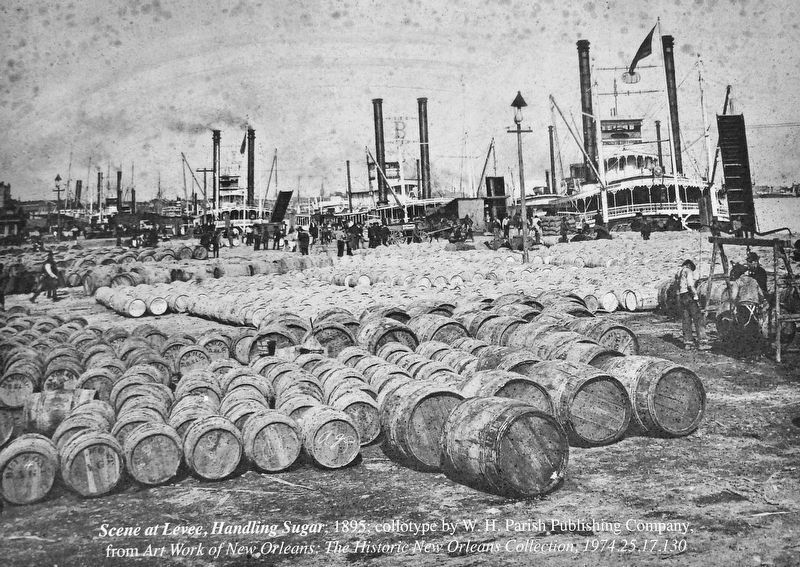
2. Marker detail: Scene at Levee, Handling Sugar; 1895
Photographed by Cosmos Mariner, May 10, 2018
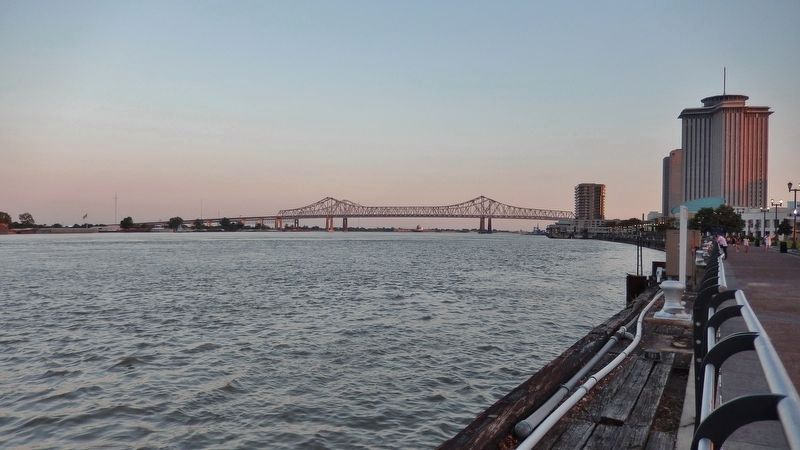
3. Mississippi River & Bridge
Credits. This page was last revised on February 12, 2023. It was originally submitted on April 15, 2021, by Cosmos Mariner of Cape Canaveral, Florida. This page has been viewed 405 times since then and 45 times this year. Photos: 1, 2, 3. submitted on April 15, 2021, by Cosmos Mariner of Cape Canaveral, Florida.
