Greenwood District in Tulsa in Tulsa County, Oklahoma — The American South (West South Central)
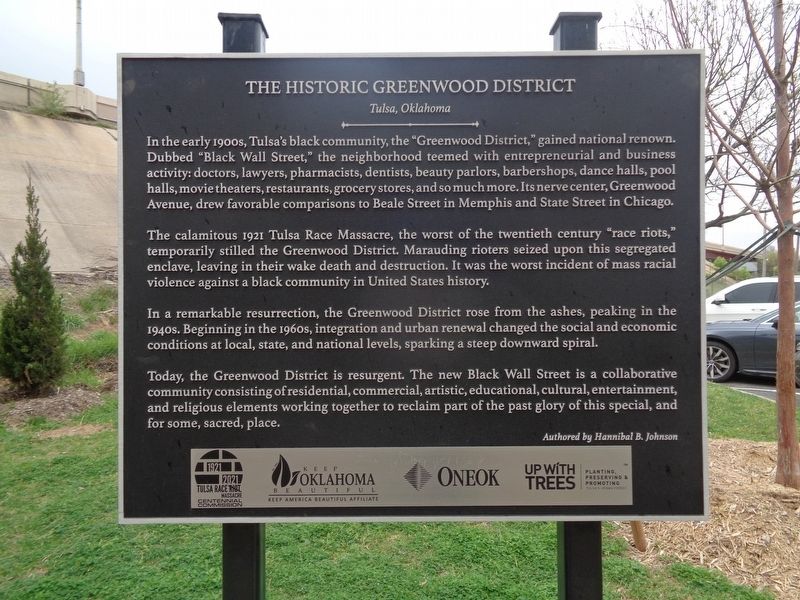
The Historic Greenwood District
Tulsa, Oklahoma
Photographed by Jason Voigt, April 7, 2021
1. The Historic Greenwood District Marker
The calamitous 1921 Tulsa Race Massacre, the worst of the twentieth century "race riots," temporarily stilled the Greenwood District. Marauding rioters seized upon this segregated enclave, leaving in their wake death and destruction. It was the worst incident of mass racial violence against a black community in United States history.
In a remarkable resurrection, the Greenwood District rose from the ashes, peaking in the 1940s. Beginning in the 1960s, integration and urban renewal changed the social and economic conditions at local, state, and national levels, sparking a steep downward spiral.
Today, the Greenwood District is resurgent. The new Black Wall
this page online
Authored by Hannibal B. Johnson
Erected by 1921 Tulsa Race Massacre Centennial Commission, Keep Oklahoma Beautiful, OneOK, Up With Trees.
Topics. This historical marker is listed in these topic lists: African Americans • Civil Rights • Industry & Commerce. A significant historical year for this entry is 1921.
Location. 36° 9.622′ N, 95° 59.172′ W. Marker is in Tulsa, Oklahoma, in Tulsa County. It is in the Greenwood District. It is on North Greenwood Avenue north of East Archer Street, on the right when traveling north. Touch for map. Marker is at or near this postal address: 125 N Greenwood Ave, Tulsa OK 74120, United States of America. Touch for directions.

Regionally, this marker is in Oklahoma’s Muscogee Nation, specifically in the Cherokee Nation, and in Northeast Oklahoma—Green Country. It is also in the American South, specifically on the prairies, and on the
Photographed by Jason Voigt, April 7, 2021
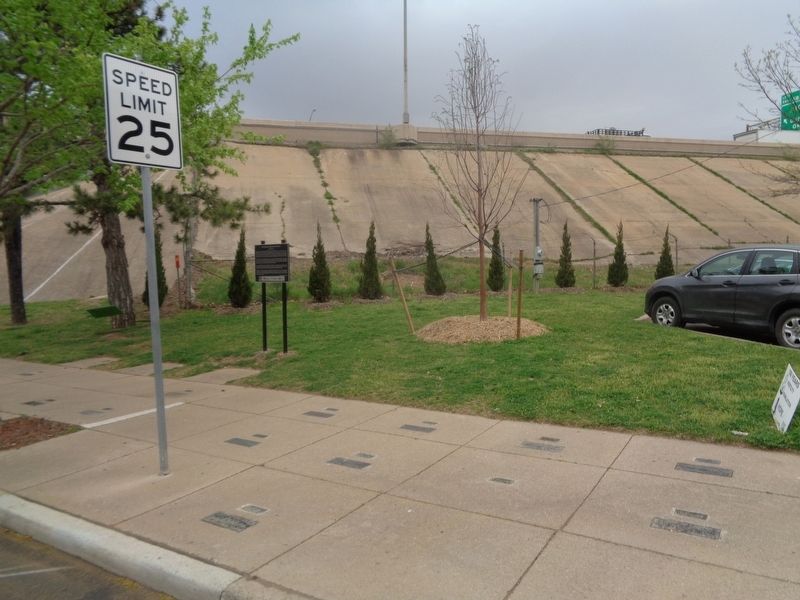
2. The Historic Greenwood District Marker
Interstate 244 is in the background
Other nearby markers. At least 8 other markers are within walking distance of this marker: Dreamland Theater (here, next to this marker); 100 Block North Greenwood Avenue (within shouting distance of this marker); A Bench by the Road (within shouting distance of this marker); Historic Vernon AME Church Prayer Wall for Racial Healing (about 300 feet away, measured in a direct line); Lynching in America / The 1921 Tulsa Massacre (about 400 feet away); 504 E. Archer (at Greenwood) (about 400 feet away); Vernon A.M.E. Church (about 400 feet away); U-Haul of “Downtown” (about 400 feet away). Touch for a list and map of all markers in Tulsa.
Also see . . . Tulsa's Greenwood District on Wikipedia. (Submitted on April 20, 2021, by Jason Voigt of Glen Carbon, Illinois.)
Credits. This page was last revised on February 16, 2023. It was originally submitted on April 20, 2021, by Jason Voigt of Glen Carbon, Illinois. This page has been viewed 1,055 times since then and 65 times this year. Photos: 1, 2. submitted on April 20, 2021, by Jason Voigt of Glen Carbon, Illinois.
