St. Marks in Wakulla County, Florida — The American South (South Atlantic)
The Old Store on the Wakulla River
1784-1804
Photographed by Cosmos Mariner, May 3, 2021
1. The Old Store on the Wakulla River Marker
(front side)
(front side)
[front side]
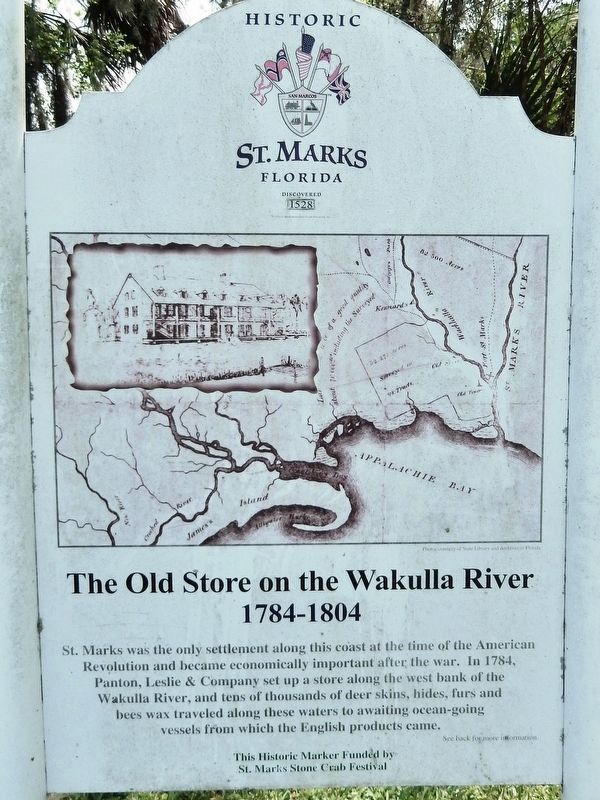
St. Marks was the only settlement along this coast at the time of the American Revolution and became economically important after the war. In 1784, Panton, Leslie & Company set up a store along the west bank of the Wakulla River, and tens of thousands of deer skins, hides, furs and bees wax traveled along these waters to awaiting ocean-going vessels from which the English products came.
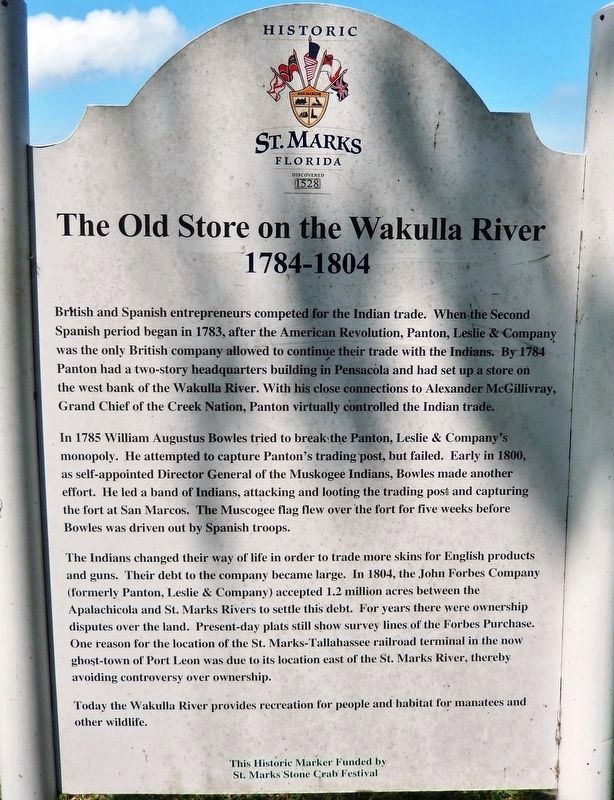
British and Spanish entrepreneurs competed for the Indian trade. When the Second Spanish period began in 1783, after the American Revolution, Panton, Leslie & Company was the only British company allowed to continue their trade with the Indians. By 1784 Panton had a two-story headquarters building in Pensacola and had set up a store on the west bank of the Wakulla River. With his close connections to Alexander McGillivray, Grand Chief of the Creek Nation, Panton virtually controlled the Indian trade.
In 1785 William Augustus Bowles tried to break the Panton, Leslie & Company's monopoly. He attempted to capture Panton's trading post, but failed. Early in 1800, as self-appointed Director General
this page online
The Indians changed their way of life in order to trade more skins for English products and guns. Their debt to the company became large. In 1804, the John Forbes Company (formerly Panton, Leslie & Company) accepted 1.2 million acres between the Apalachicola and St. Marks Rivers to settle this debt. For years there were ownership disputes over the land. Present-day plats still show survey lines of the Forbes Purchase. One reason for the location of the St. Marks-Tallahassee railroad terminal in the now ghost-town of Port Leon was due to its location east of the St. Marks River, thereby avoiding controversy over ownership.
Today the Wakulla River provides recreation for people and habitat for manatees and other wildlife.
St. Marks Stone Crab Festival
Erected by St. Marks Stone Crab Festival.
Topics. This historical marker is listed in these topic
Photographed by Cosmos Mariner, May 3, 2021
2. The Old Store on the Wakulla River Marker
(back side)
(back side)
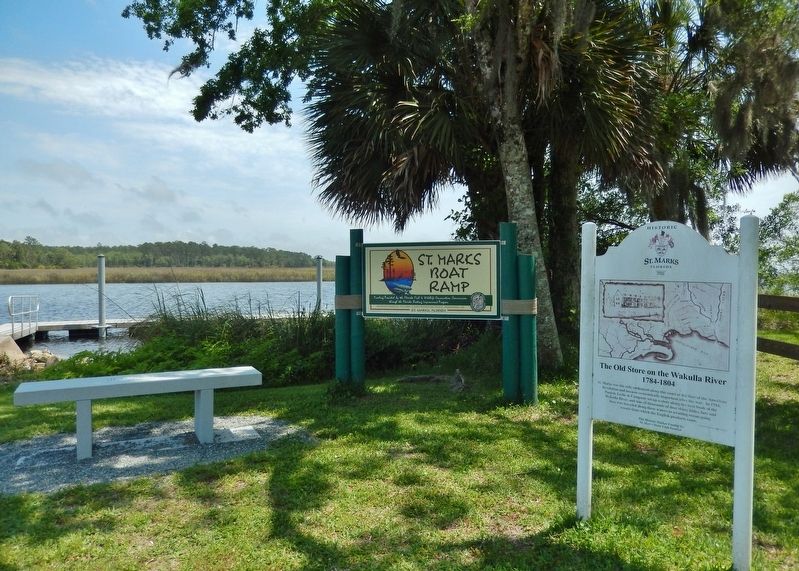
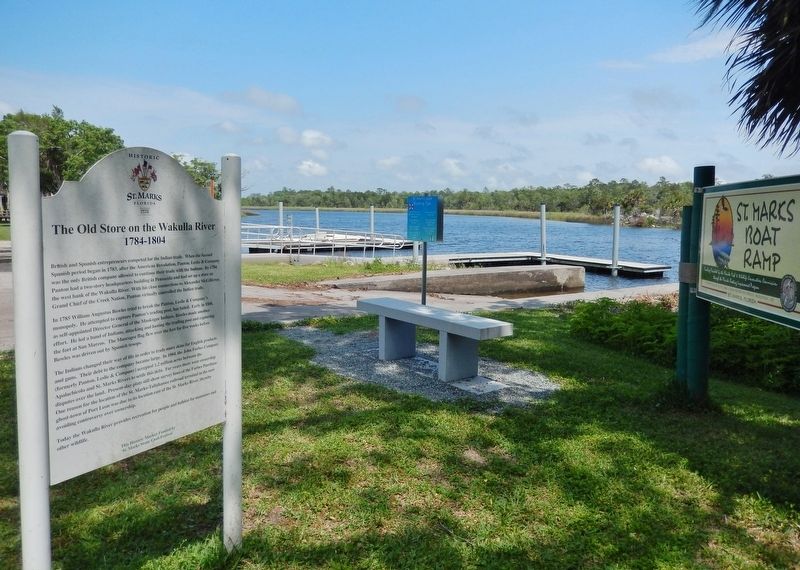
Location. 30° 9.085′ N, 84° 12.599′ W. Marker is in St. Marks, Florida, in Wakulla County. It is at the intersection of Old Fort Road and River Breeze Street when traveling south on Old Fort Road. Marker is located beside the St. Marks Boat Ramp at the south end of Old Fort Road, near St. Marks River Park. Touch for map. Marker is at or near this postal address: 148 Old Fort Road, Saint Marks FL 32355, United States of America. Touch for directions.

Regionally, this marker is in Greater Tallahassee. It is also in the American South, specifically in the Deep South, and on the Gulf Coast. Globally, it is in the North Atlantic Region, North America, a Gulf of Mexico state, the Western Hemisphere, the Western World, and the Anglosphere. Historically, it finds itself in what was once New Spain, the territory of the Mississippian Culture, one of the Confederate States of America, and the Antebellum South.
Other nearby markers. At least 8 other markers
Photographed by Cosmos Mariner, May 3, 2021
3. The Old Store on the Wakulla River Marker
(St. Marks River in background)
(St. Marks River in background)
Also see . . .
1. Panton, Leslie & Company (Wikipedia). Panton, Leslie & Company was a company of Scottish merchants active in trading in the Bahamas and with the Native Americans of what is now the Southeastern United States during the late 18th and early 19th centuries. Having already established themselves in Florida and the Bahamas, the company was able to continue operating in Florida after the colony's return to Spain in 1783 because there were no Spanish traders interested in doing business with the region's Natives. (Submitted on May 3, 2021, by Cosmos Mariner of Cape Canaveral, Florida.)
2. William Augustus Bowles (Wikipedia).
Photographed by Cosmos Mariner, May 3, 2021
4. The Old Store on the Wakulla River Marker
(back side • St. Marks River in background)
(back side • St. Marks River in background)
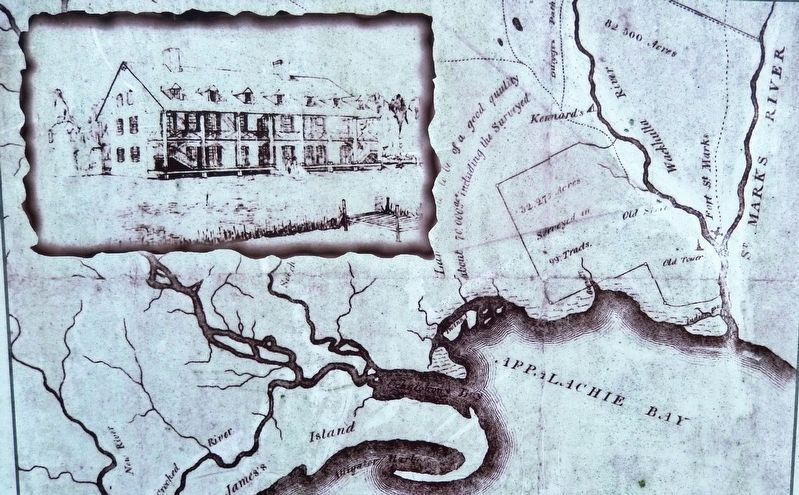
Courtesy State Library and Archives of Florida
5. Marker detail: Old Store & Map
Credits. This page was last revised on November 29, 2024. It was originally submitted on May 3, 2021, by Cosmos Mariner of Cape Canaveral, Florida. This page has been viewed 1,439 times since then and 158 times this year. Photos: 1, 2, 3, 4, 5. submitted on May 3, 2021, by Cosmos Mariner of Cape Canaveral, Florida.
