Historic Lexington Train Station
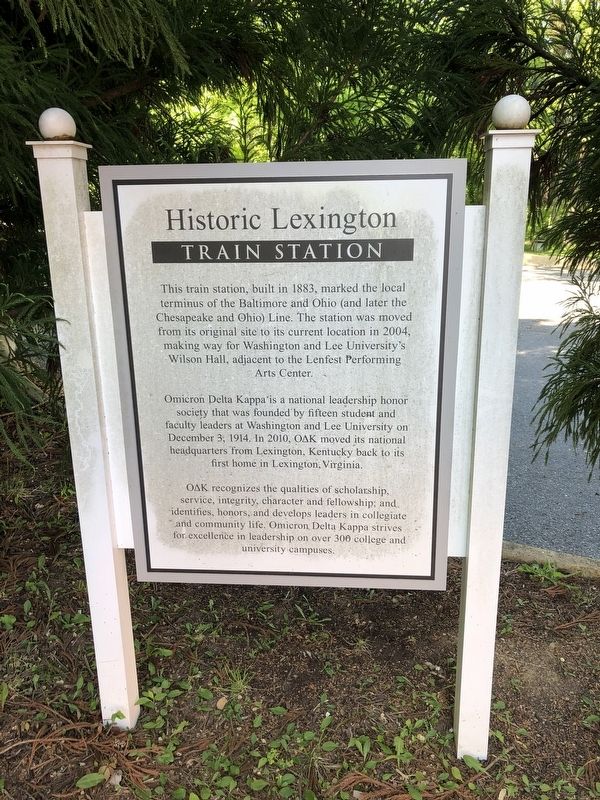
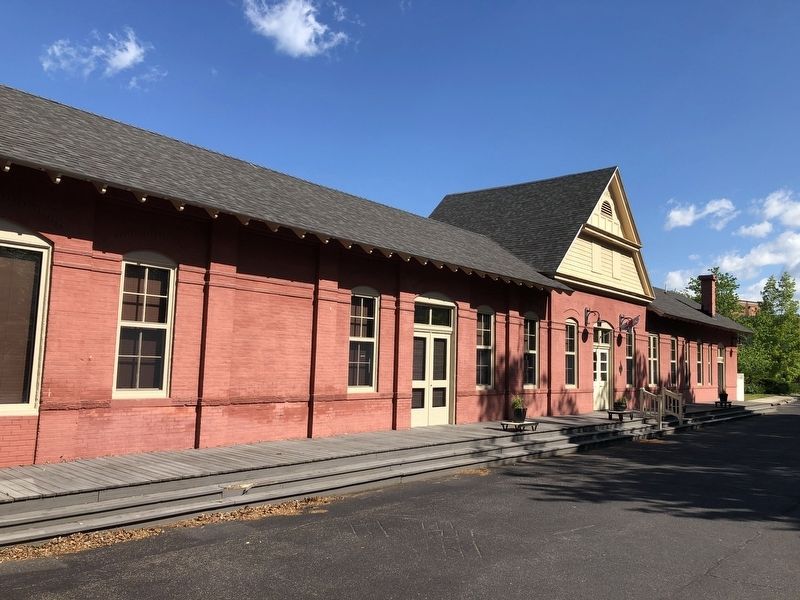
This train station, built in 1883, marked the local terminus of the Baltimore and Ohio (and later the Chesapeake and Ohio) Line. The station was moved from its original site to its current location in 2004, making way for Washington and Lee University's Wilson Hall, adjacent to the Lenfest Performing Arts Center.
Omicron Delta Kappa is a national leadership honor society that was founded by fifteen student and faculty leaders at Washington and Lee University on December 3, 1914. In 2010, ΟΔΚ moved its national headquarters from Lexington, Kentucky back to its first home in Lexington, Virginia.
ΟΔΚ recognizes the qualities of scholarship, service, integrity, character and fellowship; and identifies, honors, and develops leaders in collegiate and community life. Omicron Delta Kappa strives for excellence in leadership on over 300 college and university campuses.
Erected by Omicron Delta Kappa.
Topics and series. This historical marker is listed in these topic lists: Charity & Public Work • Education • Fraternal or Sororal Organizations • Railroads & Streetcars.
this page online
Location. 37° 47.106′ N, 79° 26.892′ W. Marker is in Lexington, Virginia. It can be reached from Mclaughlin Street 0.1 miles Glasgow Street, on the left when traveling west. Touch for map. Marker is at or near this postal address: 306 W McDowell St, Lexington VA 24450, United States of America. Touch for directions.

Regionally, this marker is in the Shenandoah Valley. It is also in the American South and specifically in the Upper South. Globally, it is in North America, the Western Hemisphere, the Western World, and the Anglosphere. Historically, it finds itself in what was once the territory of the Mississippian Culture, one of the original Thirteen Colonies, one of the Confederate States of America, and the Antebellum South.
Other nearby markers. At least 8 other markers are within walking distance of this marker: Omicron Delta Kappa (within shouting distance of this marker); Alben W. Barkley (approx. 0.2 miles away); Matthew F. Maury (approx. 0.2 miles away); Cy Twombly (approx. ¼ mile away);
Additional commentary.
1. Six Trains a Day in 1925
The December 1925 Chesapeake and Ohio Railway passenger train schedules show three trains a day arriving at the Lexington station from Balcony Falls junction, just a mile beyond Glasgow. They made stops at Glasgow, Buena Vista, and East Lexington before arriving at Lexington’s station. After a layover, they returned to Balcony Falls.
Trains 200, 202 and 204 Left Balcony Falls at 6:30 AM, 9:05 AM, and 5:03 PM respectively, arriving in Lexington at 7:30 AM, 10:15 AM, and 6:08 PM. Trains 201, 203, and 205 were the return trains, leaving Lexington at 7:45 AM, 3:45 PM and 6:13 PM. At the beginning and end college terms, additional cars and extra trains were made available to transport students to and from Lexington.
The Lexington Branch of the C&O was only 21 miles long, so they were very slow trains. At Balcony Falls passengers could change to faster trains on C&O's Richmond-Lynchburg-Clifton
For departing students, the ticket agent in Lexington would issue multiple tickets to each student—one for each connecting train on their route—to get them to their final destination, which could be anywhere in the United States, Canada or Mexico. I suspect that end-of-term tickets were issued days and weeks in advance. Their luggage would be separately transferred through, train to train just like airlines do today, except at Lynchburg, where the passenger would have to claim their luggage and and transfer by taxi between the C&O and the Southern train stations, which were a little over a mile apart.
Credits. This page was last revised on May 19, 2024. It was originally submitted on May 9, 2021, by Devry Becker Jones of Washington, District of Columbia. This page has been viewed 1,501 times since then and 114 times this year. Photos: 1, 2, 3. submitted on May 9, 2021, by Devry Becker Jones of Washington, District of Columbia.
