Meatpacking District in Manhattan in New York County, New York — The American Northeast (Mid-Atlantic)
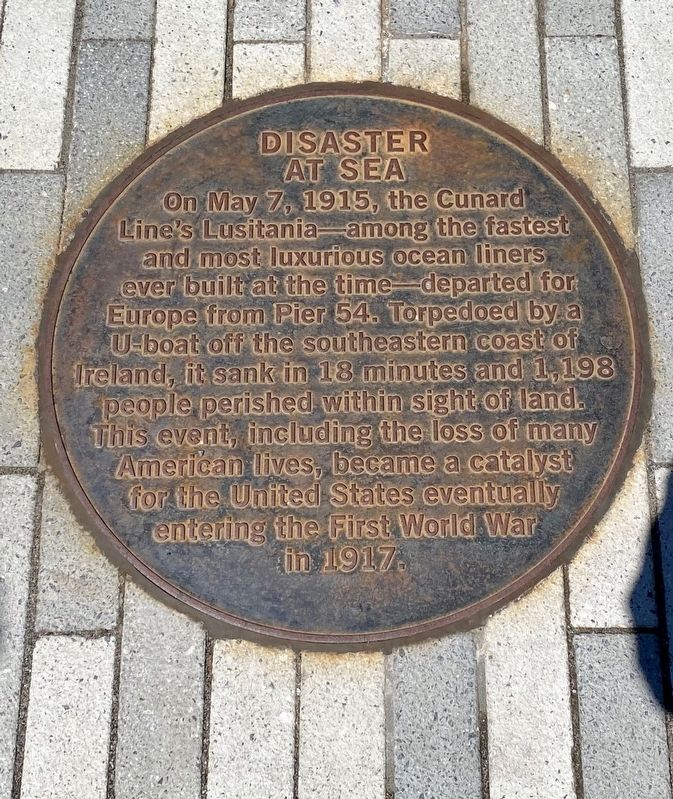
Disaster at Sea
Photographed by Andrew Ruppenstein, May 1, 2021
1. Disaster at Sea Marker
Topics and series. This historical marker is listed in these topic lists: Disasters • War, World I • Waterways & Vessels. In addition, it is included in the Lost at Sea series list. A significant historical date for this entry is May 7, 1915.
Location. 40° 44.474′ N, 74° 0.57′ W. Marker is in Manhattan, New York, in New York County. It is in the Meatpacking District. It can be reached from Hudson River Greenway. Touch for map. Marker is in this post office area: New York NY 10014, United States of America. Touch for directions.

Regionally, this marker is in New York City. It is also in the American Northeast, in the Mid-Atlantic, and on the Eastern Seaboard. Globally, it is in the North
this page online
Other nearby markers. At least 8 other markers are within walking distance of this marker: The Unsinkable Ship (a few steps from this marker); The Changing Shoreline (within shouting distance of this marker); Improving Our River Habitat (about 300 feet away, measured in a direct line); The Hudson River: Connecting Past and Present (about 500 feet away); A Park is Born (about 500 feet away); The Once Commercial Shoreline (about 500 feet away); Evolving Public Uses (about 500 feet away); High Line (about 500 feet away). Touch for a list and map of all markers in Manhattan.
More about this marker. The marker lays flat in the sidewalk just south of the south entrance to Little Island, and just a little north of the location for Pier 54.
Regarding Disaster at Sea. Contrary to what is indicated on the marker, the ship departed from Pier 54 on May 1, not May 7, 1915. The ship, however, was torpedoed and sank on May 7,

Photographed by Andrew Ruppenstein, May 1, 2021
2. Disaster at Sea Marker
The marker is visible here, embedded in the pavement, just to the right of the woman in the red sweater.
Also see . . . Sinking of the RMS Lusitania (Wikipedia). "The sinking of the Cunard ocean liner RMS Lusitania occurred on Friday, 7 May 1915 during the First World War, as Germany waged submarine warfare against the United Kingdom which had implemented a naval blockade of Germany. The ship was identified and torpedoed by the German U-boat U-20, took on a heavy starboard list, and sank in 18 minutes. The vessel went down 11 miles (18 km) off the Old Head of Kinsale, Ireland, killing 1,198 and leaving 761 survivors. The sinking turned public opinion in many countries against Germany, contributed to the American entry into World War I two years later and became an iconic symbol in military recruiting campaigns of why the war was being fought." (Submitted on May 10, 2021.)
Photographed by Larry Gertner, July 5, 2021
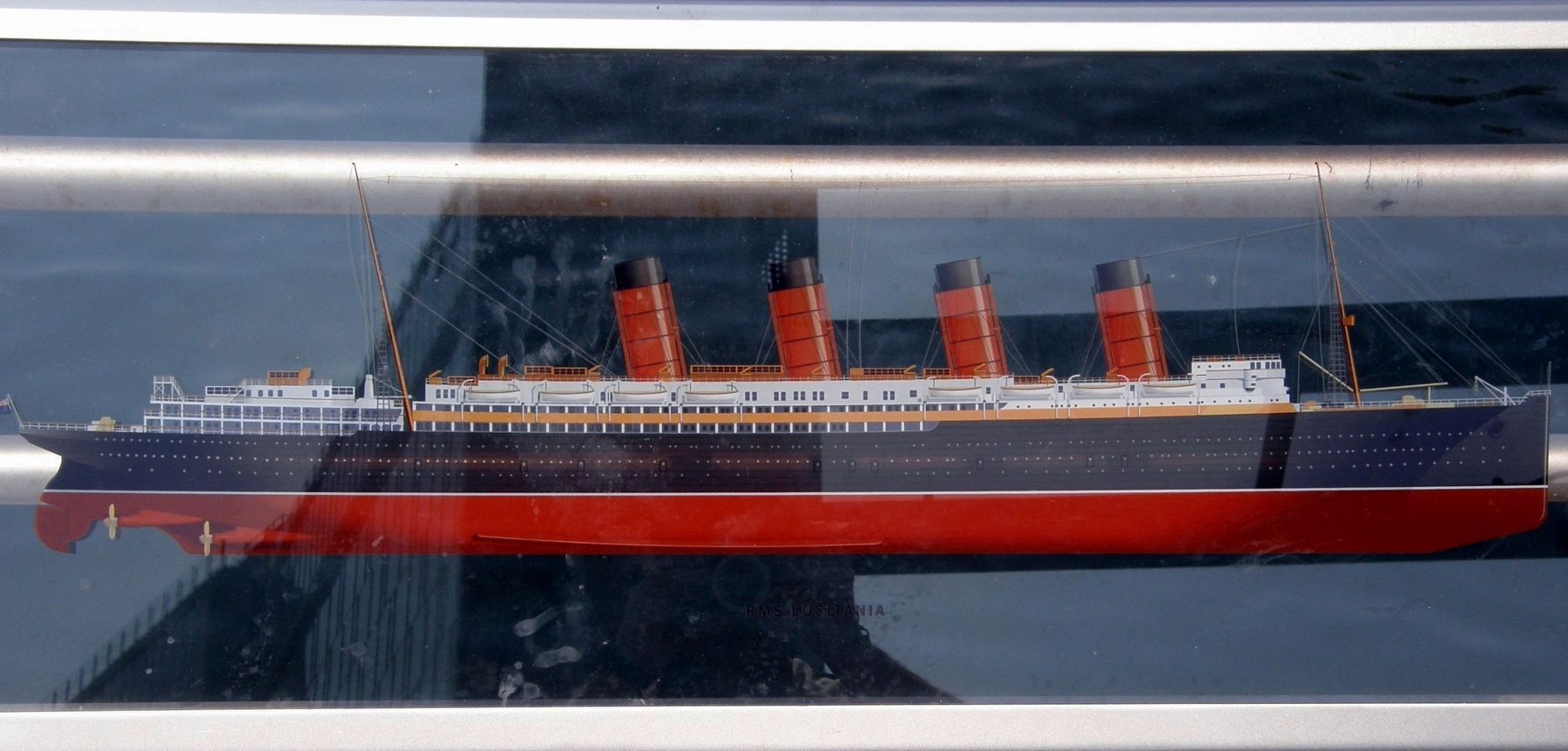
3. RMS Lusitania
Ship profile on the railing above the plaque
courtesy of the Library of Congress, circa 1915
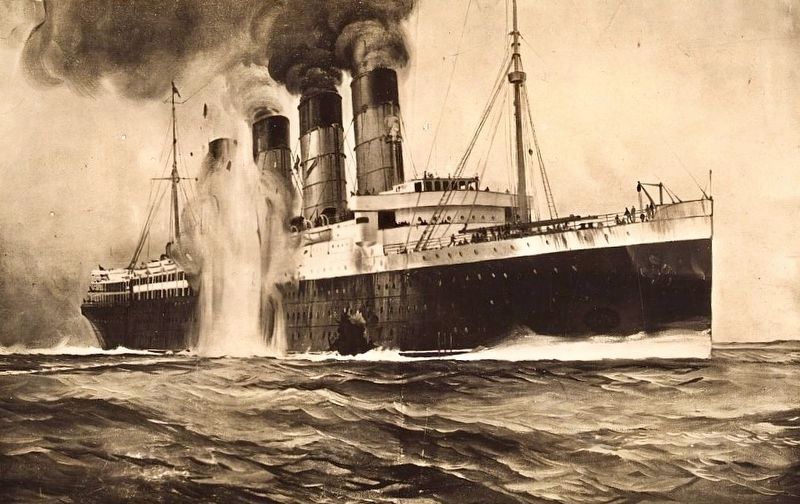
4. R.M.S. Lusitania, hit by torpedos off Kinsale Head, Ireland
"...drawing, made for the New York Herald and the London Sphere, shows the R.M.S. Lusitania as a second torpedo hits behind a gaping hole in the hull."
Credits. This page was last revised on January 31, 2023. It was originally submitted on May 9, 2021, by Andrew Ruppenstein of Lamorinda, California. This page has been viewed 385 times since then and 34 times this year. Last updated on May 10, 2021, by Bradley Owen of Morgantown, West Virginia. Photos: 1, 2. submitted on May 9, 2021, by Andrew Ruppenstein of Lamorinda, California. 3. submitted on January 30, 2022, by Larry Gertner of New York, New York. 4. submitted on May 10, 2021, by Andrew Ruppenstein of Lamorinda, California. • J. Makali Bruton was the editor who published this page.
