
Dover in Stewart County, Tennessee — The American South (East South Central)
Forrest's Attack
Breaking Out of Fort Donelson
| — | Battle of Fort Donelson | — |
Photographed by Don Morfe, July 24, 2013
1. Forrest's Attack Marker
In February 1862, Union Gen. Ulysses S. Grant attacked Forts Henry and Donelson on the Tennessee and Cumberland Rivers to take control of western Tennessee and Kentucky as well as the rivers. Grant captured Fort Henry on February 6, then approached Fort Donelson with his army on February 12. Flag Officer Andrew H. Foote's gunboats shelled in on the 14th. Confederate artillery repulsed the ironclads. Confederate Gen. John B. Floyd ordered a breakout from the fort for the next morning. At first successful, the Confederates retreated, and the Federals counterattacked. On February 16, part of Floyd's command escaped in boats. The remainder yielded to Grant's demand for “unconditional surrender”.
(main text)
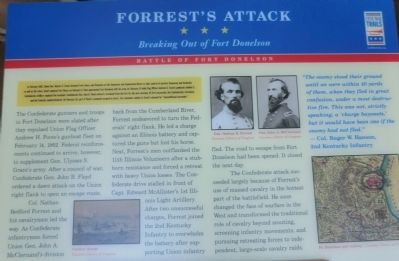
The Confederate gunners and troops in Fort Donelson were elated after they repulsed Union Flag Officer Andrew H. Foote’s gunboat fleet on February 14, 1862. Federal reinforcements continued to arrive, however, to supplement Gen. Ulysses S. Grant’s army. After a council of war, Confederate Gen. John B. Floyd ordered a dawn attack on the Union right flank to open an escape route.
Col. Nathan
this page online
The Confederate attack succeeded largely because of Forrest’s use of massed cavalry in the hottest part of the battlefield. He soon changed the face of warfare in the West and transformed the traditional role of cavalry beyond scouting, screening infantry movements, and pursuing retreating forces to independent, large-scale cavalry raids.
“The enemy stood their ground until we were within 40 yards of them, when they fled in great confusion, under a most destructive fire. This was not, strictly speaking a “charge bayonets,” but it would have been one if the enemy had not fled.”
Photographed by Don Morfe, July 24, 2013
2. Forrest's Attack Marker
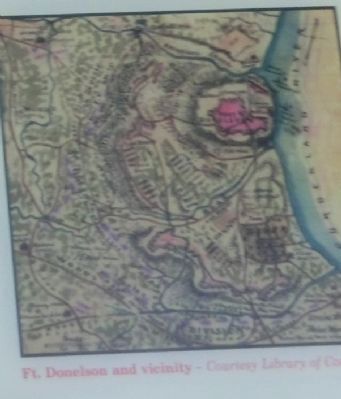
This map is on the lower right side of the marker
(captions)
Cavalry charge Courtesy Library of Congress
Gen. Nathan B. Forrest Courtesy Library of Congress
Gen. John A. McClernand Courtesy Library of Congress
Ft. Donelson and vicinity — Courtesy Library of Congress
Erected by Tennessee Civil War Trails.
Topics and series. This historical marker is listed in this topic list: War, US Civil. In addition, it is included in the Tennessee Civil War Trails series list. A significant historical month for this entry is February 1862.
Location. Marker has been reported permanently removed. It was located near 36° 28.74′ N, 87° 52.023′ W. Marker was in Dover, Tennessee, in Stewart County. It could be reached from the intersection of Donelson Parkway (U.S. 79) and Moores Drive, on the left when traveling west. The marker is on the grounds of the Stewart County Visitor Center. Touch for map. Marker was at or near this postal address: 117 Visitor Center Lane, Dover TN 37058, United States of America.
We have been informed that this marker is no longer there and will not be replaced. This page is an archival view of what was.
Regionally,

Photographed by Don Morfe, July 24, 2013
3. Forrest's Attack Marker

Other nearby markers. At least 8 other markers are within walking distance of this location: The Stewart County Iron Industry (within shouting distance of this marker); 6-pounder Gun (approx. 0.3 miles away); Porter's Battery (approx. 0.3 miles away); Fort Donelson Confederate Monument (approx. half a mile away); Confederate Monument (approx. half a mile away); Union Camp (approx. half a mile away); Lauman's Brigade (approx. half a mile away); Graves' Battery (approx. half a mile away). Touch for a list and map of all markers in Dover.
Other markers no longer nearby. Holding The Line (was here, next to this marker but has been permanently removed); Morrison's Attack (was a few steps from this marker but has been permanently removed); Battle of Dover (was a few steps from this marker but has been permanently removed); Forrest's Escape (was within shouting distance of this marker but has been permanently removed); Federal Troops and Casualties at Fort Donelson (was approx. 0.3 miles away but has been confirmed missing); Confederate Troops and Casualties at Fort Donelson (was approx. 0.3 miles away but has been confirmed missing); Fort Donelson (was approx. 0.3 miles away but has been confirmed missing).
Credits. This page was last revised on May 11, 2021. It was originally submitted on September 14, 2013, by Don Morfe of Baltimore, Maryland. This page has been viewed 988 times since then and 38 times this year. Last updated on May 10, 2021, by Shane Oliver of Richmond, Virginia. Photos: 1, 2, 3. submitted on September 14, 2013, by Don Morfe of Baltimore, Maryland. • Devry Becker Jones was the editor who published this page.
