Central Oklahoma City in Oklahoma County, Oklahoma — The American South (West South Central)
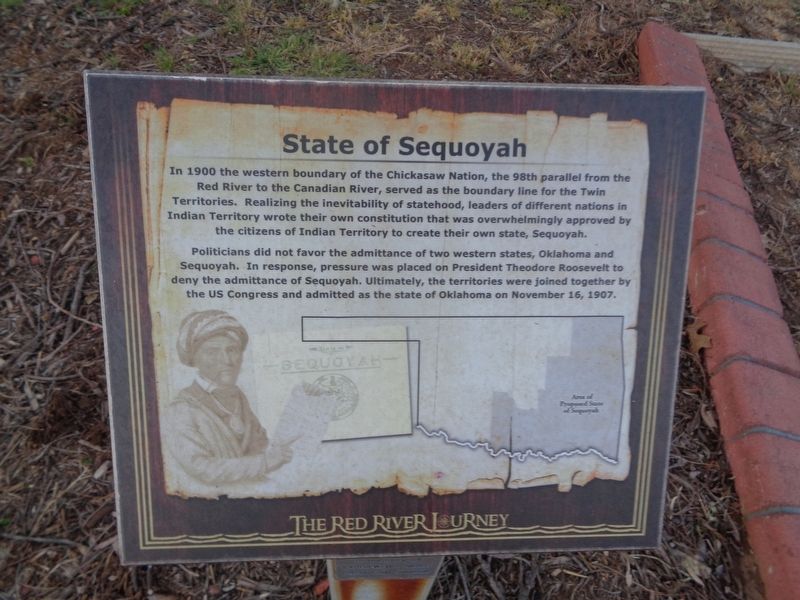
State of Sequoyah
The Red River Journey
Photographed by Jason Voigt, April 9, 2021
1. State of Sequoyah Marker
In 1900 the western boundary of the Chickasaw Nation, the 98th parallel from the Red River to the Canadian River, served as the boundary line for the Twin Territories. Realizing the inevitability of statehood, leaders of different nations in Indian Territory wrote their own constitution that was overwhelmingly approved by the citizens of Indian Territory to create their own state, Sequoyah.
Politicians did not favor the admittance of two western states, Oklahoma and Sequoyah. In response, pressure was placed on President Theodore Roosevelt to deny the admittance of Sequoyah. Ultimately, the territories were joined together by the US Congress and admitted as the state of Oklahoma on November 16, 1907.
Topics. This historical marker is listed in this topic list: Indigenous Peoples and Communities. A significant historical date for this entry is November 16, 1907.
Location. 35° 29.613′ N, 97° 29.899′ W. Marker is in Oklahoma City, Oklahoma, in Oklahoma County. It is in Central Oklahoma City. It can be reached from Nazih Zuhdi Drive west of North Laird Avenue. Marker is part of the Red River Journey pathway, which is on the grounds of
this page online

Regionally, this marker is in Central Oklahoma—Frontier Country. It is also in the American South, specifically on the prairies, and on the Southern Plains. Globally, it is in North America, the Western Hemisphere, the Western World, and the Anglosphere. Historically, it finds itself in what was once the territory of the Mississippian Culture and also the Louisiana Purchase.
Other nearby markers. At least 8 other markers are within walking distance of this marker: The Chisholm Trail (a few steps from this marker); Oil and Gas Industry (a few steps from this marker); Oklahoma's Elusive Southern Border (a few steps from this marker); Initial Point (a few steps from this marker); Corn and Pumpkin (a few steps from this marker); Red River Rivalry (within shouting distance of this marker); San Bernardo (within shouting distance of this marker); Chickasaw Nation (within shouting distance of this marker). Touch for a list and map of all markers in
Photographed by Jason Voigt, April 9, 2021
2. State of Sequoyah Marker
Also see . . . Sequoyah on Wikipedia. This is about the polymath of the Cherokee Nation, that wrote a language for the Cherokee Nation that is still in use today by tribes. He was born (believed to be around 1770) in present-day Knoxville, Tennessee) and lived in many places but made his mark in the Indian Territory. (Submitted on May 12, 2021, by Jason Voigt of Glen Carbon, Illinois.)
Credits. This page was last revised on June 4, 2024. It was originally submitted on May 12, 2021, by Jason Voigt of Glen Carbon, Illinois. This page has been viewed 315 times since then and 26 times this year. Photos: 1, 2. submitted on May 12, 2021, by Jason Voigt of Glen Carbon, Illinois.
