Gering in Scotts Bluff County, Nebraska — The American Midwest (Upper Plains)
Traces of the Trail
The Oregon Trail passed here in the 1850’s
Photographed by Bill Coughlin, August 3, 2015
1. Traces of the Trail Marker
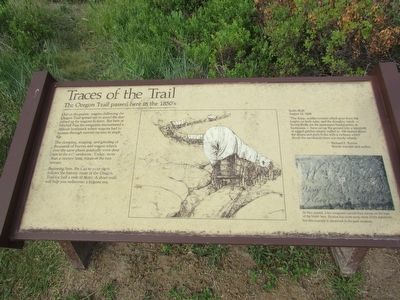
Out on the prairie, wagons following the Oregon Trail spread out to avoid the dust stirred up by wagons in front. But here at Mitchell Pass the emigrants encountered a difficult bottleneck where wagons had to squeeze through narrow ravines in single file.
The clomping, scraping, and grinding of thousands of hooves and wagon wheels over the same places gradually wore deep ruts in the soft sandstone. Today, more than a century later, traces of the ruts remain.
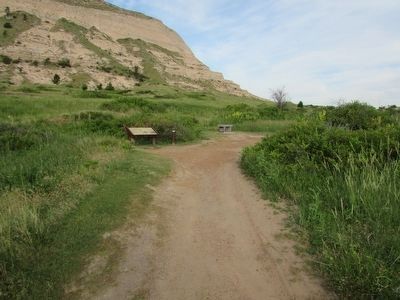
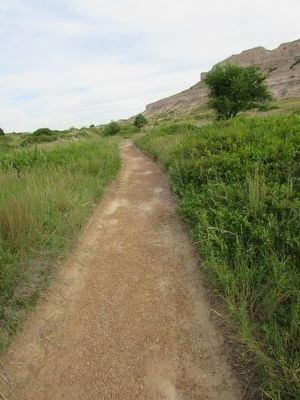
Beginning here, the trail to your right follows the historic route of the Oregon Trail for half a mile (0.8km). A short walk will help you rediscover a bygone era.
Scotts Bluff
August 13, 1860
“The sharp, sudden torrents which pour from the heights on both sides, and the draughty winds – Scott’s Bluffs are the permanent headquarters of hurricanes – have cut up the ground into a labyrinth of jagged gulches steeply walled in. We dashed down the drains and pitch-holes with a violence which shook the navebands from our sturdy wheels.”- Richard F. Burton
British traveler and author
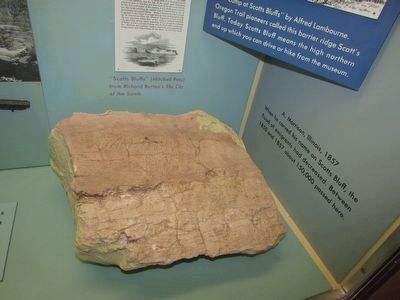
As they passed, a few emigrants carved their names on the base of the bluffs here. Erosion
this page online
Erected by National Park Service, U.S. Department of the Interior.
Topics. This historical marker is listed in these topic lists: Roads & Vehicles • Settlements & Settlers. A significant historical year for this entry is 1860.
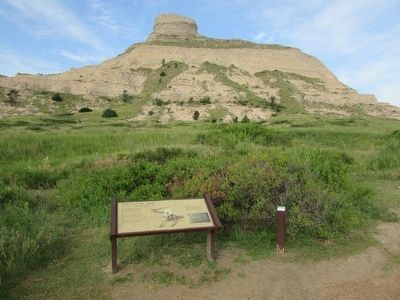
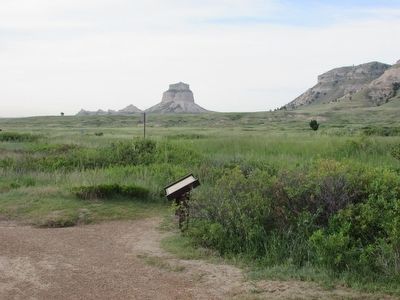
Location. This marker has been replaced by another marker nearby. It was located near 41° 49.769′ N, 103° 42.651′ W. Marker was in Gering, Nebraska, in Scotts Bluff County. It could be reached from Old Oregon Trail, on the right when traveling west. Marker is located in Scotts Bluff National Monument, along the Mitchell Pass Trail. Touch for map. Marker was in this post office area: Gering NE 69341, United States of America. Touch for directions.

Regionally, this marker was in the Nebraska Panhandle. It was also in the American Midwest, in the Corn Belt, and on the prairies. Globally, it was in North America, the Western Hemisphere, the Western World, and the Anglosphere. Historically, it found itself in what was once the Louisiana Purchase.
Other nearby markers. At least
Photographed by Bill Coughlin, August 3, 2015
2. Traces of the Trail Marker
Other markers no longer nearby. Oregon Trail (was about 800 feet away but has been permanently removed); The Bullwhackers (was approx. 0.2 miles away but has been permanently removed); Scotts Bluff (was approx. 0.7 miles away but has been permanently removed); Pony Express (was approx. 0.7 miles away but has been permanently removed); The Overland Experience (was approx. 0.7 miles away but has been permanently removed).
More about this marker. In addition to the photo of emigrant’s signatures carved in the bluff, a picture of covered wagons passing through Mitchell Pass appears
Photographed by Bill Coughlin, August 3, 2015
3. Marker on the Oregon Trail
Related marker. Click here for another marker that is related to this marker. The marker has been removed and replaced with the linked marker.
Photographed by Bill Coughlin, August 3, 2015
4. Traces of the Trail Marker
Photographed by Bill Coughlin, August 3, 2015
5. Along the Oregon Trail
Photographed by Bill Coughlin, August 3, 2015
6. William Webber, May 23, 1852 - Michigan
Although many travelers on the Oregon Trail carved their names in the bluff, most have been lost over time to erosion. This example has survived and can be viewed in the Visitor Center.
Credits. This page was last revised on June 1, 2021. It was originally submitted on August 16, 2015, by Bill Coughlin of Woodland Park, New Jersey. This page has been viewed 641 times since then and 28 times this year. Last updated on May 31, 2021, by Connor Olson of Menomonee Falls, Wisconsin. Photos: 1, 2, 3, 4, 5, 6. submitted on August 16, 2015, by Bill Coughlin of Woodland Park, New Jersey. • Devry Becker Jones was the editor who published this page.
