Uptown in Pittsburgh in Allegheny County, Pennsylvania — The American Northeast (Mid-Atlantic)
Coal Transportation
Three Rivers Heritage Trail
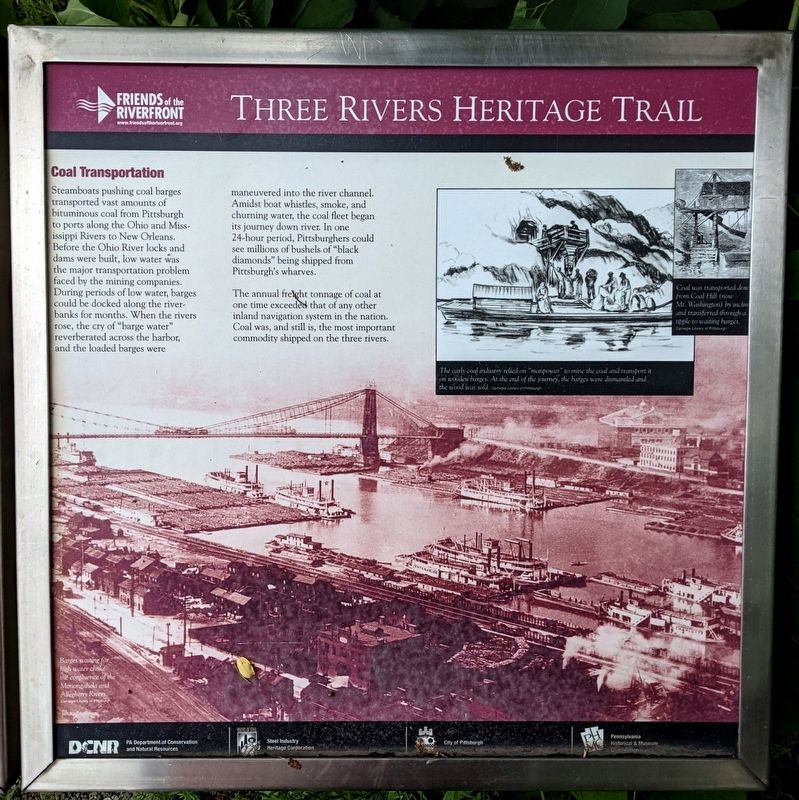
Photographed by Bernard Fisher, May 30, 2021
1. Coal Transportation Marker
 Steamboats pushing coal barges transported vast amounts of bituminous coal from Pittsburgh to ports along the Ohio and Mississippi Rivers to New Orleans. Before the Ohio River locks and dams were built, low water was the major transportation problem faced by the mining companies. During periods of low water, barges could be docked along the riverbanks for months. When the rivers rose, the cry of "barge water" reverberated across the harbor, and the loaded barges were maneuvered into the river channel. Amidst boat whistles, smoke, and churning water, the coal fleet began its journey down river. In one 24-hour period, Pittsburghers could see millions of bushels of "black diamonds" being shipped from Pittsburgh's wharves.
The annual freight tonnage of coal at one time exceeded that of any other inland navigation system in the nation. Coal was, and still is, the most important commodity shipped on the three rivers.
(captions)
The early coal industry relied on "manpower" to mine the coal and transport it on wooden barges. At the end of the journey, the barges were dismantled and the wood was sold. Carnegie Library of Pittsburgh
Coal was transported down from Coal Hill (now Mt. Washington) by inclines and transferred through a tipple to waiting barges. Carnegie Library of Pittsburgh
Barges waiting for high water choke the confluence of the Monongahela and Allegheny Rivers. Carnegie Library of Pittsburgh
Erected by Friends
this page online
Topics. This historical marker is listed in these topic lists: Industry & Commerce • Waterways & Vessels.
Location. 40° 26.078′ N, 79° 59.084′ W. Marker is in Pittsburgh, Pennsylvania, in Allegheny County. It is in Uptown. It is on Three Rivers Heritage Trail 0.8 miles east of Grant Street, on the left when traveling east. Not accessible by motorized vehicle. Touch for map. Marker is in this post office area: Pittsburgh PA 15219, United States of America. Touch for directions.

Regionally, this marker is in the American Northeast, in the Mid-Atlantic, in the Ohio River Valley, in Appalachia, and specifically in Northern Appalachia. Globally, it is in North America, the Western Hemisphere, the Western World, and the Anglosphere. Historically, it finds itself in what was once the Viceroyalty of New France, the Haudenosaunee (Iroquois) Confederacy, and one of the original Thirteen Colonies.
Other nearby markers. At least 8 other markers are within walking distance of this marker: Black Diamonds
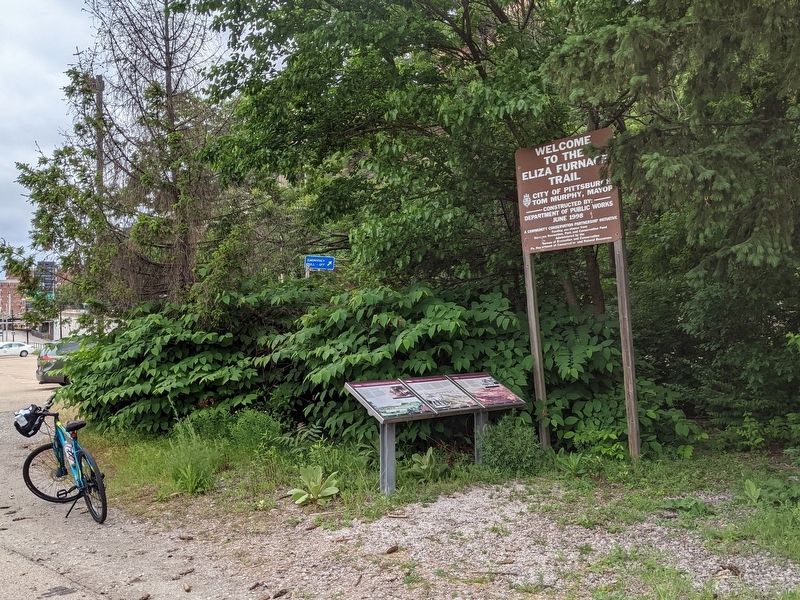
Photographed by Bernard Fisher, May 30, 2021
2. Three Rivers Heritage Trail/Great Allegheny Passage
Also see . . . Friends of the Riverfront. (Submitted on June 1, 2021.)
Credits. This page was last revised on February 2, 2023. It was originally submitted on June 1, 2021, by Bernard Fisher of Richmond, Virginia. This page has been viewed 510 times since then and 41 times this year. Photos: 1, 2. submitted on June 1, 2021, by Bernard Fisher of Richmond, Virginia.