Gering in Scotts Bluff County, Nebraska — The American Midwest (Upper Plains)
The Bullwhackers
Ox-drawn wagons carried freight here in the 1860’a and 70’s
Photographed by Bill Coughlin, August 3, 2015
1. The Bullwhackers Marker
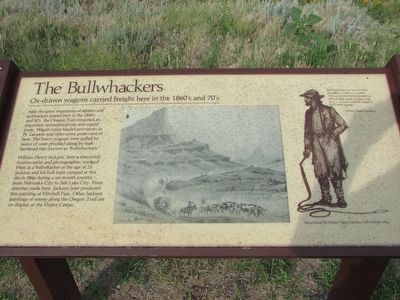
After the great migrations of settlers and goldseekers passed here in the 1840’s and 50’s, the Oregon Trail remained an important communications and supply route. Wagon trains hauled provisions to Ft. Laramie and other army posts west of here. The heavy wagons were pulled by teams of oxen prodded along by trail-hardened men known as “bullwhackers.”
William Henry Jackson, later a renowned frontier artist and photographer, trudged West as a bullwhacker at the age of 23. Jackson and his bull train camped at this site in 1866 during a six-month journey from Nebraska City to Salt Lake City. From sketches made here, Jackson later produced this painting of Mitchell Pass. Other Jackson paintings of scenes along the Oregon Trail are on display at the Visitor Center.
“Bullwhacking is an art not to be learned in a week or a month . . . Only a cunning hand can make an 18-foot whip crack out like a rifle shot – or cut a notch in a lagging bull’s hind quarter.”
Erected by National Park Service.
Topics. This historical marker is listed in this topic list: Roads & Vehicles. A significant historical year for this entry is 1866.
Location. Marker has been
this page online
We have been informed that this marker is no longer there and will not be replaced. This page is an archival view of what was.
Regionally, this marker was in the Nebraska Panhandle. It was also in the American Midwest, in the Corn Belt, and on the prairies. Globally, it was in North America, the Western Hemisphere, the Western World, and the Anglosphere. Historically, it found itself in what was once the Louisiana Purchase.

Other nearby markers. At least 8 other markers are within walking distance of this location: Assistance on the Trail (here, next to this marker); History Lives on in Art (here, next to this marker); Oregon Trail (about 400 feet away, measured in a direct line); A Transportation Corridor
Photographed by Bill Coughlin, August 3, 2015
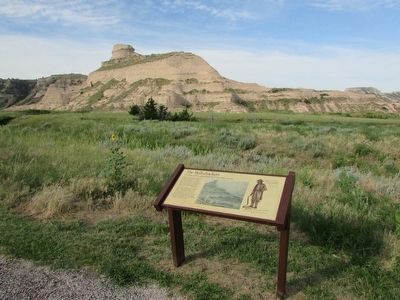
2. The Bullwhackers Marker
Other markers no longer nearby. Traces of the Trail (was approx. 0.2 miles away but has been replaced with another marker now near it); a different marker also named Oregon Trail (was approx. 0.3 miles away but has been permanently removed); Scotts Bluff (was approx. 0.7 miles away but has been permanently removed); Pony Express (was approx. 0.7 miles away but has been permanently removed); The Overland Experience (was approx. 0.7 miles away but has been permanently removed).
More about this marker. A William Henry Jackson painting of Bullwhackers guiding oxen-drawn wagons through Mitchell Pass appears at the center of the marker. The right of the marker contains a Self-portrait of William Henry Jackson with his bull whip.
Photographed by Bill Coughlin, August 3, 2015
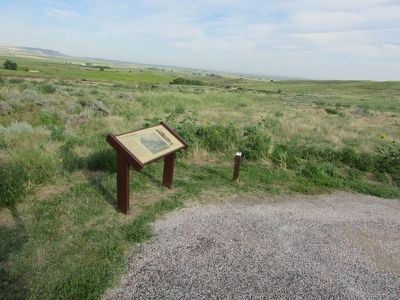
3. The Bullwhackers Marker
Photographed by Bill Coughlin, August 3, 2015
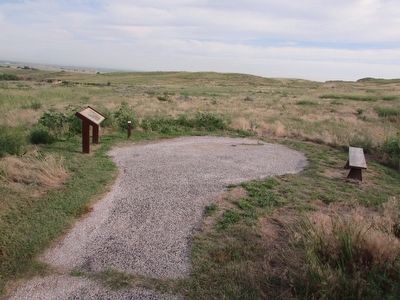
4. The Bullwhackers Marker
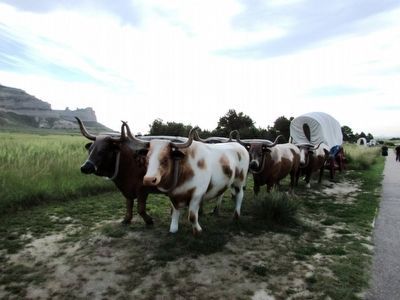
Photographed by Bill Coughlin, August 3, 2015
5. Wagons on the Oregon Trail
Wagons like this were guided along the Oregon Trails by the Bullwhackers.
Credits. This page was last revised on December 22, 2024. It was originally submitted on August 16, 2015, by Bill Coughlin of Woodland Park, New Jersey. This page has been viewed 952 times since then and 48 times this year. Last updated on June 2, 2021, by Connor Olson of Menomonee Falls, Wisconsin. Photos: 1, 2, 3, 4, 5. submitted on August 16, 2015, by Bill Coughlin of Woodland Park, New Jersey. • Devry Becker Jones was the editor who published this page.
